EasyManua.ls Logo

BRUEL & KJAER 2305 - Page 58

BRUEL & KJAER 2305
130 pages
Print Icon
To Next Page IconTo Next Page
To Previous Page IconTo Previous Page
Loading...
The
DC voltage
output
can
be
fed
into
a
digital
voltmeter
or
other
type
of
analog-to
-
digital
converter
and
the
digital
output
so
obtained
may
be
stored
on
magnetic
tape,
punched
paper
tape
or
IBM
punched
cards
in
a
standard
digital
code,
for
use
in
computer
programs.
This
system,
using
the
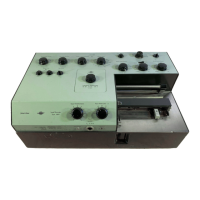
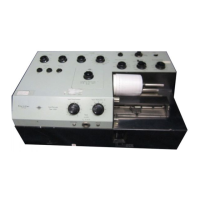
B & K Level
Recorder
and
Analog Voltage Read-Out
unit,
provides
an
output
which
is
proportional
to
the
log
of
the
true
RMS,
peak,
or
absolute
average
value
of
the
signal.
Operating
thus,
as a log
converter,
it
is
capable
of
slewing
rates
in
excess
of
200 dB/sec. Also its
dynamic
range
can
be
as
great
as
75
dB.
It
is
also
possible
to
obtain
an
analog
voltage
output
and
use
the Level
Recorder
for
writing
curves
at
the
same
time.
Description.
The
Analog Voltage
Read-Out
consists
of
thr
ee
parts
:-
1. A
linear
potentiometer
fixed
to
the
shield
which
fits
over
the
writing
arm
of
the
Lev
el
Recorder,
2.
A
contact
arrangement
for
the
Rec
order's
writing
system,
and
3. A
balancing
unit
with
a
stabilizer
for
the
voltage
supply
from
the
Level
Recorder
.
The
linear
potentiometer
has
600
windings
over
its
50
mm
working
length
(Level Rec
order
adjusted
to
50
mm
writing
width)
which
gives a
resolution
of
about
2.8
times
that
of
the
silver
lamellae
of
the
recorder
range
potentio-
meter.
In
order
to
obtain
zero
output
voltag
e
with
the
Level
Recorder
writing
stylus
in
its
zero
position
(even
though
the
contact
point
in
the
potentiometer
is
not
in
its
extreme
end
position),
and
correct
full
scale
output
voltage
with
the
Level
Recorders
writing
stylus
in
its
full
scale
position,
a
bridge
circuit
is
employed.
This
adjustment
of
the
voltage
at
zero
and
full
scale
(any
voltage
between
1
and
10 volts) is
easily
and
conveniently
carried
out
by
the
use
of
two
high
resolution
,
10
turn,
wire-wound
potentiometers.
The
power
supply
is
obtained
by
smoothing
and
stabilizing
the
24
V
DC
from
the
7-
pin
socket
of
the
Level
Recorder
. A
socket
is
provided
in
the
balancing
unit
so
that
the
remote
control
facilities
from
the Level
Recorder
are
still
avail
able. A low
pass
filter,
cut-off
frequency
100 Hz (c/s) ,
is
provided
in
the
output
leads
which
eliminates
the
contact
noise
which
may
be deve
loped
at
high
writing
speeds
.
Operation.
A.
Supply
Voltage:
Plug
the
balancing
unit
into
the
7-pin
socket
on
the
Level Recorder.
B.
Mounting
of
Contact
and
Potentiometer:
I.
With
the
recorder's
POTENTIOMETE
'R RANGE
dB
on
"Stand-by",
remove
the
cover
from
the
writing
arm
unit
on
the Level
Recorder
Type
2305.
67

Related product manuals