3.
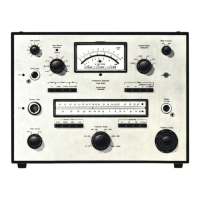
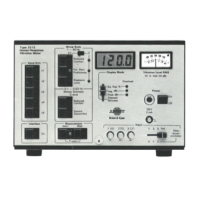
Select the required measurement mode by pressing one of the HAND-ARM
or
WHOLE
BODY pushkeys. If a WHOLE BODY mode is required, then it will first be necessary to put
the AXIS SELECTOR switch in the required position, i.e.
"XY"
or
"Z".
4.
Press
ST
ART to begin the measurement. The LED
in
the STOP pushkey will now go out
but that in the
ST
ART pushkey will remain on, indicating that the measurement is
in
progress. If WHOLE BODY "Reduced
Comfort"
is selected, the "Eq. Exp.
%"
overload
LED will also come on because the reference level is greater than would cause a
maximum permissible dose in less than one minute.
In
other measurement modes this
LED
will remain off.
5.
The DISPLAY MODE switch can now be set to "Leq
dB"
to display the
Leq
value of the ref-
erence signal, which will appear after a delay
of
16
s.
This value is
120
dB for the Whole
Body mode and
140
dB for the Hand-Arm mode. The corresponding values in the "Peak
dB"
position are
123
and
143
dB, as the reference signal is a sine wave. If the displayed
values vary from these by more than
1,0
dB the instrument should be serviced.
In
the "Eq. Exp.
%"
position, the display will show the accumulated exposure in %
of
the
allowed dose. Because this dose is different for all the different exposure criteria, i.e. Whole
Body Reduced Comfort, Fatigue Decreased Proficiency and Exposure Limit, and Hand-Arm, it
accumulates at a different rate for the constant input level
of
the reference signal. The rates of
accumulation of exposure dose produced by the internal reference signal are given in Table 1
for each
of
the measurement modes which can be checked in this way. It can be seen that only
the Whole Body Reduced Comfort and Fatigue Decreased Proficiency Limits can be checked
in a practical length
of
time in this way.
Measurement Mode
Accumulation
Rate
s / %
WB
Reduced
Comfort
XY
72
± 10,8
WB
Reduced
Comfort
Z
10
±
2,4
WB
Fat.
Deer.
Prof.
XY
400
±60
WB
Fat. Deer. Prof. Z
100
±15
WB
Exposure
Limit
XY
>15mins
-
WB
Exposure
Limit
Z
250
± 37,5
Hand-Arm
x1
144
±
7,2
Hand-Arm
x2
288
± 14,4
Hand-Arm
x3
288
± 14,4
Hand-Arm
x4
288
± 14,4
Hand-Arm
x5
288
± 14,4
810018
Table
1.
Equivalent Exposure Accumulation rates
for
the internal refer-
ence signal
for
the various measurement modes available on the
2512
3.3.2. Calibration using the Accelerometer Calibrator Type
4291
24
The use of
an
external calibration source allows the transducer and the cable connections to
be brought into the calibration procedure, and thus checks these points as well. However,
since the Type
2512
is designed and calibrated at the factory to be used with the B & K range
of Uni-Gain Accelerometers with unified sensitivities, there is no sensitivity adjustment on the
instrument, nor should one be required during normal use. If calibration checks using both the
Type
4291
and the internal reference signal show the instrument to be operating incorrectly,
then it should be serviced. If only the Type
4291
shows a fault, then the problem lies with the
accelerometer or its cable connections.


 To Next Page
 Loading...