7.
Select the required measurement mode by pressing one of the HAND- ARM or WHOLE
BODY pushkeys. If a WHOLE BODY mode is selected, then it will first be necessary to put
the AXIS SELECTOR switch in the required position, i.e.
"XY"
or
"Z".
8.
Press
ST
ART to begin the measurement. The LED
in
the STOP pushkey will now extin-
guish and that
in
the
ST
ART pushkey will remain on, indicating that the measurement is in
progress.
Measurement Mode
Accumulation Rate
s
I%
WB
Reduced
Comfort
0,6
-
WB
Fat.
Deer.
Prof.
50,0
±
7,5
WB
Exposure
Limit
160,0 ± 24
Hand-Arm
x1
144,0
±
7,2
Hand-
Arm
x2
288,0
± 14,4
Hand-Arm
x3
288,0
± 14,4
Hand-Arm
x4
288,0
± 14,4
Hand-Arm
x5
288,0 ± 14,4
81
00
17
Table
2.
Equivalent Exposure accumulation rates
for
an input vibration
level
of
10
m~2
as provided
by
the Accelerometer Calibrator
Type
4291
for
the various measurement modes available on the
2512
9.
The DISPLAY MODE switch can now be set to "Leq
dB"
to display the
Leq
value
of
the cali-
bration signal, which will appear after a delay
of
16
s.
These values are
108
dB
for
the
Whole
Body"
XY" mode,
117
dB for the Whole
Body"
Z"
mode, and
143
dB for the Hand-
Arm mode. If the displayed values vary from these by more than
1,0
dB the instrument
should be serviced.
In
the "Eq. Exp.
%"
position, the display will show the accumulated
exposure in
%
of
the allow~d dose. Because this dose is different
for
all the different
exposure criteria, i.e. Whole body Reduced Comfort, Fatigue Decreased Proficiency and
Exposure Limit, and Hand-Arm, it accumulates at a different rate for the constant input
level
of
the
calibration
signal.
The
rates
of
accumulation
of
exposure
dose
produced
by
the calibration signal of
10
ms-
2
peak produced by the Calibrator are given in Table 2
for
each of the measurement modes which can be checked in this way. It can be seen that,
from the point
of
view
of
the time taken, it is only practical to check the Whole Body
Reduced Comfort mode in this way.
3.4.
ST
AND ALONE OPERATION
OF
THE INSTRUMENT
26
The preliminary instructions concerning powering the instrument and calibration check
in
sections
3.1.
to
3.3.
should be carried out first and the accelerometer (or accelerometers )
connected to the instrument either via the microsockets on the front panel or, if the Seat-
Transducer Type
4322
is to be used, via the 6-pin
DIN
socket on the rear panel. Whichever
input is used, the other inputs should be covered with their respective caps to minimise the
pick-up of noise which may interfere with measurements. The cap for the
DIN
socket on the
rear panel of the instrument is permanently attatched to the rear panel via a plastic wire to re-
tain it when unscrewed. The three caps for the microsockets, however, are loose and should
be kept carefully when these outputs are in use. When the sockets are not in use, the caps
should always be
in
place on them.
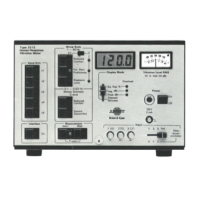
The procedure for using the Type 2512 in the stand alone mode is as follows:


 To Next Page
 Loading...