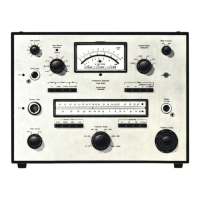
The measurement arrangement is now ready to record vibration signals.
Example
of
attenuation determination
Using the Triaxial Accelerometer Type
4321
to record a vibration with a maximum level of
approximately
10
ms-
2
,
a setting on the 2635 of 1 mV /Unit Out (i.e. 1 mV
/ms-
2
,
which would
normally be expected by the 2512 if the measurement was being made direct) gives
an
output
to the tape recorder
of
10
mV, which is a factor of
100
(40
dB) below the level for full scale in
the tape (i.e. 1
V).
The full scale level can be achieved by increasing the output from the 2635
and/or
reducing the input attenuation on the tape recorder INPUT ATTENUATOR.
In
this case,
setting
10
mV/Unit Out on the 2635 and using the "10
dB"
position on the tape recorder INPUT
ATTENUATOR increases the signal by the required
40
dB so that the 1 O
ms-
2
signal corre-
sponds to nominal recording level of 1
Von
the tape. Full scale deflection then corresponds to
10
ms-
2
.
This
40
dB must be reintroduced as an attenuation before the signal is played back
through the
2512
during the subsequent analysis.
This technique may also be used with accelerometers having other sensitivities than unity,
because the output
of
the 2635 is effectively converted to a "Unigain" sensitivity i.e.
0,
1,
1,
10,
100,
or
1000
mV / Unit Out, by dialling in the sensitivity of the transducer being used on the
TRANSDUCER SENSITIVITY conditioning controls on the 2635.
4.4.2. Analyzing Recorded Data with the 2512
The input
of
the
2512
is a charge input designed to accept
an
accelerometer with a sensitivity
of
1
pC/ms-
2
.
Only with
an
input signal
of
this sensitivity will the 2512 give the correct results.
The level of the signal from the tape recorder must therefore be adjusted by the appropriate
ammount to correspond to this sensitivity, and matched to the charge input of the 2512, as
discussed in the example of the previous section. This may be done by means of the adaptors,
attenuator set or a measuring amplifier as mentioned earlier. The general analysis arrange-
ment is as shown in Fig.4.10, and a photograph
of
the O dB adaptor
WB
0251
is reproduced in
Fig.4.11.
Fig.
4.
11.
Photograph
of
the O dB
Adaptor
WB
0251
The general procedure is as follows:
1.
Connect the instruments as in Fig.4.10. If the required attenuation of the tape recorded
signal is
O or
20
dB, one of the adaptors alone can provide the necessary attenuation, and
this should
be
fitted. If the required attenuation lies between
40
dB and -10 dB
(10
dB
amplification)-then Attenuator Set
WB
0473 can be used.
In
other cases, a combination of
one
of
these and a measuring amplifier will be necessary.
2.
If the Measuring Amplifier Type 2610 is included in the analysis set-up, its controls should
be preset
as
follows:
39


 To Next Page
 Loading...