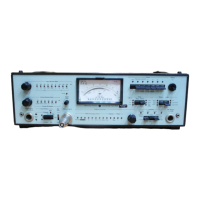
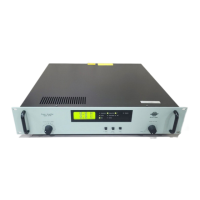
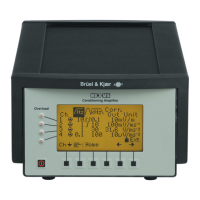
Measuring Ampifier Type 2525
User Manual Vol.2
6–17
BE1394– 11
Chapter 6 – Set-up and Display (Results) Messages
Measurement Set-up Commands
6.3.12 Alarm Detector
The syntax for the command is shown in Fig.6.28.
How you set Alarm_Detector depends on how the channel-dependent parameters
Measurement_Mode and Transducer_Sensitivity are set, as well as the setting for
channel-independent parameter Si_Imperial_Units. The level is calculated using a
formula in which the current settings of these parameters are used:
Alarm level = K × GAIN × CORR/Transducer_Sensitivity
where:
K = 1000 (for Input_Type = Acceleration or Force)
= 10 (for Input_Type = Velocity)
= 1 (for Input_Type = Displacement)
GAIN = alog10(GDB/20)
where:
GDB = Input_Gain + Fine_Gain + Output_Gain(dB)
CORR = 1 (Si_Imperial_Units =Si)
= 9.81 (Input_Type = Acceleration and Si_Imperial_U = Imperial)
= 39.37 (Input_Type = V
elocity and Si_Imperial_U = Imperial)
= 39.37 (Input_Type =Displacement and Si_Imperial_U = Imperial)
=0.225 (Input_Type = Force and Si_Imperial_U = Imperial)
The resolution of the level is determined by the resolution of the elements of the
formula. That is the resolution of 1 dB (1.12 abs) of GDB. For example a sequence
of 100, 112, 126, 141, 158, and so on.
The default level (at factory set-up) is:
Fig.6.28 The syntax for the command Alarm_Detector
941114e
Te
CHANNEL_1
RMS
POSITIVE_PEAK
NEGATIVE_PEAK
PEAK_PEAK
To 2525
: ,SP
—
ALARM_DETECTOR
:
Level
NR


 To Next Page
 Loading...