CHAPTER 1
Operation
9
WARNING: Never apply mains voltage to the mouth simulator terminals.
A drive signal is applied to the mouth simulator via the two cables that run down through the
torso from the head and are led out through the base of the torso. These cables are terminated
with banana sockets which accept standard 4 mm banana plugs. The red socket is the positive
connection, where positive means that a positive voltage on this terminal causes outward
movement of the loudspeaker cone. Any type of drive signal can be used, ranging from a pure
sine wave to an artificial voice (e.g., ITU-T Rec.P.50).
1.4 Calibration of the Mouth Simulator
The method of calibrating the mouth simulator depends on the application for which it is to be
used. For example, the standards IEEE 269 and 661, and ITU-T Rec. P.51 for measurements on
telephone equipment demand that measurements are referred to the Mouth Reference Point
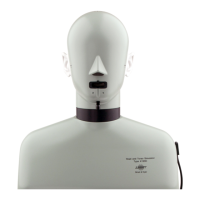
(MRP) 25mm in front of the equivalent lip-plane. Therefore, the output sound pressure level
should be measured at this position during calibration procedures. For this purpose, Type
4128-C has a microphone holder which positions a l/4 microphone with preamplifier (e.g.,
Brüel& Kjær Type 4939 or previously Type 4135 with Preamplifier Type 2670) at the MRP
(see Fig.1.3). The diaphragm of the microphone should be positioned at the level of the centre
of the mouth. This holder can also be used to hold a 1/4 microphone at the opening of the
mouth simulator orifice in order to monitor the sound pressure at this location.
Fig.1.3
1/4 microphone with
preamplifier in the holder
that positions them at the
MRP, 25 mm from the
equivalent lip-plane
Before calibrating the drive system and mouth simulator, the microphone and measuring
instrument to be used should be calibrated using either Pistonphone Type 4228 or Sound
Calibrator Type 4231, along with calibration adaptor UA-1546 supplied with Type 4128-C.
Mouth simulator calibration is then simply a matter of noting the sound pressure levels which
result from particular drive levels.


 To Next Page
 Loading...