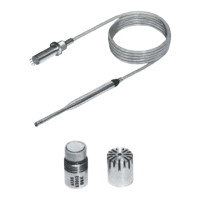
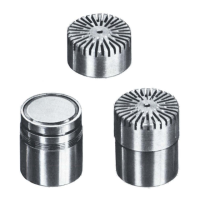
Chapter 3 — Prepolarized Free-field
1
/
2
" Microphone Type 4189
Equivalent Volume and Calibrator Load Volume
Falcon™ Range of Microphone Products
Microphone Handbook
Brüel & Kjær
3
−
18
produced by a nominal Prepolarized Free-field
1
/
2
" Microphone Type 4189 at a Peak
level of 154 dB (re 20µPa).
The microphone’s distortion increases smoothly as a function of sound pressure
level until the diaphragm’s displacement becomes so large that it hits the back
plate. When this occurs (at a Peak level of 158dB), the output voltage is clipped.
We recommend not to expose Prepolarized Free-field
1
/
2
" Microphone Type 4189 to
levels higher than 158dB (Peak).
3.6 Equivalent Volume and Calibrator Load Volume
Equivalent Volume
For some applications it is practical to express the acoustic impedance of the micro-
phone diaphragm in terms of a complex equivalent volume. This makes it easier to
evaluate the effect of microphone loading on closed cavities or acoustic calibration
couplers.
The real and imaginary parts of the equivalent volume shown in Fig.3.18 are in
parallel. They are calculated from a simple R–L–C series model of the microphone
which gives the best overall approximation of the microphone’s diaphragm imped-
ance.
The Models
The following equivalent models are valid at 101.325kPa, 23°C and 50%RH:
Lower Limit Upper Limit
1 Hz bandwidth
at 1 kHz (dB)
1
/
3
-octave at
1kHz (dB)
A-weighted (dB) Linear 20Hz to
20 kHz (dB)
< 3% distortion
(dB)
Max. SPL (Peak)
(dB)
–24.3 –0.7 14.6 15.3 146 158
Table 3.3 Dynamic range of the microphone
Lower Limit Upper Limit
1 Hz bandwidth
at 1 kHz (dB)
1
/
3
-octave at
1kHz (dB)
A-weighted (dB) Linear 20Hz to
20 kHz (dB)
< 3% distortion
(dB)
Max. SPL (Peak)
(dB)
–23.2 0.4 15.2 17.4 146 158
Table 3.4 Dynamic range of the microphone with
1
/
2
" Microphone Preamplifier Type 2669


 To Next Page
 Loading...