Multifunction Acoustic Calibrator Type 4226 – User Manual
14
3.3 Preparing for Acoustic Calibrations
3.3.1 Corrections
Generally, calibrations are qualified by a statement on the ambient conditions prevailing during
the calibration, for example, temperature and pressure. Since the specified tolerances in
Appendix A are ensured at 20 °C (68 °F) and 1013 hPa, no corrections are normally needed if
calibrations are done under these conditions.
The stability of Type 4226, however, is so high that any corrections applied will be very small, if
not negligible. The corrections to apply to a 1000 Hz reference level of 94 dB generated in
Type 4226’s coupler for temperatures and pressures that depart from 20 °C and 1013 hPa are
given respectively by the following coefficients (see also Specifications):
• +0.002 dB/°C from –10 to +50 °C
• +0.00055 dB/hPa from 650 hPa to 1080 hPa
These coefficients are so small that they can, in many cases, be justifiably ignored for calibrating
class 1 instruments under normal indoor conditions, even for frequencies up to 4 kHz.
3.3.2 Stabilization
Allow the calibration setup time to stabilize under the prevailing ambient temperature.
3.3.3 Connection to the Coupler and Adapter
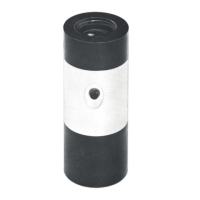
Ensure that the microphone to be calibrated is properly inserted into the coupler. This is
particularly important at high frequencies, that is, 12.5kHz and 16kHz, to ensure greater
homogeneity of the sound field in the coupler and thereby repeatability of calibration results.
Furthermore, at these frequencies minor changes in sound level (0.1 to 0.2 dB) may be detected
for a change in the axial rotation of the inserted microphone. This will be due to any asymmetry
in the coupler’s sound source, but is still within the specified tolerances of Type 4226.
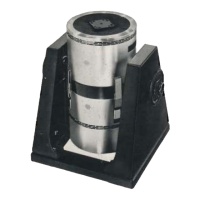
The adapters are constructed to hold and lock the microphone securely inside Coupler UA-0915.
This gives a more stable calibration.
To connect properly, fit the correct adapter to the coupler (for ½″ microphones, use UA-1231; for
¼″ microphones, use DP-0781), then place the microphone in the coupler. See example below:


 To Next Page
 Loading...