SAFETY GUIDELINES
8
DP12VL
WARNING
!
Before using an extension cord, inspect it for loose or exposed wires and cut or
worn insulation.
Keep the extension cord clear of the working area. Position the cord so that it will
not get caught on lumber, tools or other obstructions while you are working with a
power tool. Failure to do so can result in serious personal injury.
Check extension cords before each use. If damaged replace immediately. Never
use tool with a damaged cord since touching the damaged area could cause
electrical shock resulting in serious injury.
WARNING
!
This tool is powered by a precision built electric motor. It should be connected to a
power supply that is 120 volts, AC only (normal household current), 60 Hz. Do not
operate this tool on direct current (DC). A substantial voltage drop will cause a loss of
power and the motor will overheat. If the tool does not operate when plugged into an
outlet, double check the power supply.
The no-load speed of this tool is approximately 2,800 rpm. This speed is not constant
and decreases under a load or with lower voltage. For voltage, the wiring in a shop is
as important as the motor’s horsepower rating. A line intended only for lights cannot
properly carry a power tool motor. Wire that is heavy enough for a short
distance will
be too light for a greater distance. A line that can support one power tool may not be
able to support two or three tools.
ELECTRICAL CONNECTION
SPEED AND WIRING
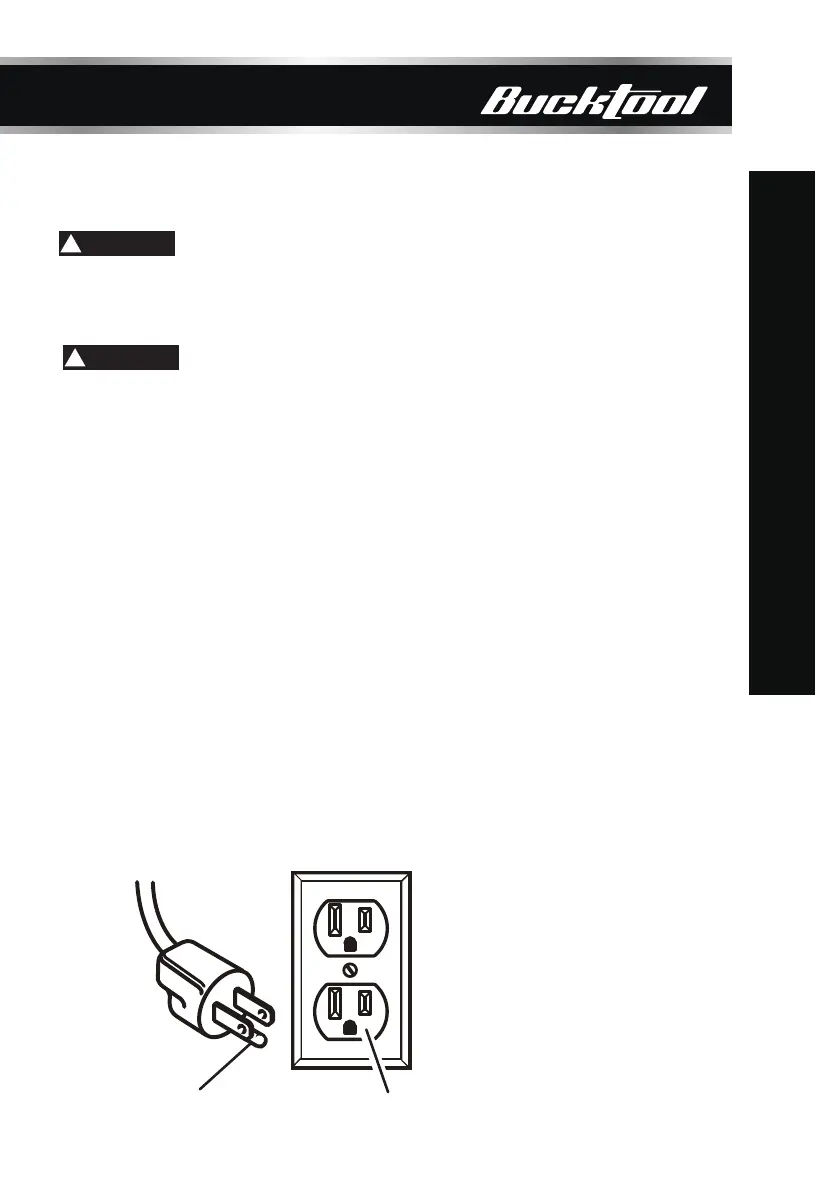
GROUNDING INSTRUCTIONS (FIG. 1)
Fig. 1
A
B


 To Next Page
 Loading...