Braking
Braking action- involves perceDtion time and reaction
’time.
First, you have to decide to push on the brake pedal.
That’s perception time. Then -you have to bring
up
your
foot and do it. That’s reaction-time.
-
Average reaction
time
is
about
314
‘of a second.
But
that’s only -an average. It might be less with one driver
and as
long
as two or.three seconds or .more with
another. <Age, physical condition, alertness,
coordination, and eyesight all play
a
part.
So
do alcohol,
drugs and frustration. .But even in
3/4
0f.a second, a
vehicle moving at
60
mph
(1
00
h/h)
travels
66
feet:
(20
m). That could. be a lot
of
distance in an-emergency,
so
keeping enough- space between your vehicle and-others
is important.
And,
of course, actual stopping distances vary greatly
with the saiface- of the raad.(whether it’s pavement or
gavel); the condition of the road (wFt, dry, icy); tire
tread; and
the
condition
of
your brakes.
Most -drivers treat their brakes with care. Some,
however; overwork the braking system with poor
driving habits.
*
Avoid needless heavy braking. Some people drive in
spurts
-
heavy acceleration followed by heavy
braking
-
rather than keeping pace with traffic.
This
is
a mistake. Your brakes may not have time to
cool
between hard stops. Your brakes will wear out much
faster if you do a lat of heavy braking.
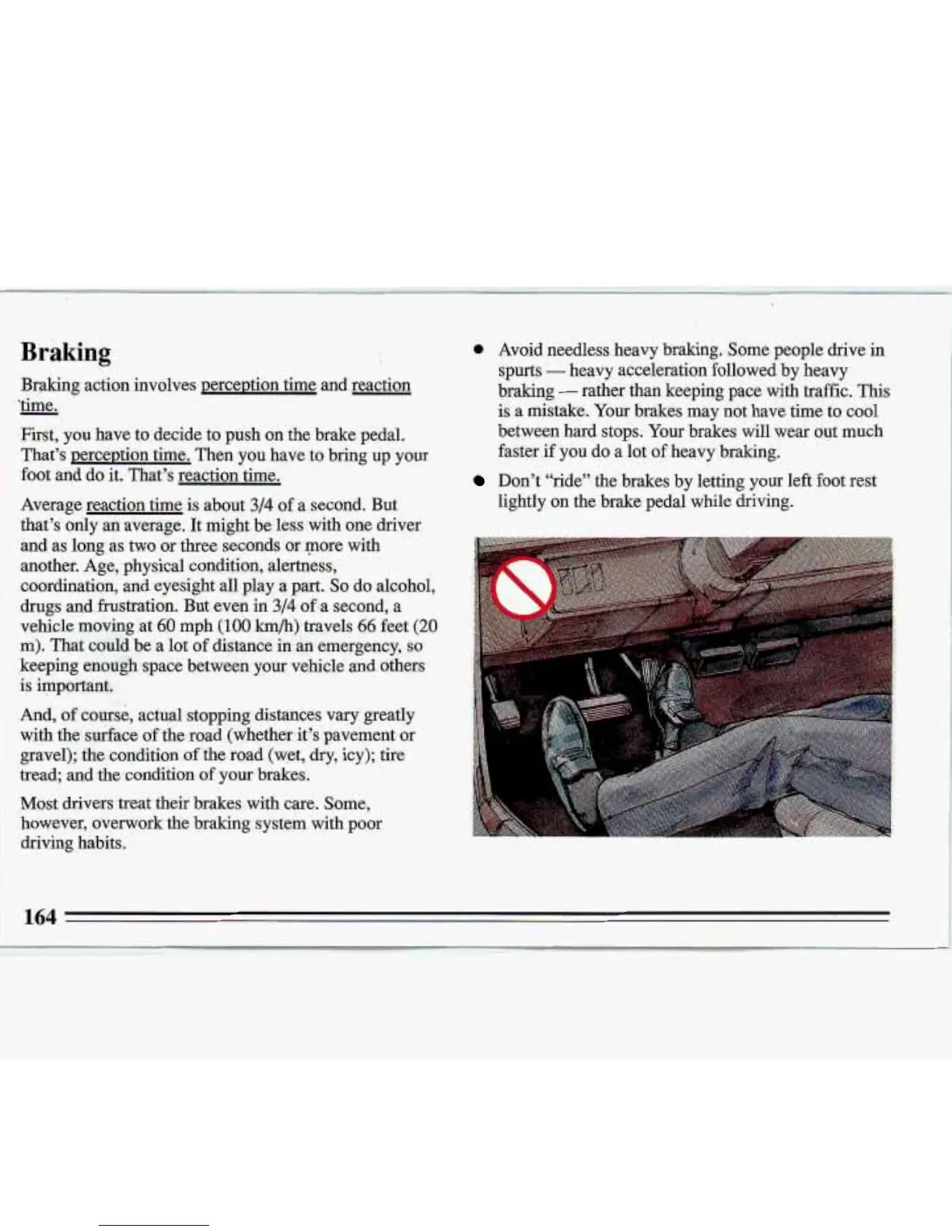
Don’t
“ride” the brakes by letting your left foot rest
lightly on the brake pedal while driving.








 To Next Page