I
CAUTION: (Continued)
Air bags are designed to work only in moderate to
severe crashes where the fi-ont of your vehicle hits
something. They aren’t designed to inflate at all in
rollover, rear, side or low-speed frontal crashes.
Everyone in your vehicle, including the driver,
should wear
a
safety belt properly
--
whether or
not there’s an
air
bag for that person.
A
CAUTION:
Air
bags inflate with great force, faster than the
blink of an eye. If you’re too close to an inflating
air
bag, it could seriously injure you. Safety belts
help keep you in position for an
air
bag inflation
in a crash. Always wear your safety belt, even
with an
air
bag. The driver should sit
as
far
back as possible while still maintaining control
of the vehicle.
An inflating
air
bag can seriously injure small
children. Always secure children properly in your
vehicle. To read how, see the part of this manual
called “Children” and the caution label
on
the
right front passenger’s safety belt.
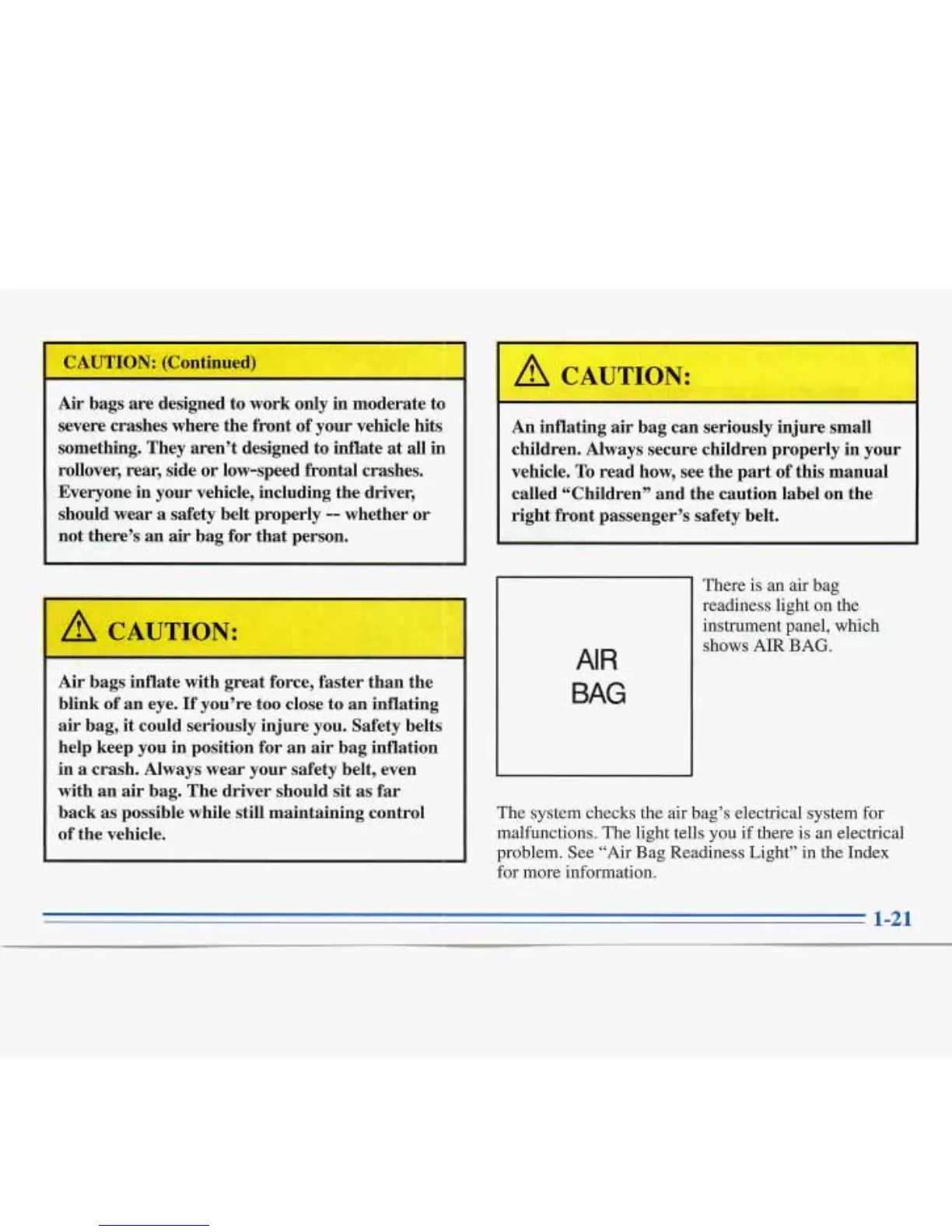
AIR
BAG
There
is
an air bag
readiness light on the
instrument panel, which
shows
AIR
BAG.
The system checks the air bag’s electrical system for
malfunctions. The light tells you
if
there
is
an electrical
problem. See
“Air
Bag Readiness Light” in the Index
for
more information.
1-21





 To Next Page