1. Grâce à la tête de détecon, ton détecteur peut reconnaître la composion de trois types
d’objets :
• Les objets à métal ferreux sont signalés par l’indicateur de gauche et un son grave.
• Les objets à métal non-ferreux sont signalés par l’indicateur de droite et un son aigu.
• Les objets non-métalliques ne sont pas détectés (plasque, bois, ssu…).
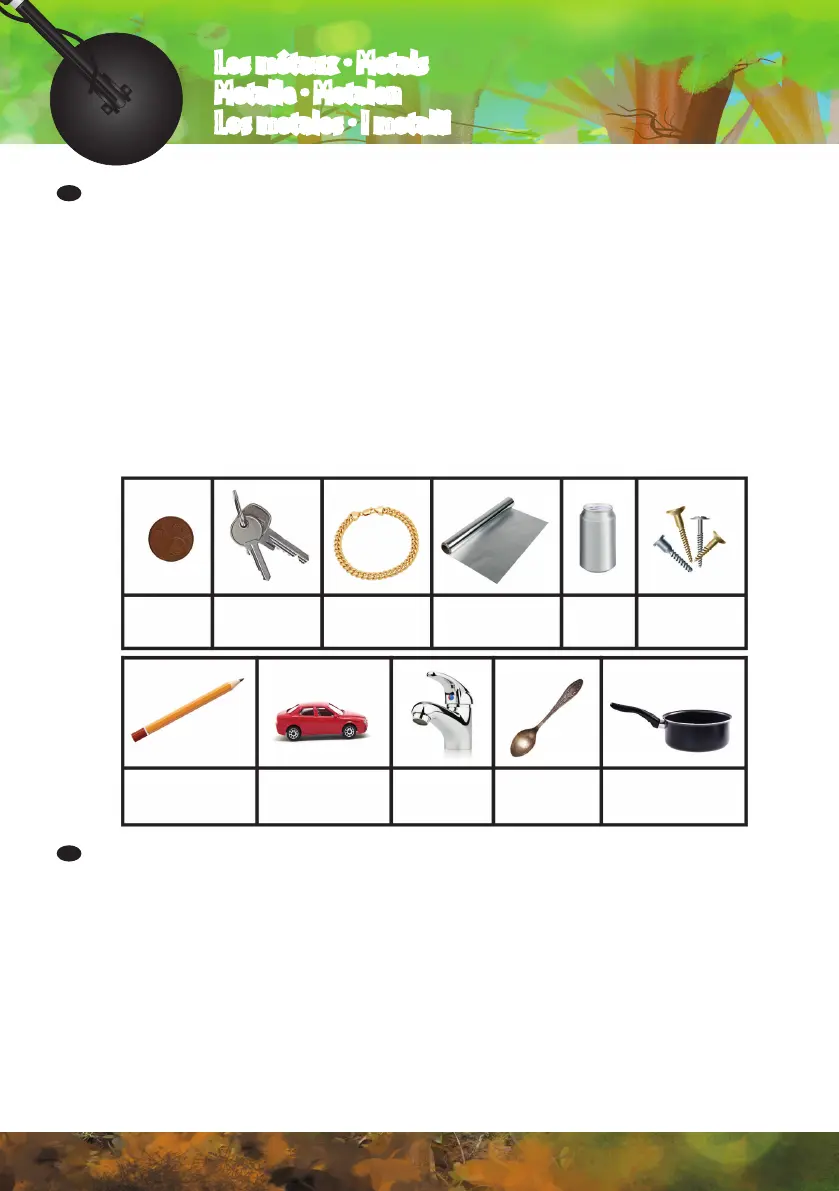
2. Trouve un des objets ci-dessous puis pose-le au sol.
3. Allume ton détecteur puis règle le bouton de la sensibilité au milieu. Passe le détecteur par-dessus
l’objet. De quelle maère est-il constué ?
Le fer est le métal le plus abondant sur Terre. On l’ulise pour créer des métaux appelés alliages:
le fer est ainsi mélangé avec du carbone pour former l’acier ou la fonte. Les métaux ferreux sont
également arés par les aimants.
Les métaux non-ferreux désignent tous les autres métaux comme l’aluminium, le zinc, le cuivre, le
tane ou le magnésium. Ils désignent également les alliages comme le laiton (cuivre et zinc) et le
bronze (cuivre et étain). Ils regroupent enn les métaux précieux comme le plane, l’argent et l’or.
Les trésors seront donc plutôt suscepbles d’être des métaux non-ferreux.
1. Thanks to its detector head, your metal detector can recognise the composion of three types of
objects:
• Ferrous metal objects are indicated by the le-hand indicator and a low sound.
• Non-ferrous metal objects are indicated by the right-hand indicator and a high sound.
• Non-metallic objects are not detected (plasc, wood, fabric etc.).
2. Find one of the objects below and put it on the oor.
3. Switch on your detector and turn the sensivity knob to the middle. Move the detector over the
object. What is it made of?
Iron is the most abundant metal on Earth. It is used to make metals known as alloys. For example,
iron is combined with carbon to make steel or cast iron. Ferrous metals (metals containing iron) are
aracted by magnets.
Non-ferrous metals are all the other metals, including aluminium, zinc, copper, tanium and
magnesium. They also include alloys such as brass (copper and zinc) and bronze (copper and n).
Finally, they include precious metals such as planum, silver and gold. Treasure is thus most likely
to be made of non-ferrous metal.
FR
EN
8
1
Les métaux · Metals
Metalle · Metalen
Los metales · I metalli


 To Next Page
 Loading...