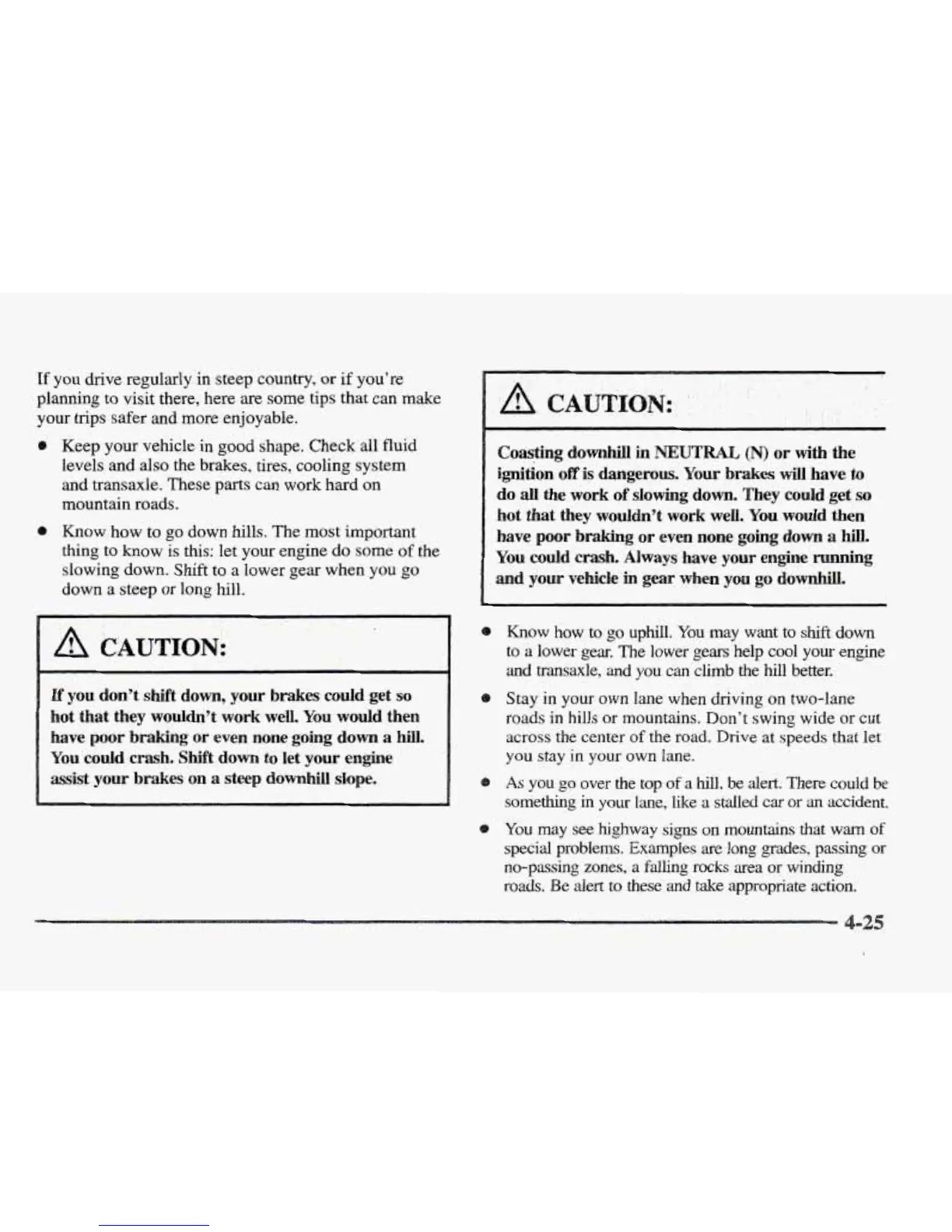
If
you
drive
regularly
in
steep country,
or
if you’re
planning to visit there, here are some tips that can
make
your trips safer and more enjoyable.
Keep your vehicle
in
good
shape.
Check
all fluid
levels and also the brakes, tires, cooling system
and transaxle. These parts can work hard on
mountain
roads.
Know how to
go
down
hills. The most important
thing to know
is
this: let your engine do some of
the
slowing down. Shift to
a
lower gear when you
go
down
a
steep
or
long hill.
~ ~ ~~
-~
~
Coasting
downhill in
NEUTRAL
(N)
or
with
the
ignition
off
is dangerous. Your brakes
will
have to
do
dl
the work
of
slowing
down.
They
codd
get
so
hot that
they
woddn9t
work
well.
You
would
then
have
poor
braking
QF
even
none
going
down
a
hill.
You
~dd
crash.
Always
have your engine
running
Saaaca
your
vehicle
in
gear
when
you
go
doMi.
A
CAUTION:
you
don’t shift
down,
your
brakes
could
get
so
hot
that
they wouldn’t work
well.
You
would
then
have
poor
braking
or
even
none
going
down
a
hu.
You
could
crash.
Shift
down
to
let
your
engine
mist
your
brakes
on
a
steep
downhill
slope.
Know
how to go uphill. You
may
want to
shift
down
to a lower gear. The lower gears help cool your engine
and transaxle, and you
can
climb
the
hill better.
Stay
in
your
own
lane when driving on two-lane
roads
in hills
OF
mountains.
Don’t
swing wide or cut
across the center
of
the
road.
Drive
at
speeds
that let
you stay
in
your
own lane.
As
you
go
over the
top
of
a
hill, be
alert.
There could
be
something in
your
lane,
like
a
stalled car
or
an
accident.
You
may
see
highway
signs
on mountains that
warn
of
special problems. Examples
are
Bong grades, passing
or
no-passing
zones,
a
falling
rocks area
or
winding
roads. Be
dert
to
these and
take
appropriate action.
-2



 To Next Page