si
ric
1.
2.
3.
4.
5.
6.
7.
8.
9.
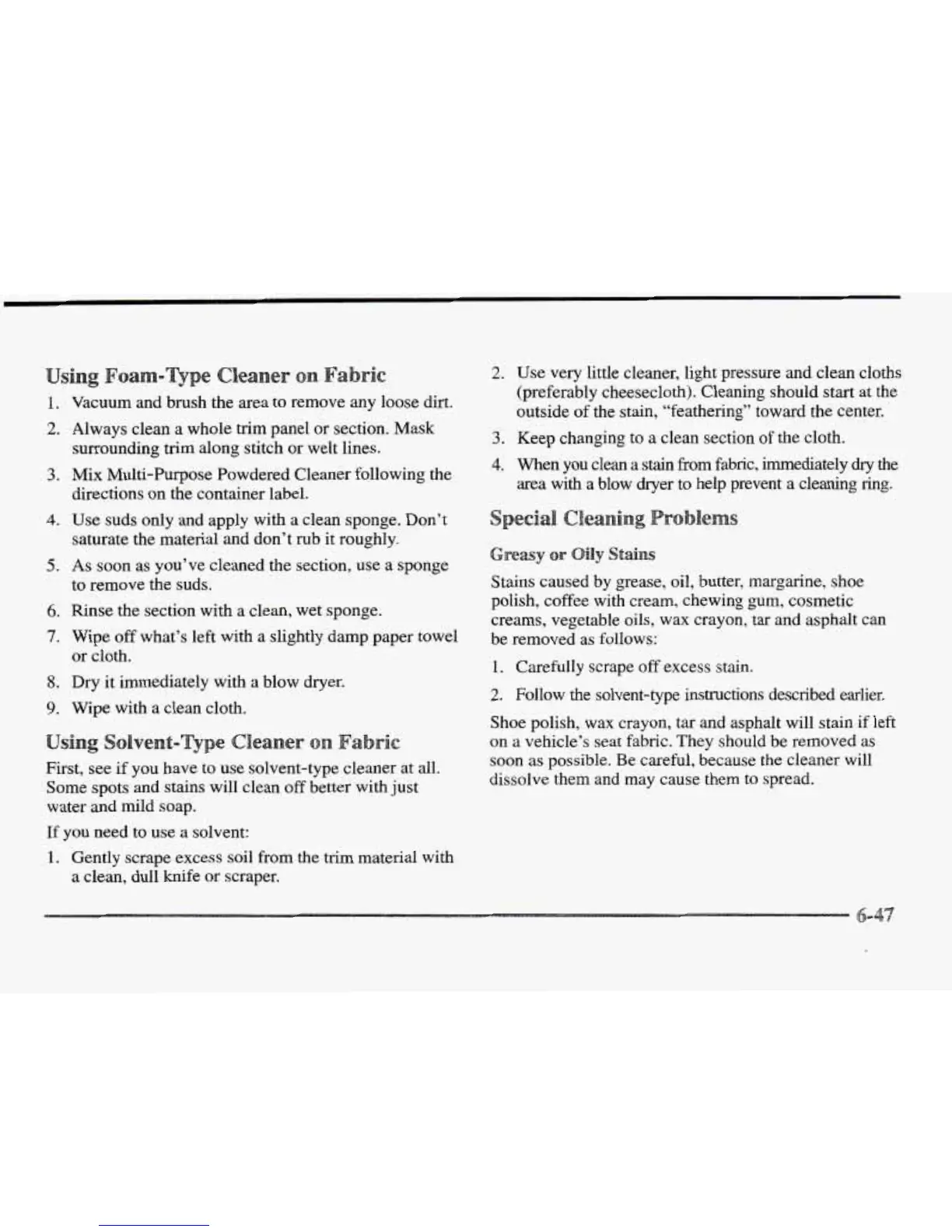
Vacuum and brush the area to remove any loose dirt.
Always clean a whole trim panel or section. Mask
surrounding trim along stitch or welt lines.
Mix Multi-Purpose Powdered Cleaner following the
directions on the container label.
Use
suds only and apply with a clean sponge. Don’t
saturate the material and don’t rub
it
roughly.
As
soon as you’ve cleaned the section, use a sponge
to remove the suds.
Rinse the section with
a
clean, wet sponge.
Wipe
off
what’s
left
with a slightly damp paper towel
or cloth.
Dry it immediately with a blow dryer.
Wipe with a clean cloth.
si
vent-
First, see
if
you have
to
use
solvent-type cleaner at all.
Some spots and stains will clean
off
better with just
water and mild soap.
If
you need to use
a
solvent:
1.
Gently scrape excess
soil
from
the trim material with
a clean, dull knife
or
scraper.
2.
Use very little cleaner, light pressure and clean cloths
(preferably cheesecloth). Cleaning should start at the
outside of the stain, “feathering” toward the center.
3.
Keep changing
to
a
clean section
of
the cloth.
4.
When
you
clean a
stain
from
fabric, immediately
dry
the
area
with
a
blow dryer to help prevent a cleaning
ring.
Stains caused by grease, oil, butter, margarine,
shoe
polish, coffee with cream, chewing
gum,
cosmetic
creams, vegetable oils, wax crayon, tar and asphalt can
be removed
as
follows:
1.
Carefully scrape
off
excess stain.
2.
Follow the solvent-type instructions described earlier.
Shoe polish, wax crayon, tar and asphalt will stain if left
on a vehicle’s seat fabric. They should
be
removed as
soon
as
possible.
Be
careful, because
the
cleaner will
dissolve them and may cause
them
to spread.



 To Next Page