To Next PageTo Next Page
 Need help?
Do you have a question about the Casio 5122 and is the answer not in the manual?
Explains power levels based on second hand movement, recovery mode, and charging times.
Details the watch's sleep state and automatic power saving functions.
Guides essential checks like power level, Home City, and DST settings before daily use.
Provides guidance on charging the watch using solar power, including best practices and warnings.
Instructions on preparing the watch for time calibration signal reception.
How to check the success or failure of the latest time calibration signal reception.
Overview of different setting modes accessible from the Timekeeping Mode.
Steps to select Home City and configure summer time (DST) settings.
Procedure to manually set the current time and date when signal reception is not possible.
Explains how to switch between different watch modes (Timekeeping, Stopwatch, World Time, Alarm).
How to view the current time in one of 29 different time zones using World Time Mode.
Procedure to exchange the Home City and World Time City settings.
Instructions for measuring elapsed time using the stopwatch function.
Guide on setting, turning on/off, and adjusting the watch alarm.
Addresses problems like incorrect time, reception failures, and hand alignment.
Details accuracy, power supply, timekeeping features, and signal reception capabilities.
Explains power levels based on second hand movement, recovery mode, and charging times.
Details the watch's sleep state and automatic power saving functions.
Guides essential checks like power level, Home City, and DST settings before daily use.
Provides guidance on charging the watch using solar power, including best practices and warnings.
Instructions on preparing the watch for time calibration signal reception.
How to check the success or failure of the latest time calibration signal reception.
Overview of different setting modes accessible from the Timekeeping Mode.
Steps to select Home City and configure summer time (DST) settings.
Procedure to manually set the current time and date when signal reception is not possible.
Explains how to switch between different watch modes (Timekeeping, Stopwatch, World Time, Alarm).
How to view the current time in one of 29 different time zones using World Time Mode.
Procedure to exchange the Home City and World Time City settings.
Instructions for measuring elapsed time using the stopwatch function.
Guide on setting, turning on/off, and adjusting the watch alarm.
Addresses problems like incorrect time, reception failures, and hand alignment.
Details accuracy, power supply, timekeeping features, and signal reception capabilities.
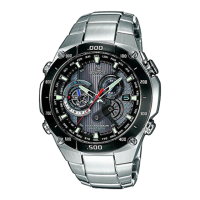
This document describes the CASIO watch, a solar-powered timepiece with radio-controlled atomic timekeeping and various functions.
The watch features a solar cell on its face that generates power from light, charging a built-in rechargeable battery. This battery powers all watch operations. The watch charges whenever it is exposed to light.
The watch includes a radio-controlled atomic timekeeping feature, which receives time calibration signals to automatically update its time settings. This function is available when the selected Home City code is in Japan, North America, Europe, or China, and supports signal reception. If the watch is used outside these areas, manual time adjustment is required. The watch can receive signals from transmitters in Anthorn (England), Mainflingen (Germany), Shangqiu City (China), Fukushima (Japan), Fukuoka/Saga (Japan), Fort Collins (Colorado, United States).
A power level indicator, observed through the movement of the 2 Second Hand in Timekeeping Mode, provides an idea of the watch's charge. Normal movement (one-second intervals) indicates Level 1, while two-second intervals indicate Level 2 (low power). If the 2 Second Hand is stopped, or the 1 Hour Hand and 3 Minute Hand are stopped at 12 o'clock, power is at Level 3, meaning all functions are disabled.
The watch has a Power Saving feature that automatically enters a sleep state when left in the dark for a certain period. There are two levels: "second hand sleep" (60-70 minutes in dark) where only the 2 Second Hand stops at 12 o'clock, and "function sleep" (6-7 days in dark) where all functions, including analog timekeeping, are disabled, though internal timekeeping is maintained. The watch will not enter a sleep state between 6:00 AM and 9:59 PM, nor while in Stopwatch Mode.
The watch offers a Stopwatch Mode with a measuring capacity of 23 hours, 59 minutes, 59.999 seconds, and a measuring unit of 1/1000 second. It supports elapsed time measurement.
A World Time Mode allows viewing the current time and date in 29 cities (29 time zones) and Coordinated Universal Time (UTC). It also supports standard time/daylight saving time (summer time) and Home City/World Time City swapping.
The watch includes a Daily Alarm function.
To begin using the watch, it's recommended to check the 2 Second Hand movement in Timekeeping Mode. If power is low (Level 2 or 3), expose the watch to light for charging. Next, configure the Home City and daylight saving time (DST) settings, as proper time calibration signal reception and World Time settings depend on these. Finally, set the current time, either by receiving a time calibration signal or manually.
The watch has several setting modes, accessed by holding down button A in Timekeeping Mode. These include Home City Setting Mode, Manual Setting Mode (for time and date), and Home Position Adjustment Mode.
In Home City Setting Mode, users can select their Home City code and choose between AT (AUTO), STD (standard time), or DST (daylight saving time). The AT (AUTO) setting automatically switches between standard and summer time based on time calibration signal data, available only for signal-supporting city codes. STD always indicates standard time, while DST advances the time by one hour for daylight saving.
To manually configure time and date, enter the Manual Setting Mode. Users can adjust the hour, minute, year (tens and ones digit), and month using buttons B and C. Holding down a button enables high-speed hand movement.
The Home Position Adjustment Mode allows users to correct the home positions of the hands (1 Hour Hand, 3 Minute Hand, 2 Second Hand, Left Dial Hand, Right Dial Hands, 24-hour Hand, Day) if they are misaligned due to magnetism or impact.
To use the Stopwatch Mode, navigate to it using button A. Pressing button B starts and stops the stopwatch, while button C resets it.
To use the World Time Mode, navigate to it using button A. Button B cycles through city codes, and button C allows swapping the Home City and World Time City.
To use the Alarm Mode, navigate to it using button A. Button B turns the alarm on or off, and button C allows setting the alarm time.
To ensure optimal performance and prevent power depletion, it's crucial to regularly expose the watch to light for charging. When not wearing the watch, leave it in a location where it is exposed to light. For best charging, expose it to light as strong as possible.
When wearing the watch, ensure the face is not blocked by clothing, as even partial blockage can cause the watch to enter a sleep state.
Avoid exposing the watch to bright light for extended periods in conditions that can cause it to become very hot, such as on a car dashboard in direct sunlight, too close to an incandescent lamp, or under direct sunlight, to prevent burn injury.
If the watch experiences problems with signal reception, ensure the Home City setting is correct and that there is sufficient power. If the time or day is incorrect despite successful signal reception, check the Home City setting and adjust hand home positions if necessary.
If the watch enters a sleep state, move it to a well-lit area or press any button to recover.
If the watch's hands are misaligned, use the Home Position Adjustment Mode to correct them. This can happen if the watch is subjected to strong magnetism or impact.

 General