21
CONNECTION TO THE POWER SUPPLY
The refrigerator corresponds to the 1st class of protection against
electric shock and is connected to the electrical supply using a
two-pole outlet with a grounding contact.
– Before connecting to the mains, make sure that:
– The mains voltage corresponds to the data indicated on the
special plate on the back of the refrigerator;
– The grounding contact of the electrical outlet is connected to
the grounding wire of the power supply cable of the electrical
network (the connecting wire must be designed for a current of
at least 10 A);
– The socket and plug are of the same type; if the plug does
not fit into the outlet, the outlet should be replaced with the
corresponding plug of the power cord (the work must be
performed by a qualified electrician).
The refrigerator must be installed in such a way that you always
have access to an outlet. A refrigerator connected in violation
of the safety requirements of high-power household appliances
described in this manual is potentially dangerous.
The manufacturer is not responsible for damage to health and
property if it is caused by non-compliance with the specified
installation standards.
5. REFRIGERATOR OPERATION
BEFORE SWITCHING ON
It is necessary to connect the refrigerator to the mains three
hours after its installation. Thus, the refrigerant will be distributed
properly after transportation – this is necessary for the proper
operation of the refrigerator.
A few hours after connecting the refrigerator to the mains, You can
put products in it.
Remove the transport spacers between the compressor and the
back wall of the niche, as well as other spacers and adhesive
tapes that keep the moving parts of the device from shifting.
If the device has a protective coating of polymer film, carefully
remove it, taking precautions not to damage the paint or polymer
coating of the parts.
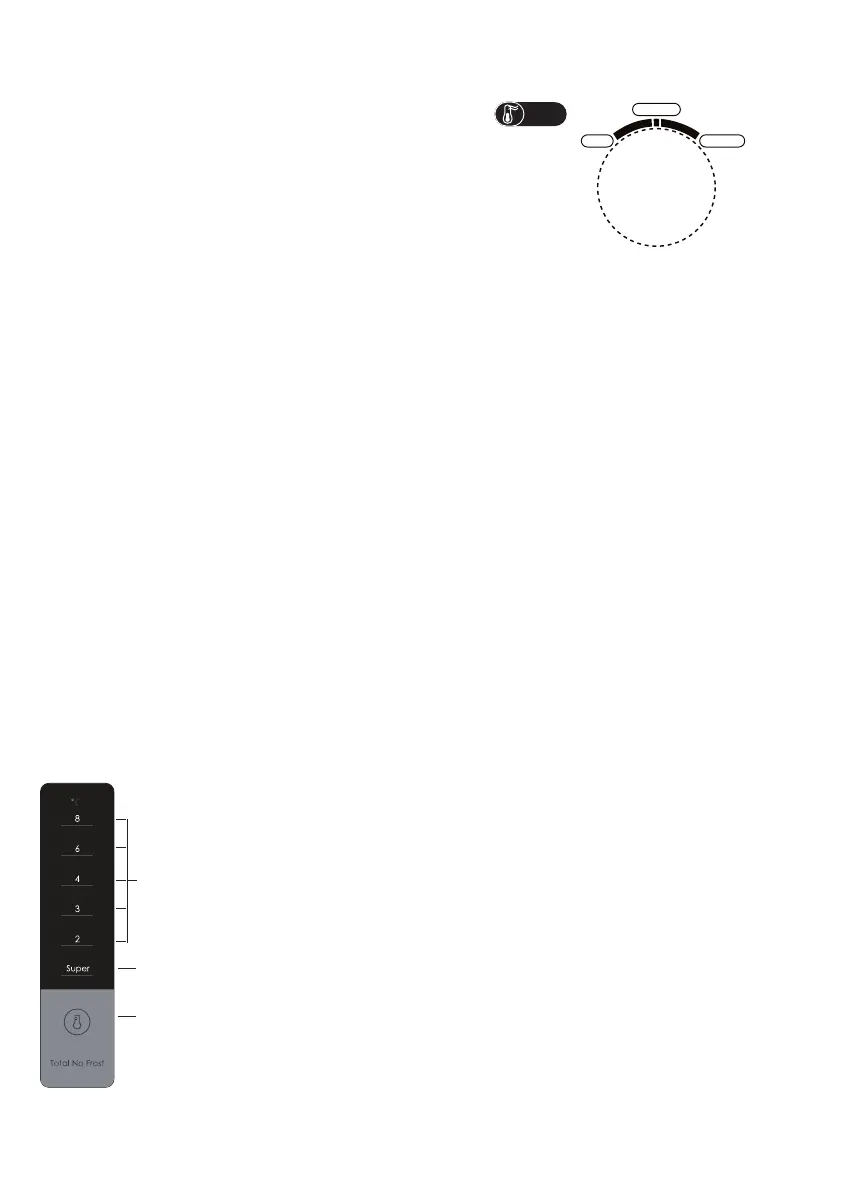
DISPLAY
NORMAL
COLDERCOLD
(summer) (winter)
Freezer
Control
1
2
3
When you turn on the refrigerator for the
first time, the display (including all
indicators) will light up at maximum
brightness for three seconds, after which
only the backlight of the activated mode will
remain on.
1. Temperature selection button
2. Button to activate the «Super cool» mode
3. Indicators of the temperature regime of
the refrigerating chamber (2, 3, 4, 6, 8 °С)
To change the temperature mode, use the
button (1). Select the required temperature
by successive pressing of the button, after
15 seconds the mode is activated.
If you need to quickly cool the zero zone, use
the «Super cool» mode. To activate the mode,
press the «Super» button. The indicator will
turn on, confirming the activation of the mode. After 2.5 hours, the
mode will turn off.
USING THE FREEZER
NORMAL
COLDERCOLD
(summer) (winter)
Freezer
Control
The freezer temperature control is located at the bottom of
the refrigerator compartment, behind the bottom «zero zone»
container.
Using the temperature controller, you can select the mode in
accordance with the requirements:
«COLD» - the mode of increased freezing. It is used in summer
time, or at an ambient temperature above 35 °C.
«COLDER» - reduced freezing mode. It is used in winter time, or at
an ambient temperature below 10 °C.
«NORMAL» - the average value between the «COLD» and «COLDER»
modes. Typically used at ambient room temperature.
In order to ensure the best storage conditions for products, follow
the recommendations below. Products intended for freezing and
storage in the freezer should be carefully packed to avoid the
formation of excessive frost.
– Preferably, the products placed inside the freezer should not
come into contact with the back and side walls.
– For proper storage and ease of subsequent defrosting, place the
products in small portions.
– Do not place full glass containers with freezing liquids in the
freezer for a long time, especially if.
– They contain tightly sealed effervescent or carbonated drinks.
The liquid, crystallizing, can destroy the container.
– Do not put liquids in containers without a lid in the freezer, in
order to avoid an increase in humidity, because this leads to an
increase in temperature.
6. MAINTENANCE AND CARE
When cleaning or maintaining the refrigerator, first turn off the
power by removing the plug from the socket. Empty the chambers
of food. Use neutral detergents. Never use abrasive detergents,
alkaline products, organic acids and hot water as this may
damage the paintwork. Do not use sharp or metal objects as this
may damage the refrigerator.
The door seal gets dirty easily and needs to be washed more often.
If you do not use the refrigerator for a long time, remove the plug
from the socket, defrost, wash and dry the refrigerator.
7.TROUBLESHOOTING
In case of unsatisfactory operation of the refrigerator or
malfunction, study this section before contacting an authorized
service center. In some cases, you can fix the problems yourself.


 To Next Page
 Loading...