A-4
• DO NOT leave a lit gas outdoor stove unattended. Keep children and pets away from outdoor stove
at all times.
• DO NOT place outdoor stove on any type of tabletop surface.
• DO NOT use outdoor stove in high winds.
• Disconnect the LP cylinder by rst turning off valve on top of the cylinder, turn off burner valves, then
disconnect regulator from valve on propane tank by turning plastic connector counterclockwise.
• Avoid burning of or impact with the outdoor stove to prevent spillage or splashing of hot
cooking liquid.
• Never drop food or accessories into hot cooking liquid. Lower accessories and food slowly into
the cooking liquid in order to prevent splashing or overow. When removing food from the outdoor
stove, care shall be taken to avoid burns from hot cooking liquids.
• DO NOT place empty cooking vessel on the outdoor stove while in operation. Use caution when
placing anything in cooking vessel while the outdoor stove is in operation.
• Never overll the cooking vessel with water.
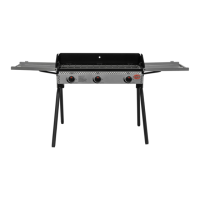
• DO NOT operate with legs in the folded position. This stove is only intended to operate freestanding
with the legs fully extended and locked into position.
• This outdoor stove is not intended for and should never be used as a heater.
• Never use a cooking vessel larger than the capacity and diameter recommended by the
manufacturer (no larger than 10 in. in diameter).
• Place dust cap on LP cylinder valve outlet whenever the LP cylinder is not in use. Only install the
type of dust cap on the LP cylinder valve outlet that is provided with the LP cylinder valve. Other
types of caps or plugs may result in leakage of propane.
DANGER
• Liquid propane (LP) gas is ammable and hazardous if handled improperly. Know its characteristics
before using any propane product.
• Propane Characteristics: ammable, explosive under pressure, heavier than air and settles in pools
and low areas.
• In its natural state, propane has no odor. For your safety, an odorant has been added.
• Contact with propane can cause freeze burns to skin.
• Never use an LP cylinder with a damaged body, valve, collar or footing.
• Dented or rusted LP cylinders may be hazardous and should be checked by your propane
gas supplier.
• Use caution when assembling and operating your outdoor stove to avoid scrapes or cuts from
sharp edges.
• Use caution when moving outdoor stove to prevent strains.
• Never move outdoor stove when it is in use or hot. Allow the cooking vessel to cool to 115°F (45°C)
before moving or storing.
• To protect against bacteria that could cause illness, keep all meats refrigerated and thaw in
refrigerator or microwave. Keep raw meats separate from other foods, and wash everything that
comes in contact with raw meat.
• Cook meat thoroughly, and refrigerate leftovers immediately.
• Use a calibrated food thermometer and the USDA guidelines to ensure that meat, poultry, seafood,
and other cooked foods reach a safe minimum internal temperature.
• Have a re extinguisher near at all times. Maintain and check your re extinguisher regularly.


 To Next Page
 Loading...