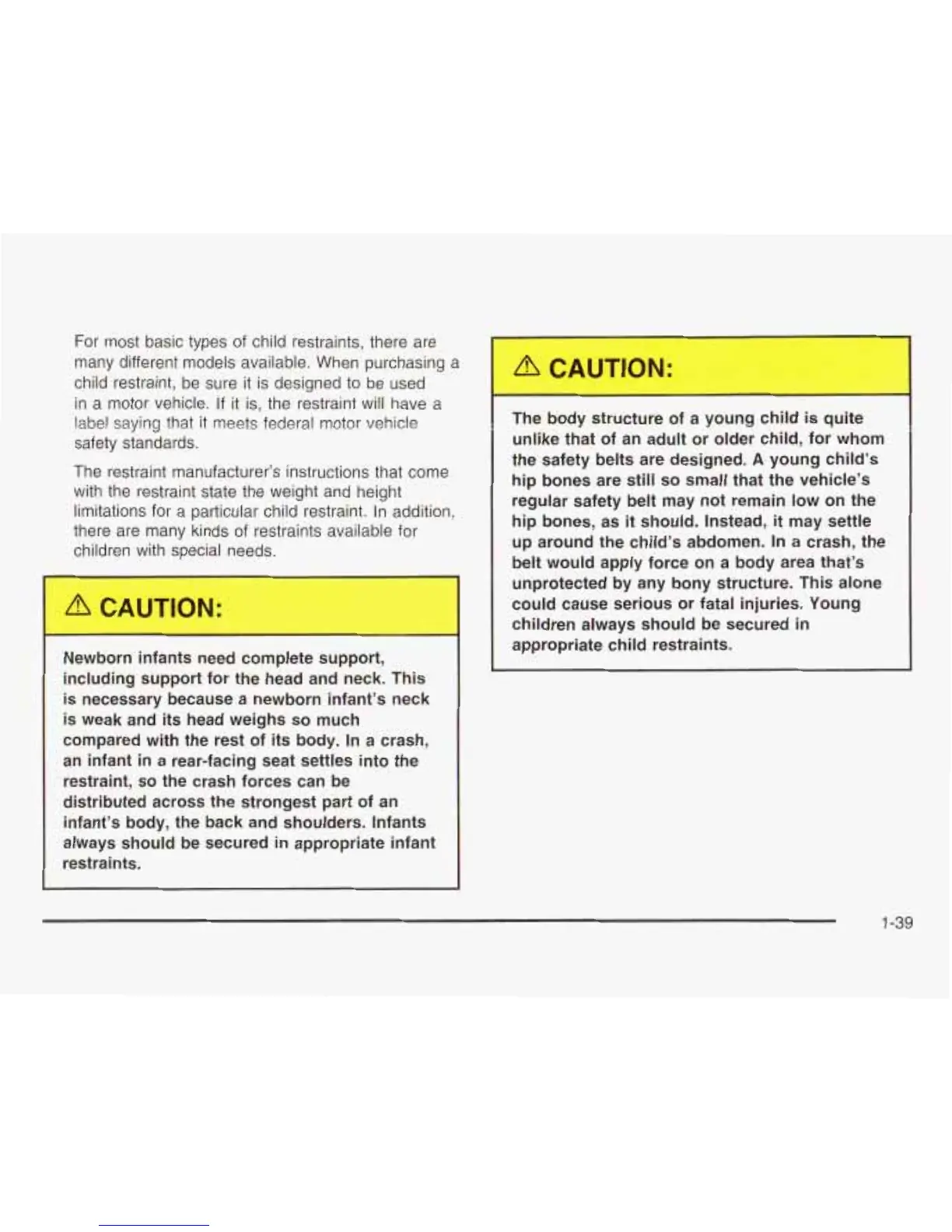
For most basic types of child restraints, there are
many different models available. When purchasing a
child restraint, be sure it is designed
to
be used
in a motor vehicle.
If
it is, the restraint will have a
label saying that
it
meets federal motor vehicle
safety standards.
The restraint manufacturer’s instructions that come
with the restraint state the weight and height
limitations for a particular child restraint. In addition,
there are many kinds of restraints available for
children with special needs.
Newborn infants need complete support,
including support for the head and neck. This
is necessary because a newborn infant’s neck
is weak and its head weighs
so
much
compared with the rest of its body.
In
a crash,
an infant in a rear-facing seat settles into the
restraint,
so
the crash forces can be
distributed across the strongest part of an
infant’s body, the back and shoulders. Infants
always should be secured
in
appropriate infant
restraints.
Th
~ 3ody strucl
e
o
young child
is
quite
unlike that
of
an adult or older child, for whom
the safety belts are designed.
A
young child’s
hip bones are still
so
small that the vehicle’s
regular safety belt may not remain
low
on the
hip
bones, as
it
should. Instead,
it
may settle
up around the child’s abdomen. In a crash, the
belt would apply force
on
a body area that’s
unprotected by any bony structure. This alone
could cause serious or fatal injuries. Young
children always should be secured in
appropriate child restraints.
1-39






 To Next Page