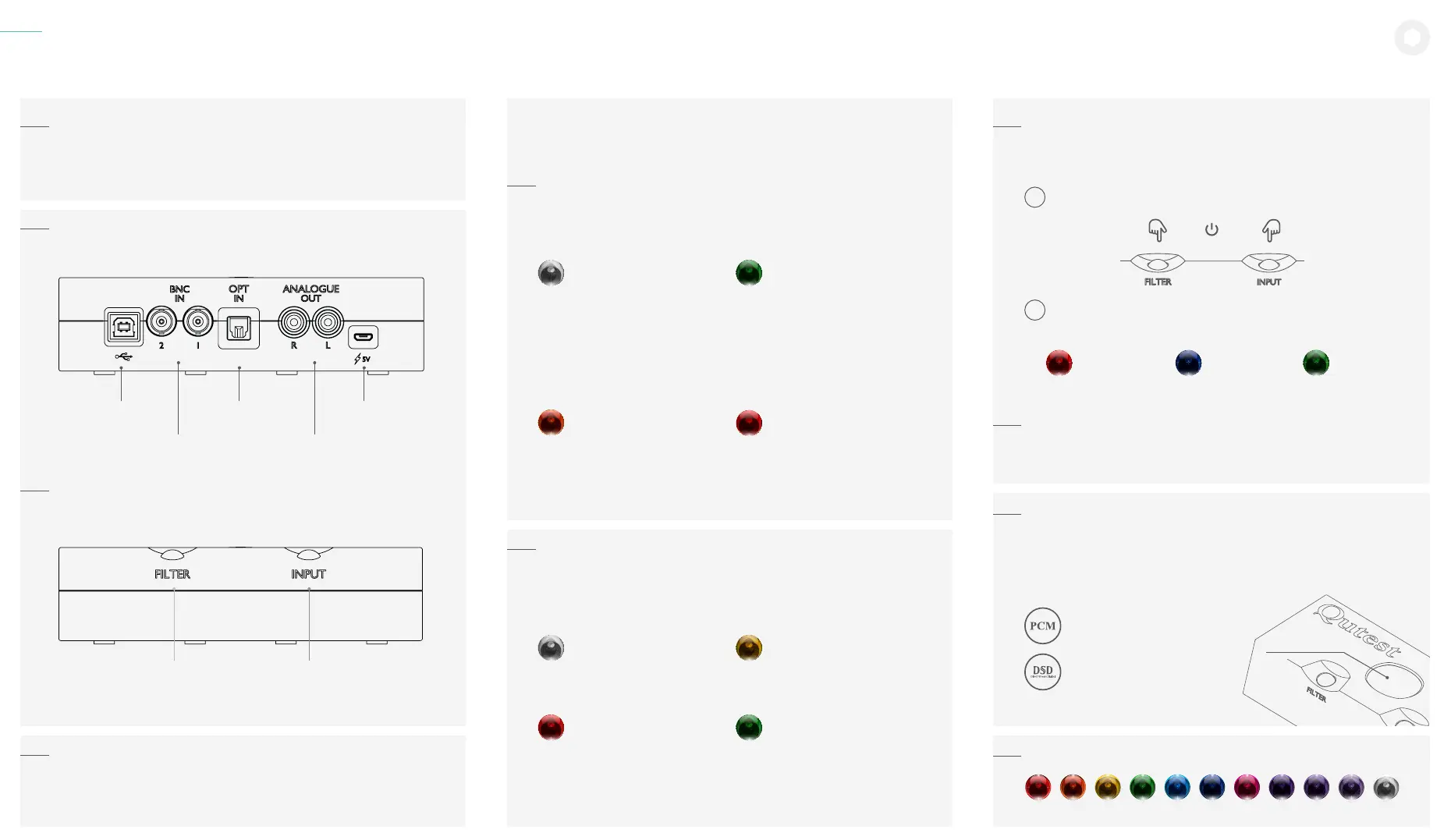
HD Type-B USB
Up to 768kHz and DSD 512 native
playback. DSD 64 - DSD 256 via
DoP, native DSD via ASIO
COAX 2
Up to 384kHz and up to DSD 128
(via DoP). Dual-data* capable
COAX 1
Up to 384kHz and up to DSD 128
(via DoP). Dual-data* capable
Optical input
Up to 192kHz and DSD 64 (via DoP)
Qutest has two selector spheres on the front of the unit, FILTER and INPUT.
Each button also has an additional function - variable line-level output
mode and variable display brightness. Please refer to the sections below to
learn more.
Filters
By cycling through the four filter options, it is possible to subtly change the
device’s tonal characteristics. Qutest achieves this not by strictly applying
an equalisation curve, but by changing the way in which the FPGA handles
the data.
Rear
Front
Power connection
Qutest is supplied with an external power supply and has been designed to
be permanently connected to a power source. A 5V 2.1-amp Micro USB cable
and power supply is supplied. Note: Qutest cannot be powered via the USB
Type-B input.
Introduction
Welcome to Qutest, an advanced ultra-compact FPGA digital-to-analogue
converter proudly developed and manufactured by Chord Electronics in
Kent, England. Please take a few moments to familiarise yourself with
its operation.
Variable line level output
Qutest has a three-stage variable output voltage feature (1V, 2V and 3V)
enabling compatibility with a wide range of partnering amplifiers and
pre-amps.
Setting the brightness of the LEDs
To adjust the brightness level (after Qutest has finished the start-up
sequence), again, press both ‘FILTER’ and ‘INPUT’ to cycle between ‘High’
and ‘Low’ modes. This will dim both the internal and external LEDs.
How to read sample rate
Qutest is fully future-proof with 768kHz PCM support, DSD up to 256 via
DoP (Mac) and native DSD up to DSD 512 playback (via ASIO driver for
Windows). Sample rate switching is fully automatic, intuitively triggered
by your device, playback application or computer. You can identify the
incoming sample rate by observing the colour displayed in the viewing
porthole and referencing it to the guide below:
Sample frequencies in kHz
Inputs
With four selectable digital input options, Qutest is a standalone DAC that
acts as a digital hub to allow audio components to be instantly upgraded.
Many hi-fi and audio components can benefit, including CD transports and
players, streamers, computers, laptops, tablets and smartphones, plus most
audio devices with a suitable digital output.
*M-Scaler compatibility: Using dual data, Qutest can accept an upsampled signal from a Chord
Electronics M-Scaler. To do so, connect the Dual-Data BNC outputs 1&2 of M-Scaler, to input BNC’s
1&2 of Qutest. Now ensure your M-Scaler OP SR button is set to MAX (white) and your Qutest input
is set to COAX 1 (yellow). The Qutest now will auto-detect dual data and switch into this mode.
Selectable options and
variable line level
Variable line level output
and how to read sample rate
2.0 3.0
Filter selection switch - 4x
filters available
Input selector switch
Micro USB power
supply input -
5V 1-amp minimum
RCA analogue outputs
(Left and Right)
2x BNC coaxial input -
24-bit/384kHz/Dual-data
mode capable to 768kHz
Optical input:
24-bit/192kHz DSD 64
USB Type-B input:
32-bit 768kHz
PCM/up to DSD 512
MEMORY FUNCTION:
Qutest remembers the last-used setting, including filter, input and variable voltage selection.
During start-up (the first 16 seconds), simultaneously press both
‘FILTER’ and ‘INPUT’ buttons
44.1kHz to 768kHz - 16-bit to 32-bit
Automatic sample rate switching
DSD up to DSD 256 via DoP,
native DSD up to DSD 512 via
ASIO driver
* Native DSD playback is only available via Windows OS
with the driver available from the Chord Electronics website.
General operation, and
important information
1.0
Incisive neutral HF roll-o
Designed for purists in mind, who
playback high sample rate PCM
recordings, this option has an ultra
linear frequency response with a
high frequency filter past 20kHz to
remove HF distortion and noise from
these recordings. This includes a
16FS to 256FS WTA2 filter with the
HF filter enabled.
Warm HF roll-o
Designed to introduce a little warmth
to recordings, this filter will satisfy
and is ideal for high resolution PCM
playback. This is a 16FS filter but
with a high-frequency roll-o.
1V RMS 2V RMS 3V RMS
Incisive neutral
Designed for all who wish to hear
the full spectrum of audio no matter
what sample rate, this option has an
ultra linear frequency response. For
the technically minded this includes
a 16FS to 256FS WTA2 filter.
Warm
Designed to introduce a
little warmth to recordings, this filter
will satisfy. This is a 16FS WTA1
filter only.
1
Release press and repeat the duplicate press again to reach the desired
output level ranging from 1V, 2V and 3V. Once the start-up sequence
has completed, the output level will be fixed. Repeat the steps above to
change the level.
2
Viewing Glass
44.1 48 88.2 96 176.4 192 352.8 384 705.6 768 DSD
Chord Electronics
Qutest | Manual
_



 To Previous Page
 Loading...