technological solutions
TECHNICAL DATA SHEET
Cav. Uff. Giacomo Cimberio S.p.A.
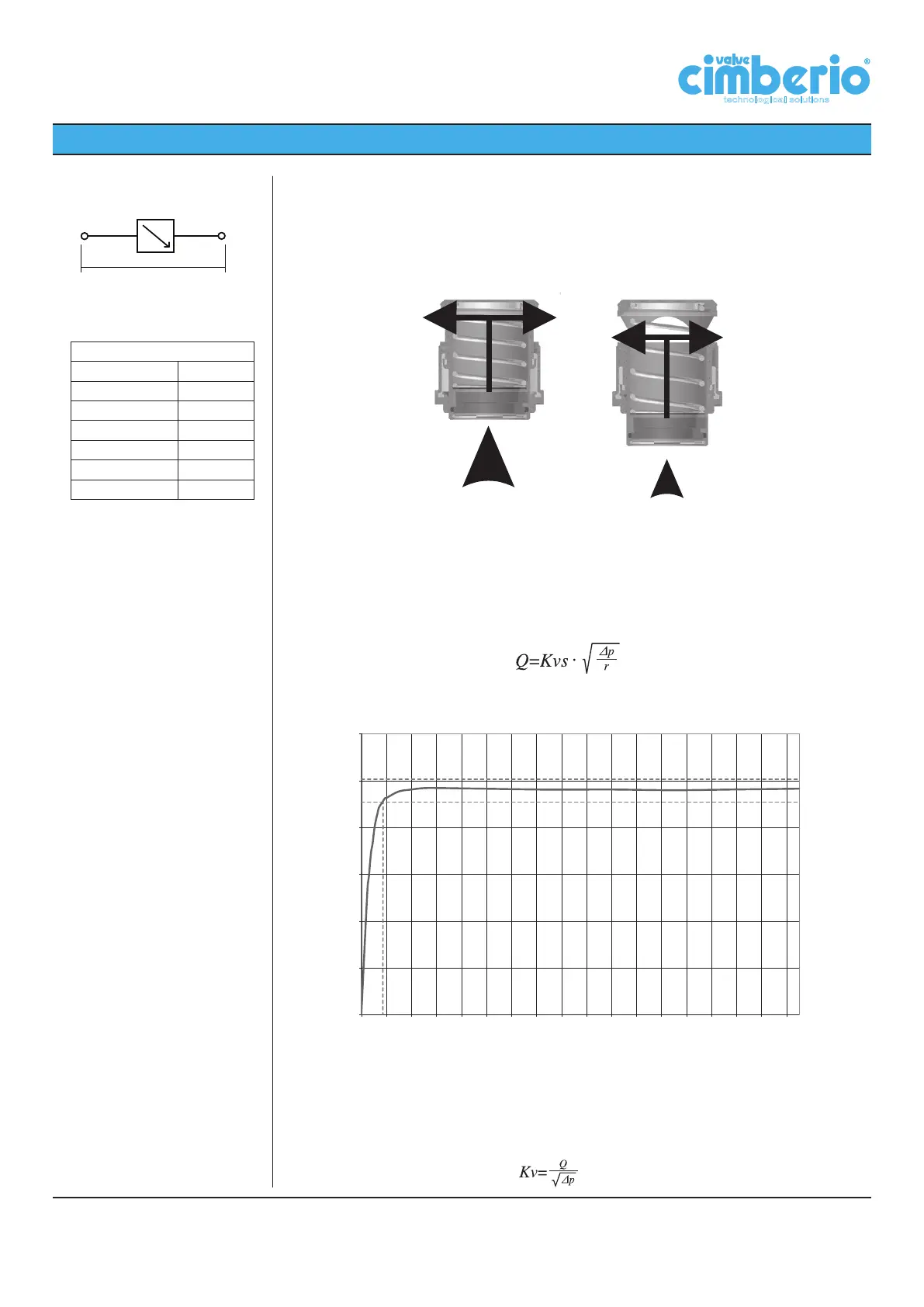
When the pressure increases, the spring is compressed and the piston reduces outlet win-
dows, in order to maintain the same flow rate; when ∆p decreases the windows start to
open again (see picture on the right).
Constant flow is obtained through the valve, despite pressure fluctuations.
By simply measuring differential pressure across the valve, the flow through the cartridge
is obtained as follows:
• If measured differential pressure is above ∆p
min
(start-up pressure), the flow rate is the
same as the one stated on the cartridge table;
• If measured differential pressure is below minimum ∆p
min
stated on cartridge table,
flow rate is calculated with one of the following formula:
where:
Q is the flow rate in m
3
/h, r is the relative density, ∆p is the pressure drop across the valve .
Sizing:
K
vs
Kvs - Kv across the valve when it is
fully open (at start up pressure)
FLOW COEFFICIENT
Kv, in metric system represents the flow in m
3
/h of water at the temperature of 15.5°C
(density =998 kg/m
3
) which causes a pressure drop of 1 bar. In the USA flow coefficient is
called Cv (Kv = 0.865 Cv).
Relative density
Fluid r
Water 1.000
Water and glycol 10% 1.012
Water and glycol 20% 1.028
Water and glycol 30% 1.040
Water and glycol 40% 1.054
Water and glycol 50% 1.067
0
0.02
0.04
0.06
0.08
0.10
0.12
20 40 60 80 100 120 140 160 180 200 220 240 260 280 300 320 340
Differential pressure - kPa
Flow rate - l/s
∆p min
5


 To Next Page
 Loading...