3
Molecular weight: 48
Odor:
Readily detectable at concentrations above 0.02 ppm in air
Color:
Bluish in ozone generator cell, but ozone/air mixture exiting
generator is invisible – even at high ozone concentrations.
Gas Density:
2.144 grams/liter at 32°F (approx. 150% that of oxygen).
Solubility:
Only partially soluble in water, but about 10-20 times more
soluble than oxygen (at 68°F).
• Ozone is generated on site – no transportation or storage is required.
• The most powerful oxidizer commercially available – very effective for
disinfection and oxidation without handling problems.
• Ozone creates no potentially harmful by-products (such as THMs) – the only
by-product is oxygen.
• Ozone leaves no telltale taste or odor.
References
1. Water Quality Association, “Ozone for POU, POE and Small Water System Water Treatment Applications,” Lisle, IL, 1999.
H
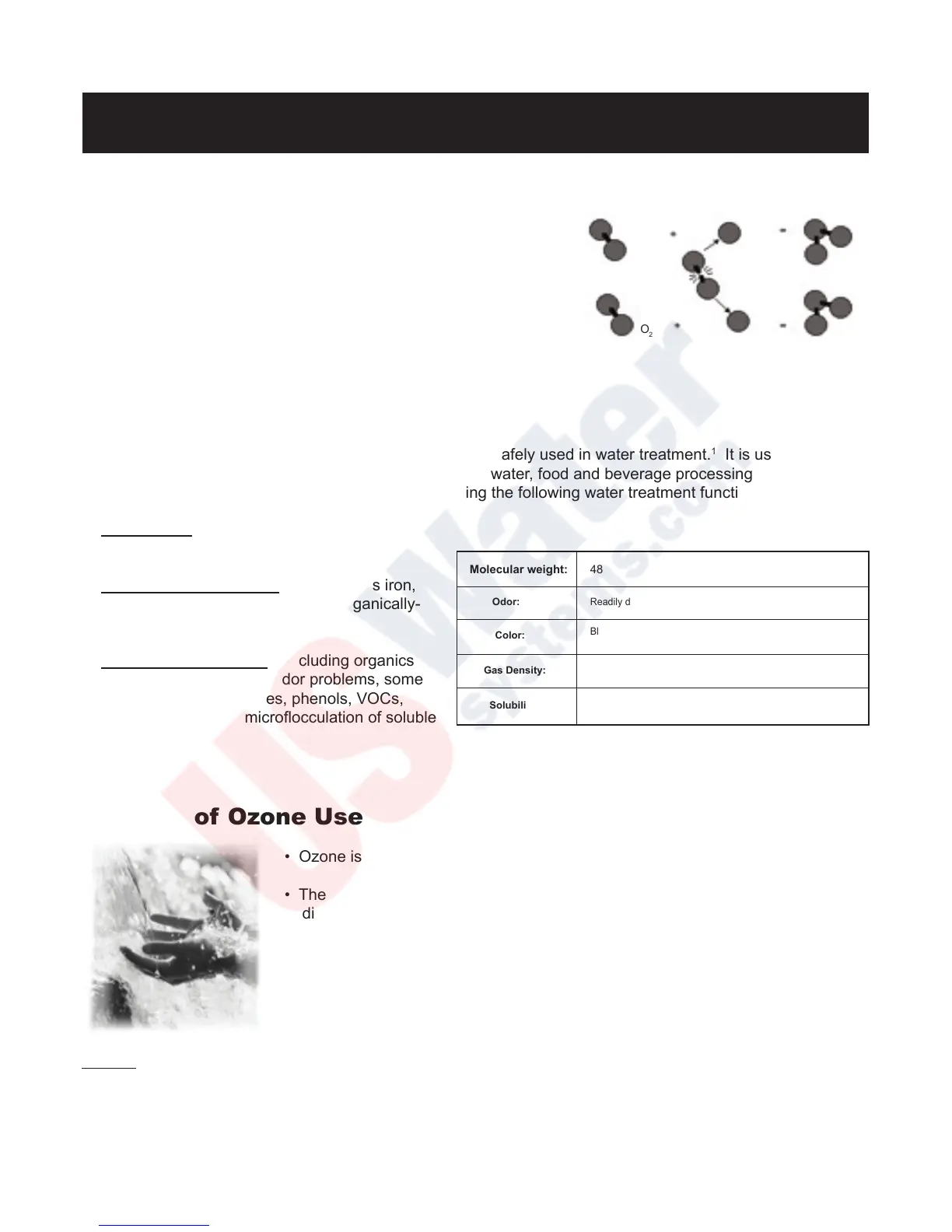
Ozone is generated by exposing oxygen molecules
(O
2
) in an air stream to a controlled, high energy
electrical eld. As the air stream passes through the
electrical eld produced inside the ozone
generator, some oxygen molecules are split, forming
single oxygen atoms (O
1
). These oxygen atoms then
recombine with other O
2
molecules in the air stream,
forming ozone (O
3
).
Ozone is the most powerful oxidizer available that can be safely used in water treatment.
1
It is used to treat
drinking water, bottled water, swimming pool water, wastewater, food and beverage processing water, and in
many other applications. Ozone is effective in performing the following water treatment functions:
O
1
O
2
O
3
Electrical Field
Oxygen (O
2
)
O
1
O
2
O
3
• Disinfection – Bacterial disinfection,
inactivation of viruses and cysts.
• Oxidation of Inorganics – Precipitates iron,
manganese, suldes, nitrites and organically-
bound heavy metals.
• Oxidation of Organics – Including organics
causing color, taste and odor problems, some
detergents and pesticides, phenols, VOCs,
turbidity control and microocculation of soluble
organics.
Ozone (O
3
)


 To Next Page
 Loading...