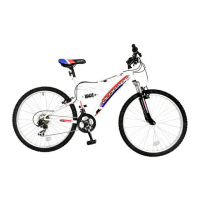
HANDLEBARS AND STEMS
As your cycle may be fitted with a standard ‘quill’ stem or an A-Head stem, you must always
check that all the bolts are tight before cycling.
Standard Stem: Loosen expander bolt so that expander wedge is not tight in bottom of
handlebar stem. Gently tap the top of the expander bolt to further loosen the wedge if
necessary. When the expander wedge is loose, move the handlebars up or down until you
find the optimum height at which you can easily reach the brake levers and comfortably
grasp the handlebars. Usually this height is level with, or slightly lower than, the top of the
saddle. Be sure the stem is in line with the front wheel.
When desirable height has been achieved, align the handlebar with the front wheel and
securely tighten expander bolt.
Caution: It is extremely important to tighten the expander bolt sufficiently, so that when
the wheel is held between your legs and the handlebars are twisted, the handlebars do not
move. Do not over tighten, as it may increase risk of injury to the rider. Position grip portion
of handlebars horizontally and securely tighten the binder bolt.
Note: Whenever the handlebar stem is removed from the head tube then the expander bolt
should be lightly greased.
A-Head stem: The height of the extension on A-head systems can be altered in 2 ways
either by disassembly of the bars and flipping the extension over. This gives a simple up or
down position of the extension angle or move the position of the extension spacers.
1. Remove compression cap and bolt.
2. Loosen clamp bolts that secure the extension to the steerer.
3. Remove the extension from steerer fit extra spacer washers or remove
them under the extension. This adjustment is limited as the compression bolt
must be able to engage the thread inside the steerer. Also the clamp bolts
must act onto the steerer directly.
4. If lowering the extension put the spacers you remove back on top of the
extension and under the compression cap. this saves re cutting the steerer.
5. Re tighten the compression cap to take slack up from the headset bearings.
6. Re tighten the steerer clamp bolts to lock everything in position.
Caution: Do not over tighten the top compression bolt, this should be pre-set to eliminate
bearing play, overtightening will cause premature wear.
If in doubt contact your retailer for service.
6mm Allen Key
Handlebar
Stem Bolt
(Allen Head)
Recessed Type
A-Head Type
Compression Bolt
Steerer
Clamp Bolts
Compression Cap
5 Star Washer
Stem Bolts
Extension
Spacers
Bearing Seat
Top cup with Bearings
inside
Minimum Insertion
Mark
Binder Bolt
Stem Expander
Bolt
Standard Stem
BRAKES
WARNING
For safe riding it is important to completely understand the operation of your bicycle’s
brake system. Improper use of your bicycle’s brake system may result in a loss of
control or an accident, which could lead to severe injury. Because each bicycle may
handle differently, be sure to learn the proper braking technique (including brake lever
pressure and bicycle control characteristics) and operation of your bicycle. This can
be done by consulting your professional bicycle dealer and this owner’s manual, and by
practicing your riding and braking technique.
There are two brake mechanisms working independently. One on the front wheel and
the other on the rear wheel. The brakes are operated by hand levers fastened to the
handlebars. The right lever controls the front brake and the left lever controls the rear
brake.
To stop with safety:
1. Operate the rear brake (left lever) slightly before the front brake (right lever).
2. Apply firm pressure to both front and rear brake levers.
Caution: If the front brake is applied with too much pressure, the rider may
be thrown off the bicycle.
3. Never apply the front brake on a turn. This is especially dangerous when
cornering or riding on slippery or loose surface roads.
4. Brakes are less effective in wet weather. Ride slower and allow more distance
for stopping.
5. Do not ride your bicycle if the braking system is not working correctly. If you are
in doubt, take your bicycle to your dealer.
Page 7
HANDLEBARS AND STEMS
As your cycle may be fitted with a standard ‘quill’ stem or an A-Head stem, you must always
check that all the bolts are tight before cycling.
Standard Stem: Loosen expander bolt so that expander wedge is not tight in bottom of
handlebar stem. Gently tap the top of the expander bolt to further loosen the wedge if
necessary. When the expander wedge is loose, move the handlebars up or down until you
find the optimum height at which you can easily reach the brake levers and comfortably
grasp the handlebars. Usually this height is level with, or slightly lower than, the top of the
saddle. Be sure the stem is in line with the front wheel.
When desirable height has been achieved, align the handlebar with the front wheel and
securely tighten expander bolt.
Caution: It is extremely important to tighten the expander bolt sufficiently, so that when
the wheel is held between your legs and the handlebars are twisted, the handlebars do not
move. Do not over tighten, as it may increase risk of injury to the rider. Position grip portion
of handlebars horizontally and securely tighten the binder bolt.
Note: Whenever the handlebar stem is removed from the head tube then the expander bolt
should be lightly greased.
A-Head stem: The height of the extension on A-head systems can be altered in 2 ways
either by disassembly of the bars and flipping the extension over. This gives a simple up or
down position of the extension angle or move the position of the extension spacers.
1. Remove compression cap and bolt.
2. Loosen clamp bolts that secure the extension to the steerer.
3. Remove the extension from steerer fit extra spacer washers or remove
them under the extension. This adjustment is limited as the compression bolt
must be able to engage the thread inside the steerer. Also the clamp bolts
must act onto the steerer directly.
4. If lowering the extension put the spacers you remove back on top of the
extension and under the compression cap. this saves re cutting the steerer.
5. Re tighten the compression cap to take slack up from the headset bearings.
6. Re tighten the steerer clamp bolts to lock everything in position.
Caution: Do not over tighten the top compression bolt, this should be pre-set to eliminate
bearing play, overtightening will cause premature wear.
If in doubt contact your retailer for service.


 To Next Page
 Loading...