APPENDIXC
DISKETTE FORMATS: GCRlMFM
Basically, the surface
of
a formatted diskette
is
divided into a number
of
concentric
circles called tracks. Each track
is
subdivided into sectors (also called blocks) and each
sector consists
of
a number
of
bytes. The number of tracks per diskette, sectors per track,
and bytes per sector depends on the type
of
recording format used.
The
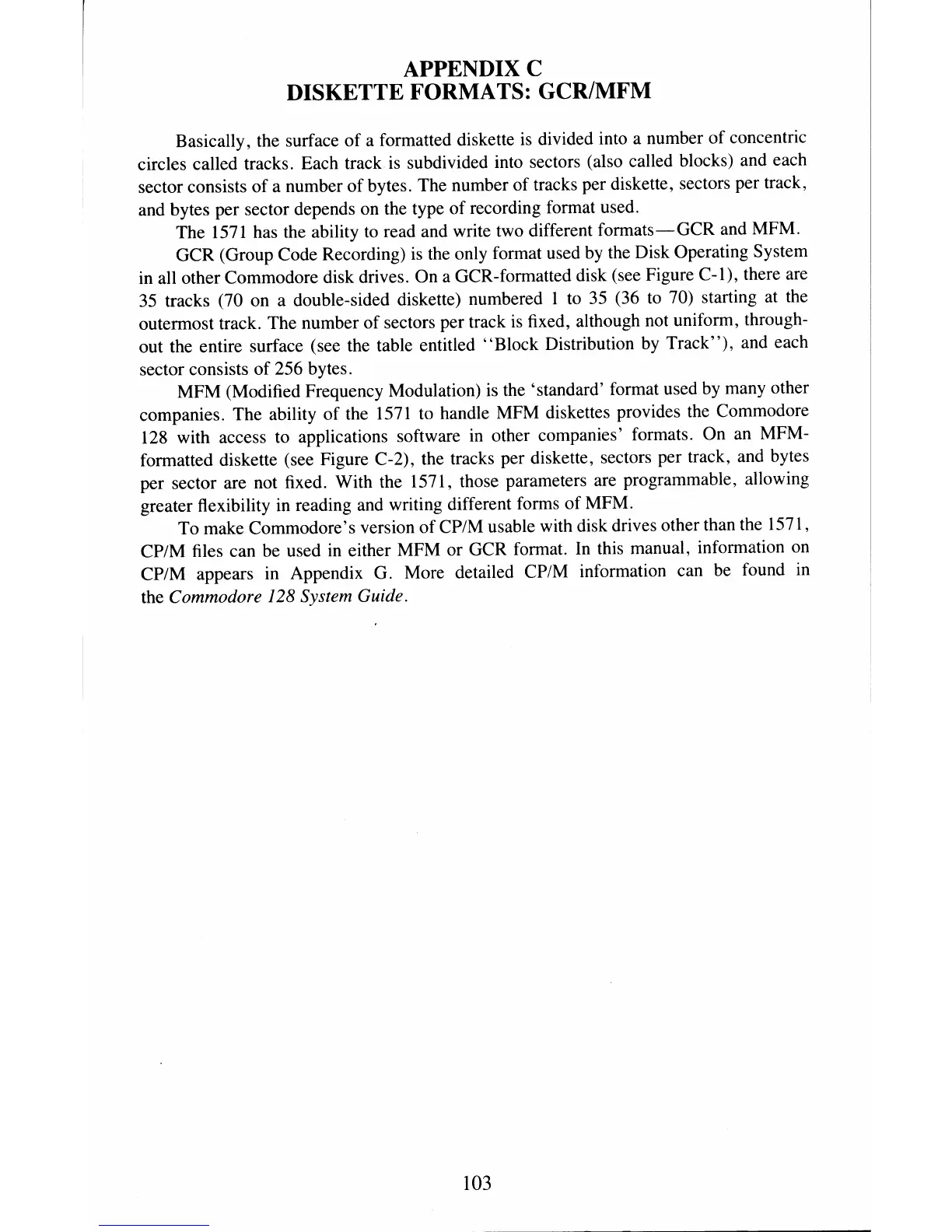
1571
has the ability
to
read and write two different
formats-GCR
and MFM.
GCR (Group Code Recording)
is
the only format used
by
the Disk Operating System
in all other Commodore disk drives. On a GCR-formatted disk (see Figure
C-l),
there are
35
tracks (70 on a double-sided diskette) numbered 1 to
35
(36
to
70) starting at the
outermost track. The number
of
sectors per track
is
fixed, although not uniform, through-
out the entire surface (see the table entitled "Block Distribution
by
Track"), and each
sector consists
of
256 bytes.
MFM (Modified Frequency Modulation)
is
the 'standard' format used by many other
companies. The ability
of
the
1571
to handle MFM diskettes provides the Commodore
128
with access to applications software
in
other companies' formats. On an MFM-
formatted diskette (see Figure C-2), the tracks per diskette, sectors per track, and bytes
per sector are not fixed. With the 1571, those parameters are programmable, allowing
greater flexibility in reading and writing different forms
of
MFM.
To make Commodore's version
of
CP/M usable with disk drives other than the 1571,
CP/M files can be used
in
either MFM or GCR format.
In
this manual, information
on
CP/M appears in Appendix G. More detailed CP/M information can be found in
the
Commodore 128 System Guide.
103


 To Next Page