CHAPTER 10
BURST COMMANDS
The Burst Command Instmction Set (BCIS)
is
a series of powerful, versatile, and
complex commands that enables the user to format, read, and write in numerous formats.
Burst commands are sent via kemal calls, but the handshaking
of
data
is
done
by
the user
for maximum performance. There is
no
parameter checking, so exercise care when using
the BCIS. For instance,
if
a burst read with an illegal track address
is
sent to a 1571, the
drive will noisily keep trying
to
find the invalid track. Reading and writing in other
formats is automatic if the commands are given in proper sequence. Please become
thoroughly familiar with all the commands and follow the examples given
in
this chapter.
It's important to follow the handshake conventions exactly for maximum performance.
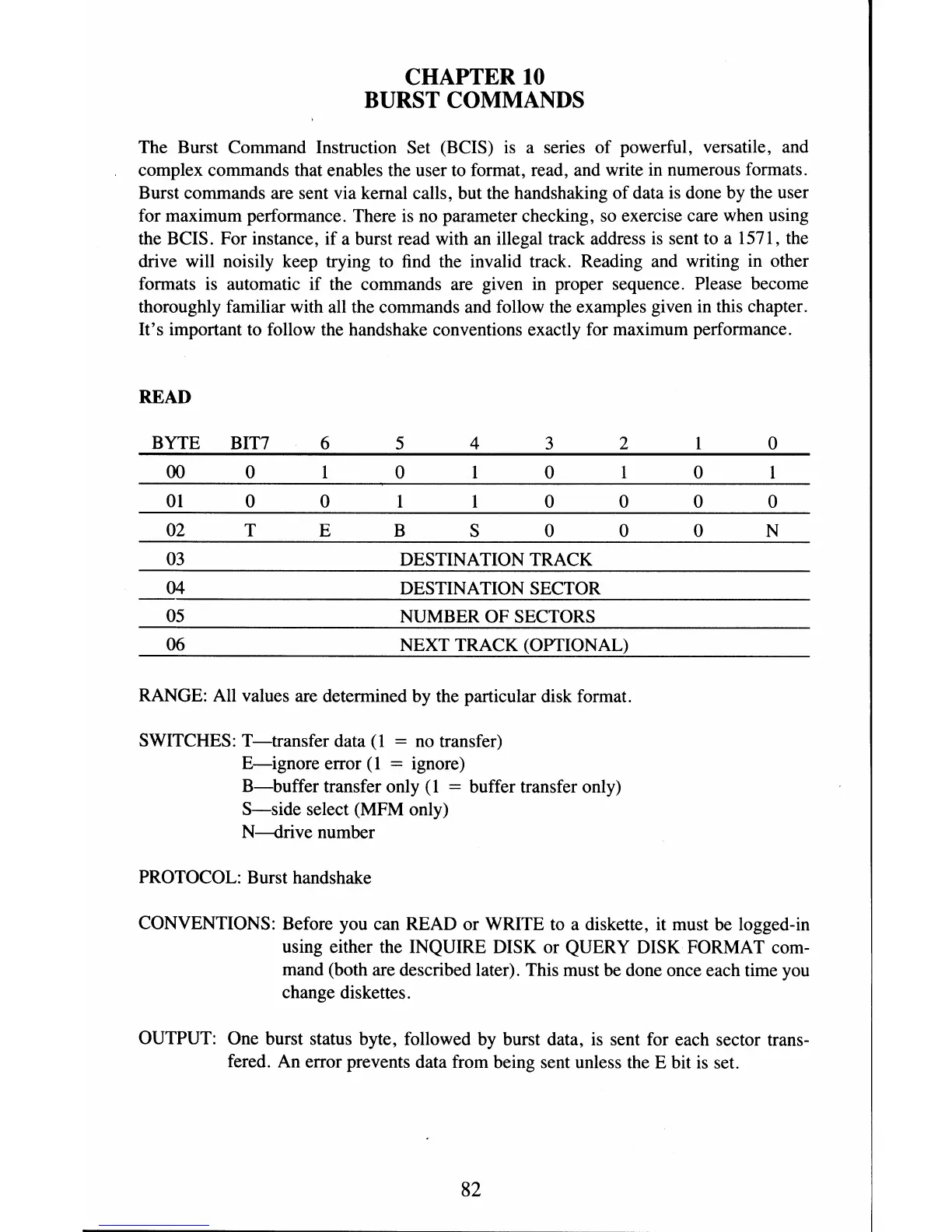
READ
BYTE BIT7 6
5
4
3
2
()()
0 1
0 1 0
1
01
0 0 0 0
02 T
E B S 0 0
03
DESTINATION TRACK
04
DESTINATION SECTOR
05
NUMBER OF SECTORS
06
NEXT TRACK (OPTIONAL)
RANGE: All values are determined by the particular disk format.
SWITCHES:
T-transfer
data
(1
=
no
transfer)
E-ignore
error
(1
= ignore)
B-buffer
transfer only
(1
= buffer transfer only)
S-side
select (MFM only)
N--<lrive number
PROTOCOL: Burst handshake
1
0
0
0 0
0 N
CONVENTIONS: Before you can READ or WRITE
to
a diskette, it must be logged-in
using either the INQUIRE DISK or QUERY DISK FORMAT com-
mand (both are described later). This must be done once each time you
change diskettes.
OUTPUT: One burst status byte, followed
by
burst data, is sent for each sector trans-
fered. An error prevents data from being sent unless the E bit
is
set.
82


 To Next Page