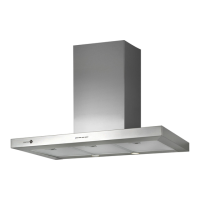
This manual describes the Controlair Decorative Hood, an extractor hood designed and manufactured exclusively for domestic use. It is available in different models, including 1M and 2M versions, and can be configured for either external fume extraction or recirculation with an activated charcoal filter.
Function Description
The Controlair Decorative Hood is designed to extract fumes and odors from the kitchen, ensuring a cleaner and more pleasant cooking environment. It operates by drawing air through grease filters, which capture grease particles, and can optionally pass the air through activated charcoal filters for odor removal before either expelling it outside or recirculating it back into the kitchen.
Important Technical Specifications
- Minimum Distance to Hob: For gas cooking appliances, the minimum distance from the hob to the hood must be at least 65 cm. If the hob supplier's manual specifies a greater height, that instruction should be followed.
- Ducting: For external fume evacuation, a rigid PVC pipe with a minimum diameter of Ø120 mm is recommended. It is advised to avoid bends in the outlet tube, and the distance between the hood outlet and any bend should be less than 1 meter. These restrictions do not apply to hoods used in recirculation mode (without external fume outlet).
- Electrical Connection: The hood requires an electrical supply matching the voltage and frequency indicated on its rating plate. If equipped with a plug, it should be connected to an accessible socket compliant with existing standards. If not equipped with a plug, it must be directly connected to the power grid via an accessible omnipolar separating device, in accordance with local regulations.
- Room Pressure: For optimal and safe performance, the room pressure should not drop by more than 4 Pa (0.04 mbar). Sufficient permanent air inlets must be provided to prevent the premises from being sealed, especially when a kitchen extractor hood and gas-fueled appliances are used simultaneously.
- Lighting: The hood includes lighting, which can be turned on and off. For LED lighting, direct eye contact with the light should be avoided. When replacing halogen bulbs, use bulbs with an aluminum reflector; dichroic bulbs should not be used due to the risk of overheating. For LED lamp replacements, contact technical support or the brand distributor.
- Fan Speeds: The hood offers multiple fan speeds (typically 1, 2, and 3) to adjust extraction power according to cooking needs.
Usage Features
The hood's operation is controlled via a control panel, which can be either a five-button panel (P1) or a sliding switch panel (P2).
Five-button panel (P1):
- 1 (Pilot Light): Indicates extractor fan operation.
- 2 (Lighting): Turns the lighting on and off.
- 3 (Extractor Off): Turns the extractor fan off.
- 4 (Speed Button): Selects extractor fan speeds 1, 2, and 3.
Sliding switch panel (P2):
- 1 (Speed Positions): Selects extractor fan speeds OFF, 1, 2, and 3.
- 2 (Pilot Light): Indicates extractor fan operation.
- 3 (Lighting Switch): Turns the lighting on and off.
Safety Precautions:
- Always ensure adequate ventilation in the room, especially when using gas or other fuel-burning appliances simultaneously with the hood.
- Do not connect the hood to other vents used for smoke, ventilation, or hot air from other appliances.
- Continuously monitor containers with hot oil to prevent fire hazards.
- Do not flambé food directly under the hood.
- Accessible parts of the hood may become hot when used with cooking appliances.
- In case of an electrostatic discharge (e.g., lightning), the hood may temporarily stop working. To reset, disconnect the power supply for one minute and then reconnect it.
- Children under 8 years old should be kept away from the appliance unless under permanent supervision. Children 8 years and older, and individuals with reduced physical, sensory, or mental capabilities, or lack of experience, can use the appliance if supervised and instructed on safe use and associated risks. Children should not play with the appliance, and cleaning/maintenance should not be performed by unsupervised children.
- If the power cable is damaged, it must be replaced by the manufacturer, its after-sales service, or similarly qualified personnel to avoid danger.
Maintenance Features
Regular maintenance is crucial for the hood's optimal performance and safety. Always switch off the electricity supply before performing any maintenance work.
- Exterior Cleaning: Use a liquid, non-corrosive detergent. Avoid abrasive cleaning products, solvents, high-pressure cleaning devices, or steam cleaning devices.
- Grease Filters (Fig. 5):
- To prevent fires, clean the grease filters thoroughly once a month or whenever the display pilot light indicates.
- Remove the filters and wash them with hot water and detergent.
- If using a dishwasher, load the filters vertically to prevent solid residue from accumulating. Metal parts may darken in a dishwasher, but this does not affect their functional capacity.
- Increase cleaning frequency if the hood is used for more than 2 hours a day.
- Always use genuine filters from the manufacturer.
- Activated Charcoal Filters (Fig. 7):
- These filters should be replaced every 3 months.
- Increase replacement frequency if the hood is used for more than 2 hours a day.
- Always use genuine filters from the manufacturer.
- Bulb Replacement (Fig. 6):
- Do not handle bulbs until the electricity supply has been switched off and they have cooled.
- Use new bulbs according to the specifications on the hood nameplate.
- For LED lamp replacements, contact Technical Support or the brand distributor.
In case of a fault, contact an official distributor or authorized dealer. The manufacturer reserves the right to make changes to the equipment or manual without prior notice. For technical assistance or additional information, contact your distributor or an official, authorized technical service.

 Need help?
 General

 To Next Page