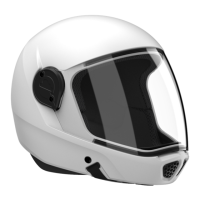
How to Adjust the Ventilation System
There are two sliding actuators in the front of the chinbar. Figure 9.
1. The ventilation that is directed toward the inside surface of the visor to aid in reducing fogging Air Flow A
2. The ventilation that is directed towards your mouth. Airow B
We advise that the upper vent slider Air Flow A is always in the open position when used for skydiving
specic activities Figure 10.
The Liner
Your G4 helmet features an unique liner. This liner can be replace
.Please visit www.ycookie.com for instructions on removing
and replacing your liner.
Caring for your G4 Helmet
Your G4 Helmet should be cleaned using water, mild detergent and a soft cloth. Ammonia and acid based
cleaning products should not be used at all. Any use of paints or adhesives can damage the exterior of the
helmet and reduce the helmets ability to provide protection. Please store your helmet away from direct
light or heat source as this can damage the helmet. When traveling we recommend using the helmets
original packaging.
An impact to the G4 helmet can cause damge even if there are not any visible signs. A damaged helmet
will not protect you against further impacts. If you suspect the helmet to have been damaged it must be
replaced immediately.
We recommend replacing your helmet afer every three years of use as we cannot guarantee that it will
oer sucient protection after this period. You must also replace your helmet if it is showing signs of
Cracking, Peeling and any Deformation. Childrens helmets should be replaced once they no longer t
Your should Always
1. Wear your G4 helmet low over your forehead and the chinstrap beneath your chin.
2.
Fasten your buckle and ensure the neck curtian is tight around the rear of your head and neck.
Adjust the Anchor Cord if required.
3. Make sure these adjustments are correct prior to use.
4. Store your helmet in a cool and dry place.
5. Replace your G4 helmet after and accident, even if no damage is shown.
6. Ensure the visor is tted and closed when wearing it for Skydiving or Flying in a Wind Tunnel.
7. Ensure your visor is clean befor use and replace it if it is dicult to see through or if the lens
begins to fog.
Your should Never
1. Wear a helmet that has been in an accident, even if no damage is shown.
2.
Wear a helmet with an unfastened chinstrap or if the neck curtain is loose around the rear of your head.
3. Wear this helmet for any activities that is not Skydiving or Wind Tunnel ying.
4. Clean this helmet with Chemical Cleaners.
5. Fit any non Cookie Composites accessory to the helmets shell.
Installing the Audible Altimeter
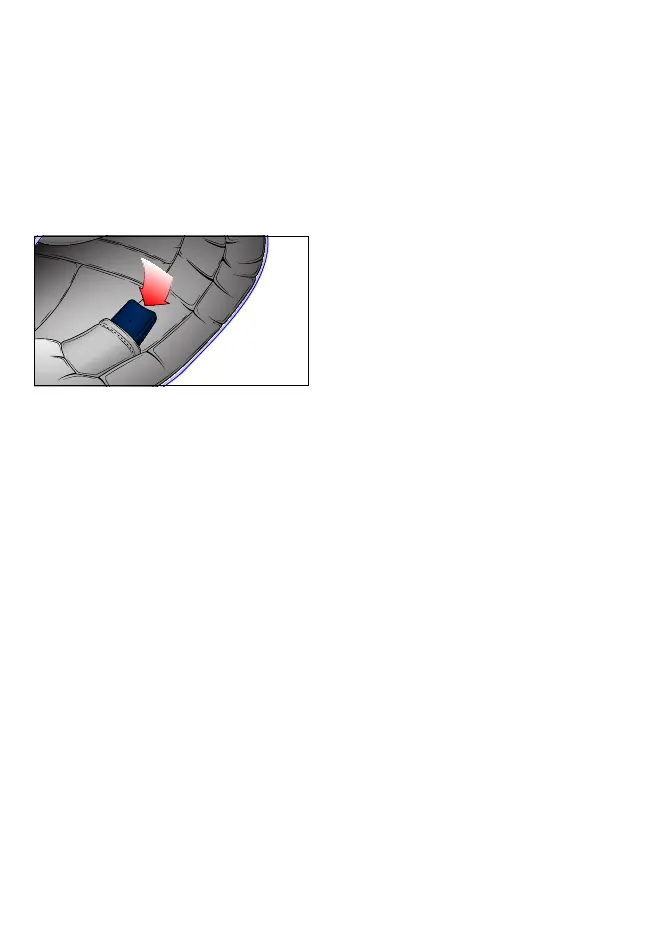
Install your audible altimeter into the pocket located over each ear
Figure 11.
Figure 9.
How to Open your G4 Visor
Place your index nger in position A on the top of visor locking plate
and your thumb on the bottom position B. Next you will need to push
the visor locking plate in the forward direction unlocking the mechansim.
Once you have moved the visor locking plate forward 9mm or 3/8 .inch [•)
you can now begin to rotate the visor locking plate in an upward direction.
It is best to do this with the G4 on your head. It may take a couple of tries to
perfect the movement and holding your elbows upwards in line with your
shoulders can assist with this movement. To close the visor, simply hold the
top of the visor and rotate downward. The visor will make a loud sound as it locks
into place and the springs return the visor to the locked position.
HELMET OWNER’S MANUAL
English
HELMET OWNER’S MANUAL
English
Figure 10.
A
A
B
A
Figure 11.
24 25
Il rivestimento
Il casco G4 presenta un rivestimento esclusivo
che può essere sostituito. Visitare il sito
Web www.flycookie.com per istruzioni sulla
rimozione e sostituzione del rivestimento.
Bisogna sempr
1. Indossare il casco G4 basso sulla fronte e la
cinghia per il mento sotto il mento.
2. Allacciare la fibbia e assicurarsi che la
protezione per il collo sia aderente intorno
alla parte posteriore della testa e del collo.
Regolare la cordicella di sicurezza,
se necessario.
3. Verificare che queste regolazioni siano
corrette prima dell’uso.
4. Conservare il casco in un luogo fresco
e asciutto.
5. Sostituire il casco G4 dopo un incidente,
anche se non sono visibili danni.
6. Assicurarsi che la visiera sia ben inserita e
chiusa quando si indossa il casco per attività
di paracadutismo o per volare in una galleria
del vento.
7. Verificare che la visiera sia pulita prima
dell’uso e sostituirla se la visibilità non è
chiara o la lente inizia ad appannarsi.
Non bisogna mai
1. Indossare un casco che è stato in un
incidente, anche se non vi sono danni visibili.
2. Indossare un casco con cinghia per il
mento non allacciata o protezione per il
collo allentata intorno alla parte posteriore
della testa.
3. Indossare il casco per attività che non
riguardino il paracadutismo o il volo in una
galleria del vento.
4. Pulire il casco con detergenti chimici.
5. Annettere accessori non prodotti da Cookie
Composites alla struttura del casco.
Manutenzione del casco G4
Il casco G4 deve essere pulito con acqua,
detergente delicato e un panno morbido. Non
utilizzare assolutamente prodotti per la pulizia
a base di ammoniaca e acido. Qualsiasi utilizzo
di vernici o adesivi può danneggiare la parte
esterna del casco e ridurre la capacità del
casco di fornire protezione. Conservare il casco
lontano dalla luce diretta o da fonti di calore,
per evitare di danneggiarlo. Durante i viaggi si
consiglia di utilizzare la confezione originale
del casco.
Se il casco G4 subisce un urto possono essere
riportati dei danni anche se non vi sono segni
visibili. Un casco danneggiato non è in grado
di proteggere contro ulteriori urti. Se si
sospetta che il casco sia stato danneggiato,
sostituirlo immediatamente.
Si consiglia di sostituire il casco ogni tre anni
di utilizzo poiché non possiamo garantire che
offrirà una protezione sufficiente dopo questo
periodo. È necessario sostituire il casco anche
se sono visibili segni di incrinatura, distacco e
di qualsiasi deformazione. I caschi per bambini
devono essere sostituiti quando le dimensioni
non sono più adeguate.
Installazione dell’altimetro udibile
Installare l’altimetro udibile nella tasca situata
su ogni orecchio. Figura 11.
Figura 11.
MANUALE DELL’UTENTE DE L CASCO
Italiano


 To Next Page
 Loading...