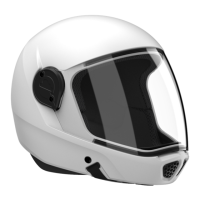
How to Adjust the Ventilation System
There are two sliding actuators in the front of the chinbar. Figure 9.
1. The ventilation that is directed toward the inside surface of the visor to aid in reducing fogging Air Flow A
2. The ventilation that is directed towards your mouth. Airow B
We advise that the upper vent slider Air Flow A is always in the open position when used for skydiving
specic activities Figure 10.
The Liner
Your G4 helmet features an unique liner. This liner can be replace
.Please visit www.ycookie.com for instructions on removing
and replacing your liner.
Caring for your G4 Helmet
Your G4 Helmet should be cleaned using water, mild detergent and a soft cloth. Ammonia and acid based
cleaning products should not be used at all. Any use of paints or adhesives can damage the exterior of the
helmet and reduce the helmets ability to provide protection. Please store your helmet away from direct
light or heat source as this can damage the helmet. When traveling we recommend using the helmets
original packaging.
An impact to the G4 helmet can cause damge even if there are not any visible signs. A damaged helmet
will not protect you against further impacts. If you suspect the helmet to have been damaged it must be
replaced immediately.
We recommend replacing your helmet afer every three years of use as we cannot guarantee that it will
oer sucient protection after this period. You must also replace your helmet if it is showing signs of
Cracking, Peeling and any Deformation. Childrens helmets should be replaced once they no longer t
Your should Always
1. Wear your G4 helmet low over your forehead and the chinstrap beneath your chin.
2.
Fasten your buckle and ensure the neck curtian is tight around the rear of your head and neck.
Adjust the Anchor Cord if required.
3. Make sure these adjustments are correct prior to use.
4. Store your helmet in a cool and dry place.
5. Replace your G4 helmet after and accident, even if no damage is shown.
6. Ensure the visor is tted and closed when wearing it for Skydiving or Flying in a Wind Tunnel.
7. Ensure your visor is clean befor use and replace it if it is dicult to see through or if the lens
begins to fog.
Your should Never
1. Wear a helmet that has been in an accident, even if no damage is shown.
2.
Wear a helmet with an unfastened chinstrap or if the neck curtain is loose around the rear of your head.
3. Wear this helmet for any activities that is not Skydiving or Wind Tunnel ying.
4. Clean this helmet with Chemical Cleaners.
5. Fit any non Cookie Composites accessory to the helmets shell.
Installing the Audible Altimeter
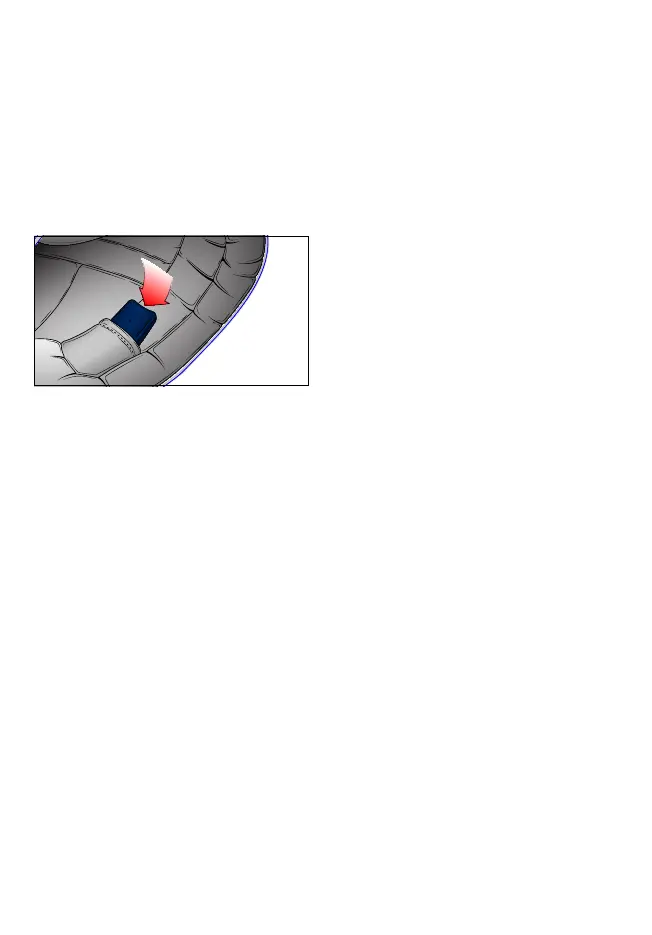
Install your audible altimeter into the pocket located over each ear
Figure 11.
Figure 9.
How to Open your G4 Visor
Place your index nger in position A on the top of visor locking plate
and your thumb on the bottom position B. Next you will need to push
the visor locking plate in the forward direction unlocking the mechansim.
Once you have moved the visor locking plate forward 9mm or 3/8 .inch [•)
you can now begin to rotate the visor locking plate in an upward direction.
It is best to do this with the G4 on your head. It may take a couple of tries to
perfect the movement and holding your elbows upwards in line with your
shoulders can assist with this movement. To close the visor, simply hold the
top of the visor and rotate downward. The visor will make a loud sound as it locks
into place and the springs return the visor to the locked position.
HELMET OWNER’S MANUAL
English
HELMET OWNER’S MANUAL
English
Figure 10.
A
A
B
A
Figure 11.
36 37
Figura 11.
Instalación del altímetro acústico
Instale el altímetro acústico en el bolsillo
ubicado por encima de cada oreja (figura 11).
Revestimiento
El casco G4 cuenta con un revestimiento único,
que se puede cambiar. Para obtener
instrucciones sobre la extracción y el cambio
del revestimiento, ingrese en
www.flycookie.com.
Siempre debe hacer lo siguiente
1. Colocarse el casco G4 hasta la parte baja
de la frente, con el barbiquejo por debajo
del mentón.
2. Abrochar la hebilla y verificar que el tapizado
del cuello quede apretado contra la parte
posterior de la cabeza y el cuello. Ajustar el
cordón del tirante, de ser necesario.
3. Asegurarse de que estos ajustes se hayan
hecho correctamente antes de usar el casco.
4. Guardar el casco en un lugar fresco y seco.
5. Cambiar el casco G4 luego de un accidente,
incluso si no se observan daños.
6. Comprobar que el visor esté ajustado
y cerrado al utilizarlo en actividades
de paracaidismo o de vuelo en túneles
aerodinámicos.
7. Verificar que el visor esté limpio antes de
usar el casco y cambiarlo si no permite ver
bien o si la pantalla se empieza a empañar.
Nunca debe hacer lo siguiente
1. Utilizar el casco luego de un accidente,
incluso si no se observan daños.
2. Utilizar el casco sin abrochar el barbiquejo
o si el tapizado del cuello queda suelto
alrededor de la parte posterior de la cabeza.
3. Utilizar el casco para actividades que
no sean de paracaidismo o de vuelo en
túneles aerodinámicos.
4. Limpiar el casco con productos químicos
de limpieza.
5. Colocar accesorios que no sean de Cookie
Composites en el armazón del casco.
Cuidado del casco G4
El casco G4 se debe limpiar con agua, un
detergente suave y un paño suave. No se
deben utilizar productos de limpieza a base de
amoníaco o ácidos en ninguna circunstancia.
El uso de pinturas o adhesivos puede dañar el
exterior del casco y reducir su capacidad de
protección. El casco se debe guardar lejos de
fuentes directas de luz o calor, ya que pueden
dañarlo. Para el traslado, se recomienda
utilizar el empaquetado original del casco.
Los impactos contra el casco G4 pueden
provocar daños, incluso si no hay ningún
indicio visible. Si el casco está dañado, no
ofrecerá protección contra futuros impactos.
Si sospecha que el casco ha sufrido algún
daño, debe cambiarlo de inmediato.
Se recomienda cambiar el casco luego de
tres años de uso, dado que no se puede
garantizar que proporcionará suficiente
protección una vez transcurrido ese período.
También se lo debe reemplazar si se observan
indicios de rajaduras, descascaramiento y
deformación. Los cascos para niños se deben
cambiar cuando ya sean demasiado pequeños
para su uso.
MANUAL PARA PROPIETARIOS DEL CASCO
Español


 To Next Page
 Loading...