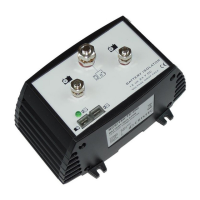
The Battery Isolator is an electronic device which is designed to distribute the charg
p between several (sets 01) batteries with the same nominal voltage. The Battery
Isolator prevents the current from flowing from one battery to another. The Bat
only be installed in the positive lead between the supplying source (for in
alternator) and the batteries. Therefore the negative output 01 the supplying source
the negative connections 01 the battery sets. The Battery Isolator has no
voltage drop when the batteries are fully charged. This is achieved by using the latest electronic
technologies, other diode splitters have at least a voltage drop 01 0,7 Volt and at a high c
current this voltage drop can reach 1,5 Volt. The voltage dro
p 01 the Battery Isolator will never
exceed 0,4 Volt at max amperage. At a charging current of 20 Amps per battery, the voltage dro
tery Isolator has therefore no influence on the charging characteristics of the
charger or the alternator. Diode compensation is not required to be ab
le to charge the batteries up
to 100%
English User Manual
is een elektronische laadstroomverdeler die op zeer betrouwbare wijze dient voor
het gelijktijdig en verliesarm laden van meerdere accugroepen van dezellde no
Battery Isolator beïnvloed de gunstige laadkarakteristiek van de aangeslote
niet, zodat de accu's direct met de juiste 'boostspanning' worden opgeladen. Er hoeft daarom geen
spanningscompensatie worden uitgevoerd, zoals bij con
ventionele scheidingsdiodes Door
toepassing van de Battery Isolator wordt voorkomen
dat de accugroepen elkaar kunnen ontladen. De
Battery Isolator is uitsluitend geschikt voor in
stallatie tussen de positieve uitgang van de acculader
en/of dynamo en de positieve aanslui
tingen van de beide accugroepen. Hierbij dienen de negatieve
der/dynamo en de negatieve aansluitingen van de accugroepen direct met
doorverbonden. Kostbare accuschakelaars en lasse onderhoudsladers op
iedere accuset
zijn hierdoor overbodig geworden
Nederlands Gebruikershandleiding
RCE/100 – 1E – 2IG
&
RCE/150 – 1E – 2IG
For 12 and 24 VDC systems Voltage drop free
Gebruikers handleiding,
Operation manual,
Betriebsanleitung,
Mode d'emploi
De IG-aansluiting kan gebruikt worden
Dm
bepaalde elektronisch geregelde dynamo's te la
met het laden van de accu's. Deze dynamo's moeten een spanning meten op de B+ aansluiting. Sluit
in deze situatie de IG aansluiting aan op de plus komend vanal het con
tact slot. Hierin is de MBI
wederom uniek in zijn soort.
Overtuig uzelf ervan dat de uitgang van de acculader/dynamo spanningsloos is gedurende de
installatiewerkzaamheden. Verbreek hiertoe aile elektrische verbindingen met de accula
en de accu's. Zorg er tevens voor dat er geen gebruikers zijn aangesloten op de accugroepen ter
voorkoming van onveilige situaties. Monteer de Battery Isolator zo dicht mogelijk bij zowel de
acculader/dynamo ais bij de accugroepen, maar nooit d
irect boven een accu i.v.m. mogelijke
corrosieve accudampen. De Battery Isolator kan warm worden ais ge
Installeer de Battery Isolator daarom op een goed geventileerde plaats, bij voorkeur op een vlakke
metalen ondergrond (nooit op de hoofdmotor), met de koelribben verticaal geplaatst.
Zie tekening voor de juiste wijze van aansluiten.
Monteer de negatieve aansluitingen van de
accugroepen en de acculader/dynamo op een gemeenschappelijk massa pu nt. De groene LED aan
n de Battery Isolator licht op wanneer er spanning op de ingang van de Battery
Isolator staat. De Battery Isolator detecteert automatisch de nominale laad
spanning (12V 01 24V). ln
tegenstelling tot conventionele scheidingsdiodes is er bij de Battery Isol
ator nauwelijks sprake van
spanningsverlies. Bij gebruik van de Battery Isolator dient de uitgangsspanning van voedingsbron
daarom NIET te worden verhoogd voor diodecom
pen satie. Ais de lader accuspanning moet
"proeven" alvorens te gaan laden, dan is deze vaak uitgevoerd met een z.g.n. sense-ingang.
Veiligheidsvoorschriften en
2. Installeer de Battery Isolator vol gens bovengenoemde instructies
3. Gebruik de Battery Isolator nooit op een locatie met gas- 01 stolontploffingsgevaar.
4.Aansluitingen en beveiligingen moeten in overeenstemming met de plaatselijk geldende
voorschriften worden uitgevoerd.
4. Gebruik kabels met voldoende draaddoorsnee en houd aile alstanden zo kart mogelijk. Gebruik
deugdelijke kabelschoenen en draai aile aansluitmoeren goed aan.
Fabrikant kan niet aansprakelijk worden gesteld voor:
• Schade ontstaan door het gebruik van de Battery Isolator
• Eventuele louten in bijbehorende handleiding en de gevolgen daarvan
• Ander gebruik geldend ais niet conlorm de bestemming van het product
De fabrikant garandeert dat de Battery Isolator is geproduceerd volgens de wettelijk van toe
zijnde normen en bepalingen. Gedurende de productie en voor aflevering zijn aile Battery Isolators
uitvoerig getest en gecontroleerd. Wanneer niet volgens de in deze hand
voorschriften, aanwijzingen en bepalingen wordt gehandeld, kunnen be
schadigingen ontstaan en/of
het apparaat zal niet aan de specificaties voldoen. Een en ander kan inhouden da
te vervallen. De garantietermijn is twee jaar.
Specifications
Type
Number of outputs
Max current
System voltage
Input voltage range
Insulation to ground
Operating tempe rature
Voltage drop
Dimensions (1 x h x d)
Weight
RCE/100 – 1E – 2IG
2
100
12-24VDC
8-30VDC
>500V@60 HZ
-40 to +85 °C
0.0V@10A /0.1 V@20A
146
x
85
x
97
mm
650
g
RCE/150 – 1E – 2IG
2
150
12-24VDC
8-30VDC
>500V@60 HZ
-40 to +85 °C
0.0V@10A /0.1 V@20A
146
x
85
x
97
mm
682
g
connection can be used to start modern electronic regulated alternators charging the
batteries. These alternators have ta measure a certain voltage at the B+ terminal. ln this case the
IG-connection has to be connected to the batteryvoltage coming fro
m the ignition key switch. This
is an other unique feature of the MBI.
Be sure that the output of the supplying source is switched off during installation. Disconnect ail
electrical connections to the charger/ alternator and the batteries. Al
so be sure that no consumers
are connected to the batteries during installation, to prevent hazardous situa
Battery Isolator not only as close as possible to the supplying source, but to the batteries as wel
but do not install The Battery Isolator straight above the batteries be
cause of possible corrosive
sulphur fumes. The Battery Isolator must be installed in a well
ventilated environment, as high
currents will heat up the Battery Isolator. Preferably, the battery isolator should b
flat metal surface (never directly to the main engine), with the fins vertical.
For correct connection see drawing. Connect the negative poles of the battery sets and the
supplying source to a common ground. When DC-power is available fr
Alternator, the green LED on top 01 the Battery Isolator illuminates
The Battery Isolator automatically detects the nominal charge voltage (12V or 24V). Unlike
convention al battery isolators, the Battery Isolator is almost free 01 voltage drops. Therefore,
when the Battery Isolator is applied, the output voltage 01 the supplying source should NOT be
increased for diode compensation. No internal or external settings are required.
Safety regulations and measures
1. Install the Battery Isolator according to the stated instructions.
2.Never use the Battery Isolator at a location where there is danger of gas or dust explosions.
3. Connections and safety features must be executed according to the locally applicable regulations.
4. Use cables with appropriate size wire and keep the cable connections as short as possible. Use
reliable terminals and fasten the bolts tightly, but do not over torque.
Manufacturer cannot be held liable for:
• Damage resulting from the use of the Battery Isolator.
• Possible errors in the included manual and the consequences of these.
The manufacturer guarantees that the Battery Isolator has been built according to
applicable standards and stipulations. During production and before delivery ail Battery Isola
were exhaustively tested and controlled. If you fail to act in accordance with the regula
instructions and stipulations of this user's manual, damage can occur and/or the unit will not fulf
specifications. This may mean that the guarantee will become null and void.
is 2 years.
Specifications
Type
Number of outputs
Max current
System voltage
Input voltage range
Insulation to ground
Operating temperature
Voltage drop
Dimensions (1 x h x d)
Weight
RCE/100 – 1E – 2IG
2
100
12-24VDC
8-30VDC
>500V@60 HZ
-40 to +85 °C
0.0V@10A /0.1 V@20A
146
x
85
x
97
mm
650 g
RCE/150 – 1E – 2IG
2
150
12-24VDC
8-30VDC
>500V@60 HZ
-40 to +85 °C
0.0V@10A /0.1 V@20A
146
x
85
x
97
mm
682
g
www.busse-yachtshop.de | info@busse-yachtshop.de


 To Next Page
 Need help?
 General