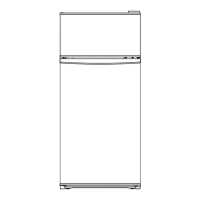
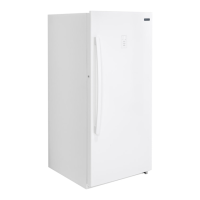
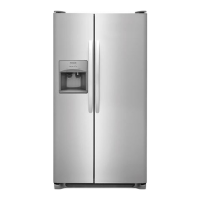
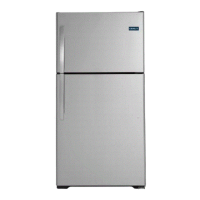
This document provides the installation and operation manual for Crosley refrigerators, specifically models CFDMH 1834 AW, CFDMH 1834 AB, and CFDMH1834AS. It covers safety warnings, proper usage, structure and functions, maintenance, and troubleshooting.
Function Description:
The Crosley refrigerator is designed for household use, primarily for storing foods. It features a refrigerating chamber and a freezing chamber. The refrigerating chamber is suitable for storing fruits, vegetables, beverages, and other short-term consumables. The freezing chamber is designed for long-term storage of frozen foods and ice making. The appliance operates on an air-cooling principle with automatic defrosting.
Important Technical Specifications:
The refrigerator dimensions are provided with a height of 67 inches to the top of the case, a width of 30 inches, a depth with the cabinet of 28 inches, a depth with the door of 31 inches, and a depth with the handle (not specified). When the door is open 90 degrees, the depth is 44 inches. When the door is open 135 degrees, the depth is 41 inches and the width is 40 inches.
The appliance uses a refrigerant and cyclopentane foaming material, both of which are flammable.
The temperature control panel includes LED lighting and indicators for different temperature settings and fault codes.
The refrigerating chamber offers temperature settings of 46°F, 40°F, and 36°F.
The freezing chamber offers temperature settings of 3.2°F, -2.2°F, and -11.2°F.
The appliance is designed for freestanding installation and is not intended to be used as a built-in appliance.
LED lamps are used for lighting, and any replacement or maintenance of these lamps must be performed by the manufacturer, its service agent, or similarly qualified personnel.
Usage Features:
- Placement: The refrigerator should be placed in a well-ventilated indoor area on a flat, sturdy surface. It should be kept away from heat sources and direct sunlight. A clearance of greater than 12 inches at the top, more than 4 inches on the sides, and no less than 3 inches at the back from the wall is recommended for proper heat dissipation. The appliance should not be sprayed or washed with water.
- Leveling: The refrigerator is equipped with leveling feet. These can be adjusted by turning clockwise to raise or counterclockwise to lower the appliance, ensuring a horizontal level.
- Starting: After transportation, the refrigerator should remain stationary for at least 2 hours before being plugged in. Before storing any food, it should run for 2-3 hours, or for over 4 hours in high ambient temperatures (summer). In case of power failure or cleaning, the plug should be pulled out, and the freezer should not be reconnected to power within five minutes to prevent compressor damage.
- Temperature Control: The refrigerating and freezing chambers have separate temperature settings, adjustable via dedicated thermostat buttons. Pressing the respective key cycles through the available temperature gears.
- Door Alarm: If the freezer or refrigerator door remains open for 120 seconds, a buzzer alarm will sound until the door is closed or the alarm is canceled by pressing the alarm off key.
- Standby Mode: The appliance can be put into standby mode by pressing the alarm off key for 3 seconds, which turns off all loads and the display. Long pressing the alarm off key for 3 seconds again will return it to normal control.
- Food Storage: Cooked foods should be cooled to room temperature before being placed in the refrigerating chamber. Foods are recommended to be sealed. Glass shelves can be adjusted for optimal storage space. In the freezing chamber, meat chunks should be divided into small pieces for easy access and consumed within the shelf life. Overloading the appliance or blocking air outlets can adversely affect freezing efficiency.
- Energy Saving Tips: Locate the appliance in the coolest area of the room, away from heat sources and direct sunlight. Allow hot foods to cool before placing them inside. Wrap foods properly and wipe containers dry to prevent frost buildup. Avoid lining storage bins with aluminum foil, wax paper, or paper toweling, as this interferes with cold air circulation. Organize and label food to reduce door openings and extended searches.
- Door Leveling: If the doors are not level, a supplied fastener-ring can be inserted using pliers in the gap between the hinge-grommet and the lower hinge to raise the lower door to the level of the higher door.
- Door Disassembly: Instructions are provided for disassembling the refrigerator door (removing screws from the hinge cover and upper hinge) and the freezing door (removing the freezing drawer and screws from the slideway support).
Maintenance Features:
- Overall Cleaning: Regular cleaning of dust behind the refrigerator and on the ground is recommended for improved cooling and energy efficiency. The door gasket should be checked and cleaned with a soft cloth dampened with soapy water or diluted detergent. The interior should be cleaned regularly to prevent odors, using a soft cloth or sponge with a solution of baking soda and warm water. After cleaning, the door should be left open to air dry. Areas difficult to clean should be wiped with a soft rag or brush. Avoid using soap, detergent, scrub powder, spray cleaner, hard brushes, steel balls, wire brushes, abrasives, organic solvents, boiling water, acid, or alkaline items, as these can damage the fridge's surfaces and plastic parts. Do not rinse directly with water to avoid short circuits.
- Defrosting: The refrigerator has an automatic defrosting function. Frost formed due to seasonal or temperature changes can be manually removed by disconnecting power and wiping with a dry towel.
- Door Tray Cleaning: Door trays can be removed by squeezing them with both hands and pushing upward. After washing, they can be reinstalled, and their height adjusted as needed.
- Glass Shelf Cleaning: Glass shelves can be removed by lifting them up and pulling them outward, allowing for adjustment or cleaning.
- Box Gall Bottom Roller Groove Cleaning: The fruit and vegetable box can be removed by lifting it upward. The roller seat, which is stuck in the box tank groove, can be removed by pressing in the direction of the arrow in the image, allowing for cleaning of the groove.
- Out of Operation: In case of power failure, minimize door openings and avoid adding fresh food. For long-term non-use, unplug, clean, and leave the doors open to prevent odors. When moving the refrigerator, secure all internal components with tape, tighten leveling feet, and tape the doors closed. The appliance should not be laid upside down or horizontally and should not be vibrated, with an inclination of no more than 45 degrees during movement.
- Troubleshooting: A troubleshooting guide is provided for common issues such as failed operation, odor, continuous compressor operation, light failure, doors not closing properly, loud noise, loose door seal, water pan overflow, hot housing, surface condensation, and abnormal noise. Users are advised to contact the after-sales department if problems persist.
Safety Warnings:
The manual emphasizes several safety warnings, including:
- Risk of Fire/Flammable Materials: The appliance uses flammable refrigerant and foaming material. It should be kept away from fire sources during disposal.
- Electrical Safety: Do not pull the power cord directly from the socket; grasp the plug firmly. Do not damage or use a damaged power cord. Use a dedicated, grounded power socket. Do not unplug the refrigerator or other electrical appliances in case of gas leakage, as sparks may cause fire.
- Ventilation: Keep ventilation openings clear of obstruction.
- Defrosting: Do not use mechanical devices or other means to accelerate defrosting other than those recommended by the manufacturer.
- Refrigerant Circuit: Do not damage the refrigerant circuit.
- Electrical Appliances: Do not use electrical appliances inside food storage compartments unless they are of the type recommended by the manufacturer.
- Child Safety: Children should be supervised to ensure they do not play with the appliance. Keys for locks on doors or lids should be kept out of reach of children. Before disposing of an old refrigerator, remove doors and leave shelves in place to prevent child entrapment.
- Stability: The appliance must be fixed in accordance with instructions to avoid instability.
- Flammable Substances: Do not store explosive substances like aerosol cans with flammable propellants. Do not place flammable, explosive, volatile, or highly corrosive items in the refrigerator or near it.
- Heavy Objects: Do not place heavy objects on top of the refrigerator to prevent accidental injuries.
- Wet Hands: Do not pick up foods or containers with wet hands from the freezing chamber to avoid frostbite.
- Maintenance: Maintenance must be conducted by a specialist. Damaged power cords must be replaced by the manufacturer or qualified professionals.
- Water Supply: Connect to potable water supply only (for ice making machines).
- Door Gaps: Be cautious of small gaps between doors and the refrigerator body to avoid finger squeezing.
- Disposal: Dispose of the product responsibly according to local regulations for environmental safety, disassembling doors and removing gaskets and shelves to prevent child entrapment.
The manual includes a warranty statement, covering one year for parts and labor, with exclusions for consequential damages, service calls not involving malfunctions, damages from unauthorized servicers or parts, and products with altered serial numbers.

 Need help?
 General

 To Next Page