Monday, August 10 200 9 2/2 TD20090810 – V03
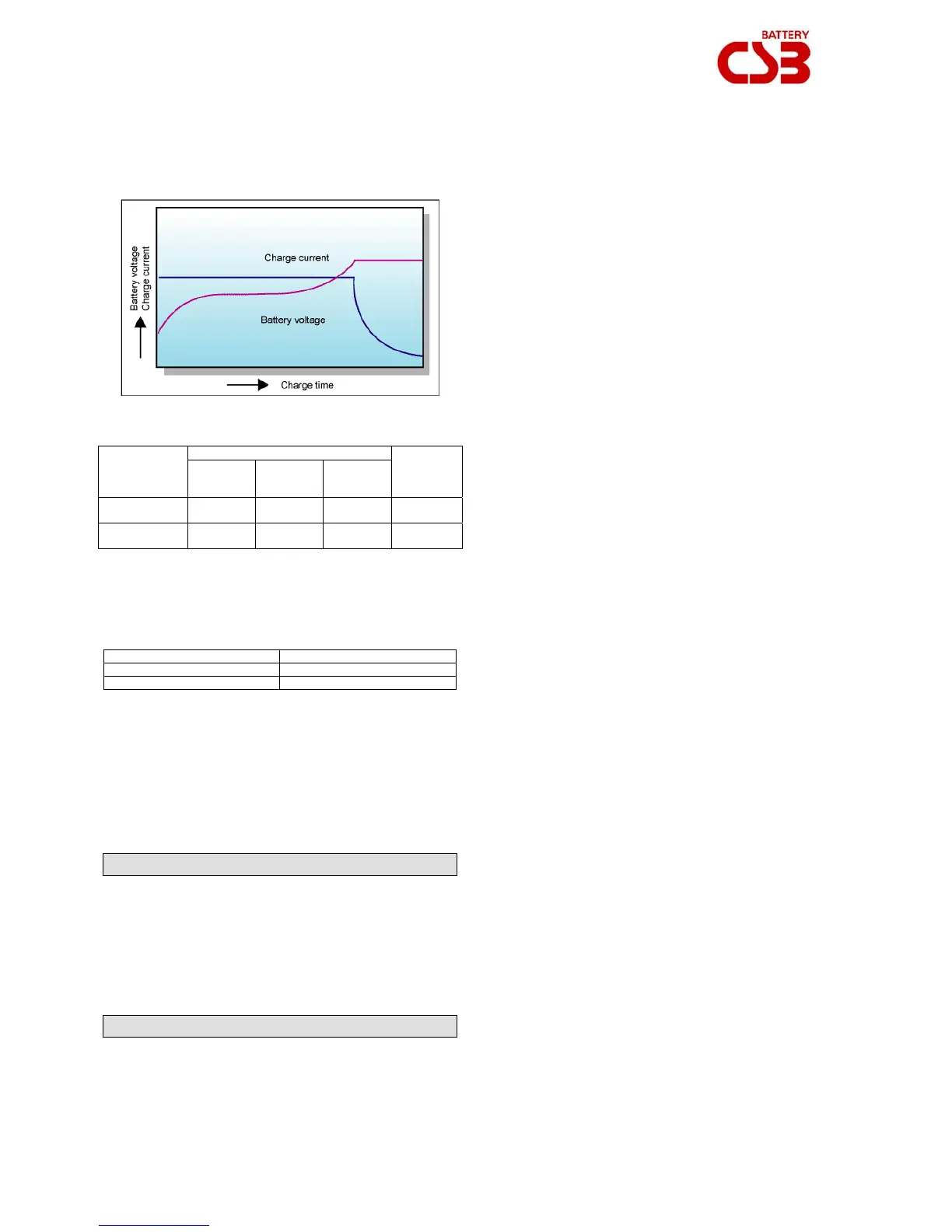
different voltage between its voltage and battery voltage. The
charging current is initially large and decreases towards the end of
charging. It is necessary to set the charging voltage according to
battery charging and temperature characteristics. Inaccurate voltage
causes an overcharge or an undercharge.
Graph 1 : Constant Voltage Characteristics.
Initial charging current should be 0.3CA or less, min 0.1CA.
Table 4 : Charge voltage and maximum charge current.
Charging voltage in V/Cell
Applications
Temp.
in °C (°F)
Set point
Allowable
range
Max
charging
current
in A
Cycle service
25ºC
(77ºF)
2.45
2.40 ~ 2.50
0.3CA
Standby
25ºC
(77ºF)
2.275
2.25 ~ 2.30
0.3CA
Temperature compensation is not necessary when the battery is
charged at an ambient temperature between 5°C (41°F) to 35°C
(95°F), with average temperature below 25°C (77°F). At temperatures
below 5°C (41°F) or above 35°C (95°F), temperature compensation
for charging voltage is necessary.
Table 5 : Temperature coefficient.
Applications Temperature coefficient
Cycle service -5mV/ºC/cell
Standby -3.3mV/ºC/cell
When batteries are used in serial, a single current is imposed on all
the cells. However, if the voltages begin to differ, the result is a
charge imbalance. To restore balance or at least prevent it from
growing, equalization charging is required. Equalization charging
characteristics are a constant voltage of 2.45 V/cell for 5 to 8 hours.
More sophisticated charging methods are available : constant-
current, constant-voltage charging method, semi-constant current
charging method, constant current charging method, multi-steps
charging method, high frequency pulse charging method. Please
contact CSB Technical Support for more details.
8. Discharging.
• The continuous discharge and maximum discharge current (for 5
Seconds) should never exceed the values shown in Product
Specifications.
• Never discharge the battery until the voltage and current are less
than the values shown in Product Specifications. Repeated over
discharge will shorten the battery's life.
• After discharging, immediately recharge the battery. Never leave it
discharged. The capacity to hold a charge may not be recovered if
the battery is left discharged for a long period.
9. Periodic Inspections & Maintenance.
For optimum reliability, it is recommended that the battery system be
monitored quarterly. If the battery system incorporates an automatic
monitoring system to gather the electrical and environmental data,
the quarterly checks are limited to the evaluation of the recorded data
and a visual inspection of the battery.
In general the types of inspections to be made during periodic
maintenance include :
• Visual battery inspection,
• Battery system capacity test,
• Battery system voltage inspection,
• Ambient temperature,
• Individual battery float voltage inspection,
• High rate load test,
• Electrical resistance and tightness of inter-unit connections.
A test of the individual unit resistance, impedance or
conductance,
while optional, is also recommended on a periodic basis. This data
and its trends can be a valuable aid in troubleshooting the system
and predicting the need for a system capacity test.
Prior to starting the periodic maintenance activity assure that all the
required maintenance tools and equipment is available and
functional. Notify anyone who will be affected by the intended
maintenance or troubleshooting activity.
All units in the battery should be numbered so as to facilitate the
recording and analysis of data unique to each unit.
9.1 Quarterly VRLA Battery Inspection
• Assure the battery room is clean, free of debris and with proper
lighting.
• Assure that all facility safety equipment is available and functional.
• Measure and record the air temperature within the battery room.
• Visually inspect the battery for :
o Cleanliness,
o Terminal damage or evidence of heating,
o Container or cover damage.
• Measure the DC voltage from each polarity of the battery to
ground and detect any ground faults.
• Measure and record the individual unit DC float charging voltage,
and current.
• Measure and record the system equalization voltage, and current.
• Measure and record the temperature of the battery cabinet
inspections.
9.1 Semiannual VRLA Battery Inspection
• Repeat the quarterly inspection.
• Randomly measure and record the resistance/conductance of the
individual units to trend the condition of the individual units over
time and to detect dramatic differences between individual units
and the average.
9.3 Annual VRLA Battery Inspection
• Repeat the semiannual inspection
• Re-torque all of the inter-unit connecting hardware. This can be
omitted if the connection resistance is measured and found to
have not increased more than 20% from the value recorded at
installation



 To Previous Page
 Loading...