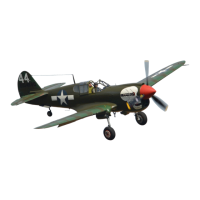
ailerons have a stressed metal skin leading edge and are fabric covered.
The flaps are of the split trailing edge type, extending from the aileron
to near the centerline of the airplane and are operated hydraulically by
an electrically driven pump or by an emergency hand pump. An indicator on
the instrument boards shows the position of the flaps at all times when
the battery switch is on.
4. Cooling system - Air passing through prestone radiators and oil cooler
and exhausting into a common exit duct. Airflow through this duct is
controlled by cowl flaps operated by a lever on the starboard side of the
cockpit with a locking device incorporated.
5. Wing Guns - Two rifle caliber guns may be carried in each panel. Wing
gun charging handles are located on the centerline of the airplane beneath
the instrument panel. Ammunition boxes hold 500 rounds per gun. The
trigger switch is located on the stick.
6. Fuel Tanks - The fuel is carried in three tanks two in the center of
the wing and one in the fuselage aft of the pilot. The total capacity of
the three tanks is 132.6 imperial gallons. (See fuel system diagram.) All
fuel tanks have "Superflexit" covering. [DF: See Erik's comments in Part
II about fuel tanks. The reference to Superflexit suggests that the
Tomahawk IIB had an exterior membranes. I earlier believed that this was a
mistaken carry-over from the I or IIA manual, but it tracks with Erik's
recollection.]
Oil Tank - Oil is carried in a 12.7 imperial gallon tank in the fuselage
behind and above the fuselage fuel tank. Climbs up to 60° and dives up to
90° should be performed only with not less than 1/3 of the maximum oil
capacity. The tank should be refilled to 9.6 imperial gallons maximum
service capacity at all times.
Coolant Tank - The coolant expansion tank is forward of the firewall and
has a capacity of two imperial gallons.
7. The fuselage is of semi-monocoque, skin stressed construction, and has
a motor mount of welded steel tube and steel forged links. The fuselage
access door is on the port side of the fuselage near the tail.
Updated:
8. Fuselage Guns - Two synchronized guns may be carried just
ahead of the pilot. These are .50 caliber Colt guns, and are charged
directly through an opening on each side of the instrument panel.
Electrically operated rounds indicator are mounted near the instrument
board on the upper longeron. The gun triggers are electrically operated by
a selector switch located above the port longeron, and the trigger switch
is located on the stick. Ammunition boxes hold 380 rounds per gun.
9. Battery - a 34 ampere hours capacity, 24 volt battery is carried in the
airplane and is accessible through the fuselage access door.
10. Landing Gear - The landing gear is equipped with oleo-pneumatic shock
struts which are hydraulically retracted to rotating backward about a
trunion at the top of the strut. During retraction the strut is rotated
90° about its longitudinal axis by gears, so that the wheel lies flush in
the wing. The gear is locked in both the up and down positions by
hydraulically operated mechanical locks. The upper half of the strut has
members attached to take side and drag loads and is attached to the lower
half of strut through a scissors to take torque. The landing gear is
equipped with 30 inch diameter smooth contour tires and wheels with 12 x 2
1/4 inch hydraulic brakes. An indicator on the instrument panel shows the
position of the landing gear at all times when main battery switch is
turned on.


 To Next Page
 Loading...