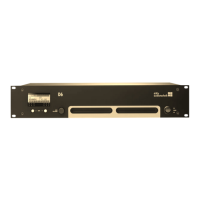
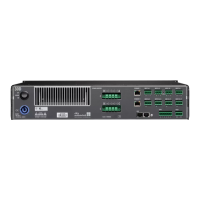
6.2.6. GPIOs (Hardware description)
Up to five opto-coupled GPIO pins [6] (General Purpose Input
Output) are available as additional digital control lines which can
be configured to be input or output (In/Out). This enables external
control and detection functions.
Configuration
Each GPIO can be defined as an input or output and combined
with either level (Hi/Lo active - non-latching) or edge (rising/falling
- latching) triggering.
A detailed description on how to configure the GPIOs and assign
the available software objects (Function) correspondingly is given
in Þ Chapter 12.5.4. "GPIOs (Configuration)" on page 55.
Note: When configuring a GPIO contact either as an input
(GPI) or as an output (GPO), observe the following:
▪ An external DC power supply is required.
▪ GPI: The corresponding pin is connected via an opto-
coupler with a serial resistance of 5.4 kΩ.
▪ GPO: The corresponding pin is connected to ground
(GND) via a relay (Low-Side-Switch).
Make sure the current per pin (GPO) does not exceed 1 A.
Technical specifications
External power supply
24 V DC (±25% / 18 V DC – 30 V DC)
Power capacity up to 150 W
GPIO connector 1 x 6-pin Phoenix Euroblock male
Pin assignment GND ( ) / GPIOs 1 – 5, In/Out
GPI Opto-coupled (galvanic isolation)
Serial resistance: 5.4 kΩ
Diode forward bias: 1.2 V
Input current draw per pin @18/24/30 V DC: 3/4/5 mA
GPO Low-Side-Switch-Relay
Current carrying capacity per pin: 1 A / Total: 5 A
6.2.7. FAULT contact
An additional 3-pin Phoenix Euroblock fault contact [7] is provided
allowing a general device error to be remotely indicated.
Note: The assignment of the corresponding software object is
fixed and cannot be changed by the user.
NO
Normally Open
C Common
NC Normally Closed
GPIOs
Schematic circuit diagram
FAULT contact
Schematic circuit diagram and switching status:
a) Device is On and operating
b) Device is Off or device error
d&b 10D/30D Manual 1.10 en18



 To Next Page
 Loading...