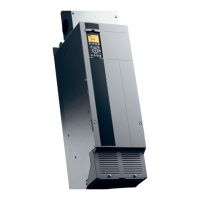
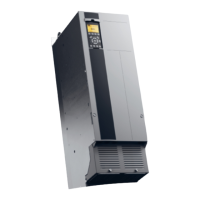
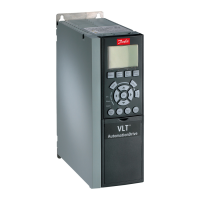
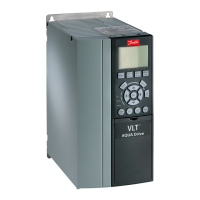
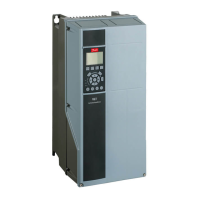
Mounting considerations:
•
Locate the unit as near to the motor as possible.
See chapter 7.6 Cable Specications for the
maximum motor cable length.
•
Ensure unit stability by mounting the unit to a
solid surface.
•
Ensure that the strength of the mounting location
supports the unit weight.
•
Ensure that there is enough space around the
unit for proper cooling. Refer to chapter 5.7 Back-
channel Cooling Overview.
•
Ensure enough access to open the door.
•
Ensure cable entry from the bottom.
9.5 Cooling
NOTICE
Improper mounting can result in overheating and
reduced performance. For proper mounting, refer to
chapter 9.4 Mounting Congurations.
•
Ensure that top and bottom clearance for air
cooling is provided. Clearance requirement:
225 mm (9 in).
•
Provide sucient airow ow rate. See Table 9.2.
•
Consider derating for temperatures starting
between 45 °C (113 °F) and 50 °C (122 °F) and
elevation 1000 m (3300 ft) above sea level. See
chapter 9.6 Derating for detailed information on
derating.
The drive utilizes a back-channel cooling concept that
removes heat sink cooling air. The heat sink cooling air
carries approximately 90% of the heat out of the back
channel of the drive. Redirect the back-channel air from
the panel or room by using:
•
Duct cooling
Back-channel cooling kits are available to direct
the heat sink cooling air out of the panel when
IP20/Chassis drives are installed in Rittal
enclosures. Use of these kits reduce the heat in
the panel and smaller door fans can be specied.
•
Back-wall cooling
Installing top and base covers to the unit allows
the back-channel cooling air to be ventilated out
of the room.
NOTICE
For E3h and E4h enclosures (IP20/Chassis), at least 1
door fan is required on the enclosure to remove the heat
not contained in the back-channel of the drive. It also
removes any additional losses generated by other
components inside the drive. To select the appropriate
fan size, calculate the total required airow.
Secure the necessary airow over the heat sink.
Frame Door fan/top fan
[m
3
/hr (cfm)]
Heat sink fan
[m
3
/hr (cfm)]
D1h 102 (60) 420 (250)
D2h 204 (120) 840 (500)
D3h 102 (60) 420 (250)
D4h 204 (120) 840 (500)
D5h 102 (60) 420 (250)
D6h 102 (60) 420 (250)
D7h 204 (120) 840 (500)
D8h 204 (120) 840 (500)
Table 9.2 D1h–D8h Airow Rate
Frame Door fan/top fan
[m
3
/hr (cfm)]
Heat sink fan
[m
3
/hr (cfm)]
E1h 510 (300) 994 (585)
E2h 552 (325) 1053–1206 (620–710)
E3h 595 (350) 994 (585)
E4h 629 (370) 1053–1206 (620–710)
Table 9.3 E1h–E4h Airow Rate
9.6
Derating
Derating is a method used to reduce output current to
avoid tripping the drive when high temperatures are
reached within the enclosure. If certain extreme operating
conditions are expected, a higher-powered drive can be
selected to eliminate the need for derating. This is called
manual derating. Otherwise, the drive automatically
derates the output current to eliminate the excessive heat
generated by extreme conditions.
Manual derating
When the following conditions are present, Danfoss
recommends selecting a drive 1 power size higher (for
example P710 instead of P630):
•
Low-speed – continuous operation at low RPM in
constant torque applications.
•
Low air pressure – operating at altitudes above
1000 m (3281 ft).
•
High ambient temperature – operating at
ambient temperatures of 10 °C (50 °F).
•
High switching frequency.
•
Long motor cables.
•
Cables with a large cross-section.
Mechanical Installation Con... VLT® AutomationDrive FC 302
140 Danfoss A/S © 01/2018 All rights reserved. MG38C202
99


 To Next Page
 Loading...