A27
A3.3
OPTION
12 AC ASSEMBLY
(Circuit
Drawing No.
430552)
(For
OPTION
10 see
page
27)
A3.3.1 General
Principles
The
preamplifier buffers
and
ranges
the signal in
order to present
0.9 volts full range
to the AC to DC
converter
section.
Once
converted to an equivalent
DC
signal, it is
applied
to the analog to digital converter on
the
main
analog assembly.
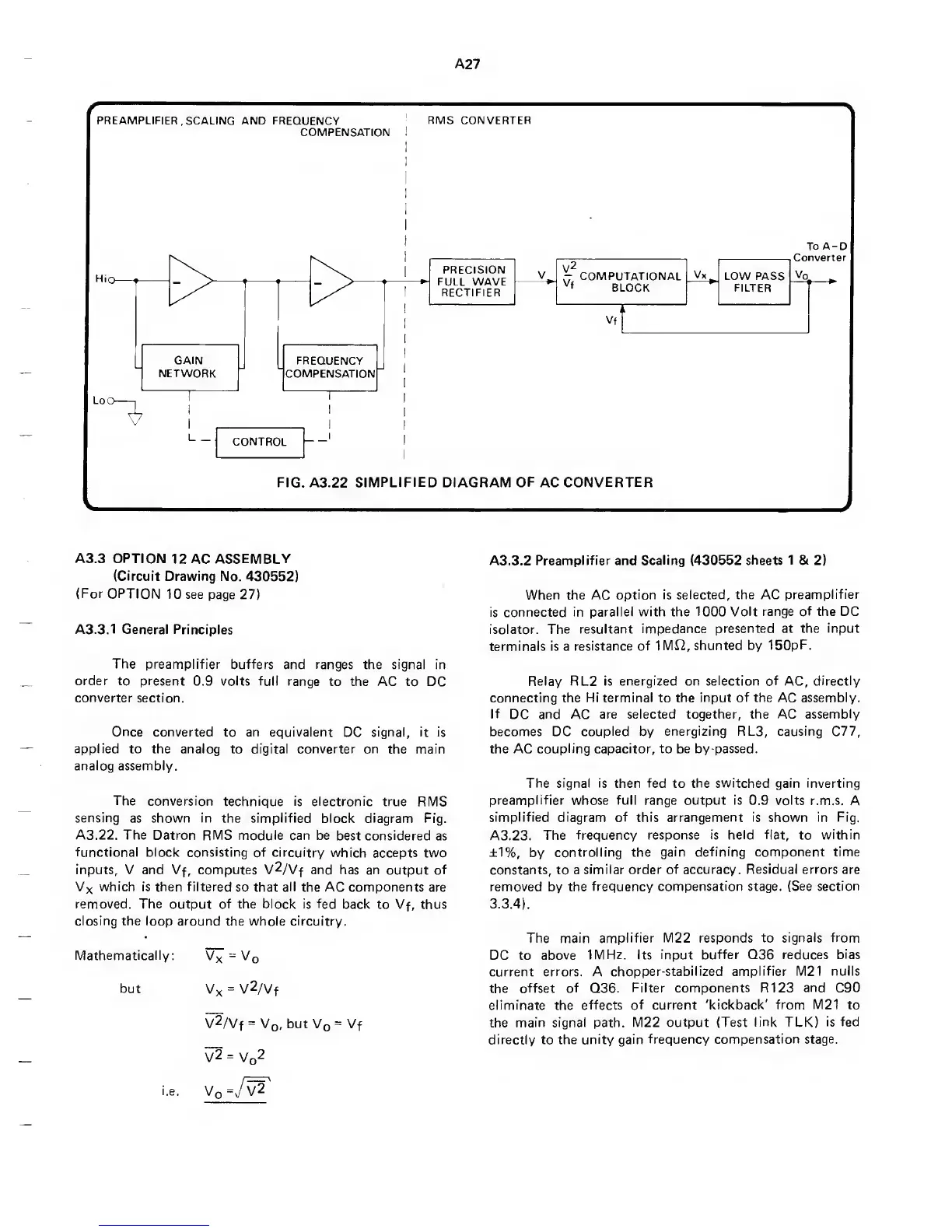
The
conversion technique is electronic
true
RMS
sensing
as shown
in
the simplified block diagram Fig.
A3. 22. The Datron
RMS module can be
best
considered
as
functional block consisting of circuitry
which accepts two
inputs, V and
Vf,
computes
V2/Vf
and has an
output
of
Vx
which is
then filtered
so that
all
the AC components are
removed. The output of the block is fed
back to
Vf,
thus
closing the loop around
the whole circuitry.
Mathematically:
Vx
=
Vq
but
Vx
=
V2/Vf
W/Vf
=
Vo,
but
Vo
=
Vf
W
=
Vq2
A3.
3.2
Preamplifier and Scaling (430552
sheets 1
&
2)
When the
AC
option
is selected, the AC
preamplifier
is connected
in parallel
with
the
1000 Volt
range of the DC
isolator.
The resultant
impedance
presented at the
input
terminals is a
resistance of
1ML2, shunted
by
150pF.
Relay RL2 is
energized
on
selection
of AC,
directly
connecting the
Hi terminal
to
the input of the
AC
assembly.
If
DC
and
AC
are selected together, the AC
assembly
becomes DC
coupled
by
energizing RL3, causing
C77,
the AC
coupling capacitor,
to
be by-passed.
The signal is then fed
to
the switched gain inverting
preamplifier
whose
full
range output
is
0.9 volts r.m.s.
A
simplified diagram of this arrangement is
shown
in Fig.
A3. 23.
The
frequency response
is held flat,
to
within
±1%,
by
controlling the gain
defining
component
time
constants, to a
similar
order
of accuracy.
Residual errors
are
removed by the
frequency compensation stage.
(See section
3.3.4).
The main
amplifier
M22
responds
to
signals from
DC to
above
1MHz.
Its
input buffer Q36 reduces
bias
current
errors.
A
chopper-stabilized amplifier
M21
nulls
the
offset of Q36.
Filter components
R123
and
C90
eliminate
the
effects of current
'kickback' from M21 to
the main
signal
path.
M22 output (Test
link
TLK)
is
fed
directly to the unity
gain
frequency compensation stage.
i.e.
Vo
=/\^


 To Next Page
 Loading...