EasyManua.ls Logo

dbx 463X - Noise Gating Principles; Gating vs. Downward Expansion; Slider Control Functions

dbx 463X
31 pages
Print Icon
To Next Page IconTo Next Page
To Previous Page IconTo Previous Page
Loading...
r
ABOUT
NOISE
GATING
Although
the
basic
idea
behind
gating
is simple
attenuate
the
background
noise
whenever
the
signal
of
interest
is
absent
there's
more
than
one
way
to
go
about
it.
Classic
gating
is
to
use a
fixed
amount
of
attenuation
(say,
30
dB)
whenever
the
signal
level
drops
below
a
given
point,
the
Threshold.
Essentially,
the
signal
is
switched
off
whenever
its
level
is
insufficient.
Another
approach
is
downward
expansion,
where
the
amount
of
attenuation
is based
on
how
far
down
the
signal
has
dropped
below
threshold.
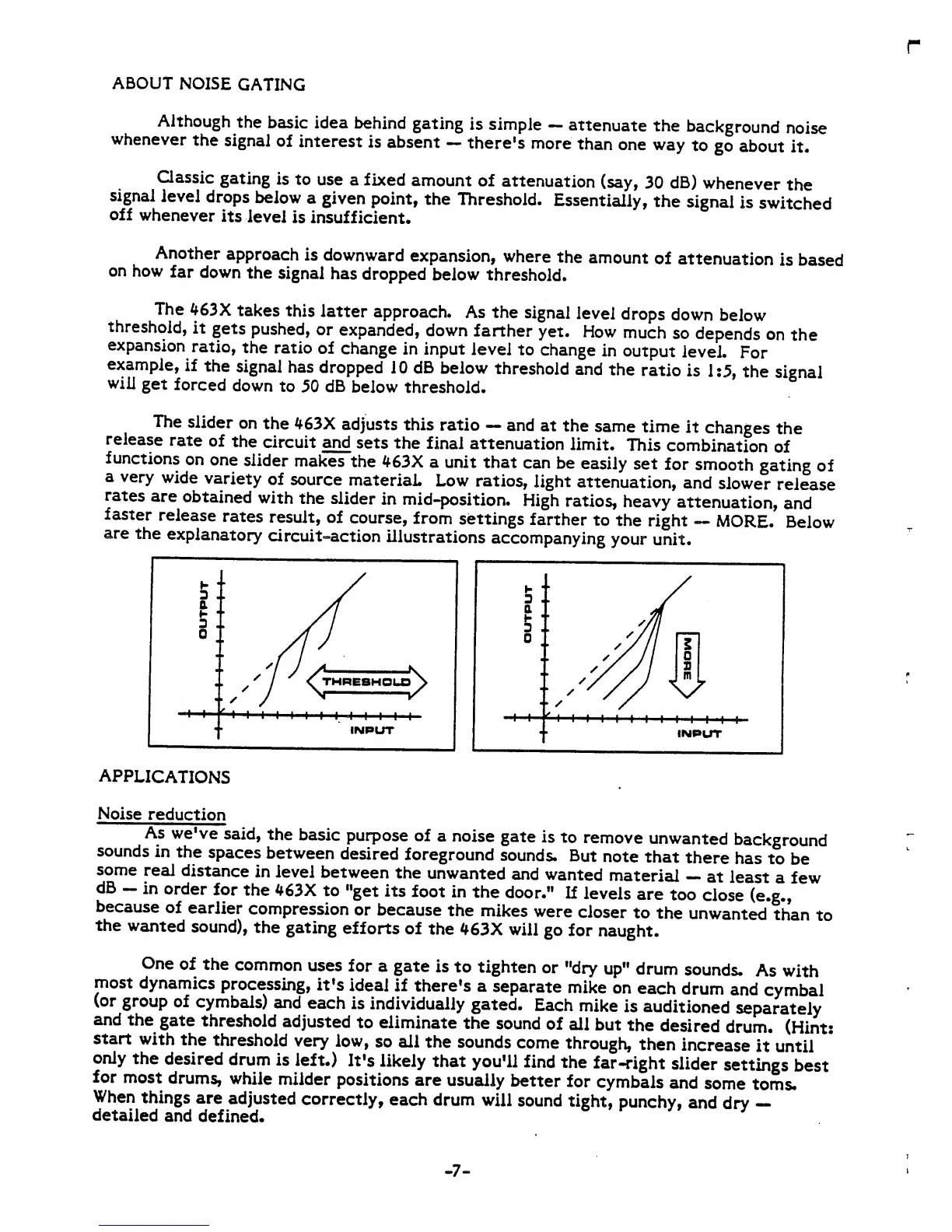
The
463X
takes
this
latter
approach.
As the
signal
level
drops
down
below
threshold,
it
gets
pushed,
or
expanded,
down
farther
yet.
How
much
so
depends
on
the
expansion
ratio,
the
ratio
of
change
in
input
level
to
change
in
output
level.
For
example,
if
the
signal
has
dropped
10
dB
below
threshold
and
the
ratio
is
1:5,
the
signal
will
get
forced
down
to
50 dB
below
threshold.
The
slider
on
the
463X
adjusts
this
ratio
and
at
the
same
time
it
changes
the
release
rate
of
the
circuit
and
sets the
final
attenuation
limit.
This
combination
of
functions
on
one
slider
makes
the
463X
a unit
that
can
be
easily
set
for
smooth
gating
of
a
very
wide
variety
of
source
material.
Low
ratios,
light
attenuation,
and
slower
release
rates
are
obtained
with
the
slider
in
mid-position.
High
ratios,
heavy
attenuation,
and
faster
release
rates
result,
of
course,
from
settings
farther
to
the
right
MORE.
Below
are
the
explanatory
circuit-action
illustrations
accompanying
your
unit.
APPLICATIONS
Noise
reduction
As
we've
said,
the
basic
purpose
of
a
noise
gate
is
to
remove
unwanted
background
sounds
in
the
spaces
between
desired
foreground
sounds.
But
note
that
there
has
to
be
some
real
distance
in
level
between
the
unwanted
and
wanted
material
at
least
a few
dB
-
in
order
for
the
463X to
"get
its
foot
in
the
door."
If
levels
are
too
close
(e.g.,
because
of
earlier
compression
or
because
the
mikes
were
closer
to
the
unwanted
than
to
the
wanted
sound),
the
gating
efforts
of
the
463X will
go
for
naught.
One
of
the
common
uses
for
a gate
is
to
tighten
or
"dry
up"
drum
sounds.
As
with
most
dynamics
processing,
it's
ideal
if
there's
a
separate
mike
on
each
drum
and
cymbal
(or
group
of
cymbals)
and
each
is
individually
gated.
Each
mike
is
auditioned
separately
and
the
gate
threshold
adjusted
to
eliminate
the
sound
of
all
but
the
desired
drum.
(Hint:
start
with
the
threshold
very
low,
so all
the
sounds
come
through,
then
increase
it
until
only
the
desired
drum
is
left.)
It's
likely
that
you'll
find
the
far
-right
slider
settings
best
for
most
drums,
while
milder
positions
are
usually
better
for
cymbals
and
some
toms.
When
things
are
adjusted
correctly,
each drum
will
sound
tight,
punchy,
and
drv
detailed
and
defined.
-
7
-