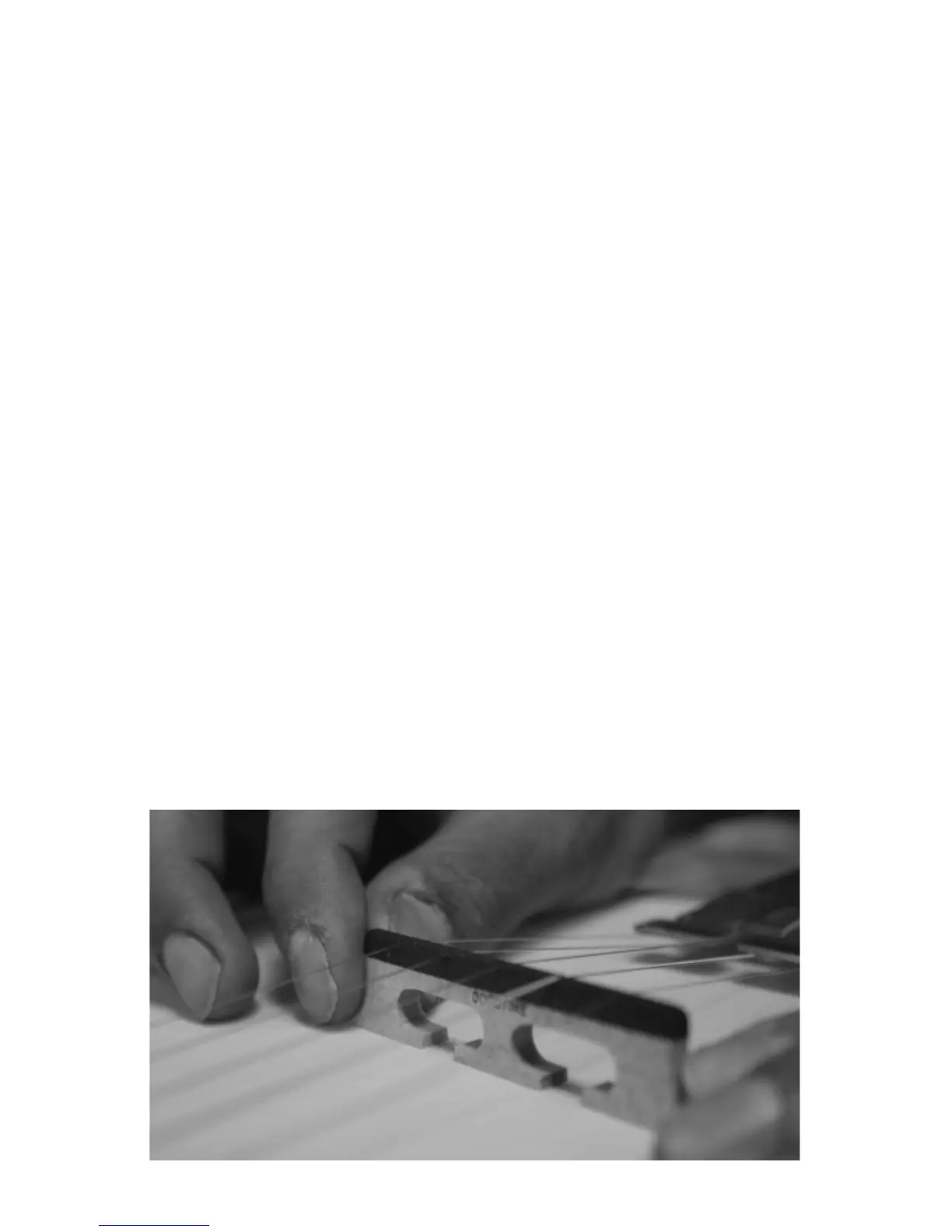
Now play that string again while fretting the 12th fret right behind
the fret wire. ese two notes should be the same if the bridge is in
the correct place.
If they aren’t the same, move the bridge:
AWAY from the NECK if the fretted note is HIGHER than the
harmonic note.
TOWARD the NECK if the fretted note is LOWER than the harmonic
note.
is is done for the 1st and 4th string. Note that the bridge may end
up slightly angled, like the saddle on a guitar. is is normal. e
2nd and 3rd strings will not be in harmonic tune. is is also normal.
A straight bridge sounds better on a banjo than a compensated
bridge. With a straight bridge, when the bridge is properly set to be
in the correct place for the 1st and 4th string, the 2nd and 3rd string
will always be off a small amount.
90% of all the professional banjo players use a straight bridge, and
don’t worry about the 2nd and 3rd strings. e other 10% use a
compensated bridge. e 2nd and 3rd strings will be more in tune,
but usually they are still not perfect. e responsiveness of the
compensated bridge is not as good as a straight bridge.
What this means for you as a goodtime banjo owner is that unless
you have perfect pitch, set your bridge with the 1st and 4th string,
and don’t worry about the 2nd and 3rd.


 To Next Page