Need help?
Do you have a question about the DeLonghi DEWC155D and is the answer not in the manual?
Provides contact numbers and website for warranty or product information.
Appliance designed exclusively for household use; other uses are strictly forbidden.
Ensures children do not operate, play with, or crawl inside the appliance.
Damaged power cable must be replaced by manufacturer or qualified electrician.
Instructions on smoothly sliding shelves in and out for wine access.
Step-by-step guide on how to safely remove shelves from the cabinet.
Detailed instructions on how to change the door opening direction.
Read and obey safety messages to reduce the chance of injury.
Explains symbols like Danger, Warning, Caution for risk assessment.
Checks for power, circuit breaker, or fuse issues when unit is unresponsive.
Checks temperature settings and environment for cooling issues.
Diagnoses causes like room temperature or frequent door openings.
Troubleshooting steps for when the interior light fails to illuminate.
Explains normal operational noises and checks for leveling.
Checks for leveling, gasket cleanliness, and shelf placement.
Explains error codes like E1-E8 related to sensor failures.
Instructions for cleaning the interior and exterior surfaces.
Advice on locating the cabinet for optimal energy efficiency.
What to do during and after a power outage to protect contents.
Recommendations for short and long vacations regarding appliance operation.
Steps for safely preparing and transporting the appliance.
Follow basic precautions to reduce risk of fire, electrical shock, or injury.
Discusses use and requirements for extension cords with the appliance.
Details the number of bottles that can be stored in upper and lower zones.
Instructions on using the lock and key to secure the cabinet door.
How to turn the wine cabinet ON or OFF using the power button.
How to adjust and display temperature settings in Fahrenheit or Celsius.
How to turn on/off the interior LED lights in each zone.
Instructions on how to activate and deactivate the control panel lock function.
Information on maintaining humidity levels using a provided tray.
Steps to take before connecting the appliance to power.
Steps for placing and leveling the wine cabinet for immediate use.
Guidelines for installing the wine cabinet into a cavity space.
Step-by-step instructions for fitting the door handle.
This document serves as a comprehensive user guide for the De'Longhi Wine Cabinet, a temperature-controlled appliance designed for optimal wine storage. It covers two models: DEWC46D and DEWC155D, offering detailed instructions for installation, operation, maintenance, and troubleshooting. The guide emphasizes safety precautions and provides helpful tips to ensure the longevity and efficient performance of the wine cabinet.
The primary function of the De'Longhi Wine Cabinet is to provide a stable, temperature-controlled environment for storing and serving wine. It features dual zones, allowing for different temperature settings to accommodate various types of wine, such as sparkling, white, and red, simultaneously. The upper zone is typically set for cooler temperatures suitable for sparkling and white wines, while the lower zone maintains warmer temperatures ideal for white and red wines. This dual-zone capability ensures that each bottle is stored at its optimal temperature, preserving its quality and enhancing its flavor profile.
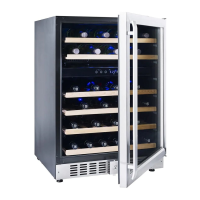
Key usage features of the wine cabinet include wooden telescopic shelves, which allow for smooth and easy access to bottles. These shelves are designed to slide out approximately one-third of the way, making it convenient to select and retrieve wines without disturbing others. The cabinet also incorporates UV-treated glass doors, which protect the wine from harmful ultraviolet light that can degrade its quality. The stainless steel fascia and door frame contribute to a sleek and modern aesthetic, while the electronic control panel with a blue LED display provides an intuitive interface for monitoring and adjusting settings.
The control panel allows users to turn the wine cabinet on or off by pressing and holding the power button for two seconds. It displays the last set temperature for both zones. Temperature settings can be adjusted in 1-degree increments using the UP and DOWN arrow buttons for each zone. The display can also be switched between Fahrenheit and Celsius by pressing the F°/C° button. A locking function for the control panel is included, which activates automatically after 12 seconds of inactivity and can be unlocked by pressing and holding the +/- buttons of the lower zone for two seconds.
Humidity control is another important feature. The cabinet is designed to maintain a humidity level between 55-75%, which is crucial for preventing corks from drying out and allowing air to enter the bottles. A small plastic tray is provided for users to fill with water and place in front of the circulation fan, assisting in maintaining the desired humidity levels. This tray needs to be refilled periodically.
The wine cabinet is equipped with an interior LED light in both upper and lower zones, which can be turned on or off via a dedicated button. This light illuminates the interior, making it easier to view and select bottles. For security, the unit comes with a door lock and key, allowing users to secure their wine collection. The keys are typically found within the plastic bag containing the user guide.
Installation of the wine cabinet is straightforward, with options for quick or recessed installation. For quick installation, the unit should be placed on a strong, level floor in a dry area away from direct sunlight and heat sources. The front leveling legs can be adjusted to ensure stability. For recessed installation, specific ventilation dimensions must be adhered to, as detailed in the manual, to ensure proper airflow and performance. The door handle needs to be attached during initial setup, and the manual provides clear instructions for this process, including how to remove decorative plugs and secure the handle with screws.
A notable customisation feature is the reversible door swing. The wine cabinet is delivered with the door opening from the left side, but users can reverse this to the right side if needed. The manual provides step-by-step instructions for this process, which involves carefully removing the door, relocating hinges, and reattaching the door and handle. This flexibility allows the cabinet to be integrated seamlessly into various kitchen or living space layouts.
Maintenance features are designed to keep the wine cabinet in optimal condition. Regular cleaning is recommended, starting with turning off and unplugging the appliance and removing all items and shelves. The interior surfaces should be cleaned with a warm water and baking soda solution, while shelves can be washed with a mild detergent. The exterior can be cleaned with warm water and a mild liquid detergent, followed by wiping dry with a soft cloth. Rubber door seals should also be cleaned regularly with a mild detergent and damp cloth to ensure proper sealing and efficient operation.
The guide also offers energy-saving tips, such as locating the wine cabinet in the coolest area of the room, away from heat-producing appliances and direct sunlight. In case of a power failure, it notes that most outages are short and should not significantly affect the internal temperature if the door is kept closed. For longer vacations, it advises removing all items, cleaning the interior thoroughly, and leaving the door slightly ajar to prevent odors and mold growth. When moving the wine cabinet, all items should be removed, loose parts taped down, adjustable legs raised, and the door secured to prevent damage.
Troubleshooting information is provided to address common operating problems, such as the cabinet not operating, not being cold enough, turning on and off frequently, or the light not working. It also covers issues like excessive noise or vibrations and the door not closing properly. Error codes like "E1," "E2," "E3," "E4," "E7," and "E8" are explained, indicating sensor failures that require professional service. The manual encourages users to consult the troubleshooting section before contacting customer service, providing contact details for De'Longhi's helplines in Australia and New Zealand.
Overall, the De'Longhi Wine Cabinet is presented as a high-quality, user-friendly appliance designed to meet the needs of wine enthusiasts. Its dual-zone temperature control, elegant design, and practical features ensure that wine is stored and served under ideal conditions, while the comprehensive user guide empowers owners to maintain and troubleshoot their unit effectively.
 General
| Type | Freestanding |
|---|---|
| Cooling System | Thermoelectric |
| Installation | Freestanding |
| Temperature Zones | Single Zone |
| Door | Glass door |
| Shelves | wooden shelves |
| Temperature Range | 41°F - 64°F (5°C - 18°C) |


 To Next Page