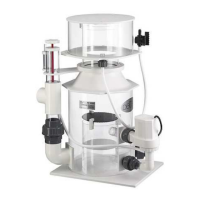
The Deltec PF Series Fluidized Bed Calcium Reactors (PF 501 – PF 1370) are designed to maintain and control calcium levels in marine aquaria, which is crucial for the health and growth of corals. The recommended calcium level is above 400 mg/litre, ideally between 470-500 mg/litre.
Function Description:
These reactors operate on the fluidized bed principle, utilizing Deltec Hy Carb Media for optimal performance. The core function involves dissolving calcium media to enrich the aquarium water with calcium. The reactor consists of a transparent cylindrical container, a bubble counter, and provisions for a pH electrode, allowing for precise control over the calcium dissolution process. Water is circulated through the reactor, passing through the fluidized media, while CO2 is introduced to lower the pH, facilitating the dissolution of calcium carbonate. The resulting calcium-rich water is then returned to the aquarium.
Important Technical Specifications:
| Model |
Dimensions (l/w/h) app. |
Quantity app. |
For Aquaria up to |
Tube Ø |
| PF 501 |
200 x 170 x 500 mm |
2.9 kilos |
1000 ltr. |
110 mm |
| PF 601 |
260 x 210 x 550 mm |
8.7 kilos |
2000 ltr. |
160 mm |
| PF 601S |
305 x 255 x 550 mm |
14.0 kilos |
3000 ltr. |
200 mm |
| PF 1001 |
375 x 305 x 1080 mm |
34.0 kilos |
5000 ltr. |
200 mm |
| PF 1370 |
480 x 350 x 1300 mm |
97.0 kilos |
20000 ltr. |
300 mm |
The reactors include a non-return valve and a micro filter as standard components. An optional solenoid valve can be integrated for automated pH control.
Usage Features:
- Installation:
- Thoroughly wash the granulate media to remove any floating matters or foreign particles before filling.
- To fill, remove the reactor head by turning it anticlockwise, then remove the strainer plate and sponge.
- Fit cap No. 12 over the central feed pipe No. 15 to prevent media from entering the pipe.
- Fill the vessel up to the designated fill line with media.
- Refit the strainer plate with the sponge pointing downwards.
- Clean and grease the O-Ring and all sealing surfaces with silicon spray or grease before refitting the reactor head clockwise.
- Place the reactor on an even surface near the filter sump or aquarium.
- Bubble Counter: Fill the bubble counter with tap water by loosening the cap nut, removing hoses, withdrawing the counter, and filling it under a tap.
- Connecting the Reactor:
- Connect a flexible CO2 supply hose to the bubble counter (or solenoid valve if present).
- Connect the micro filter to a water supply, either from a separate pump or a bypass of the main aquarium pump.
- Open the tap at the micro filter to fill the reactor with water.
- Start the circulation pump.
- To ease bleeding, temporarily raise the outlet hose higher than the reactor body.
- Operation:
- Set the CO2 supply to approximately one bubble per second.
- Adjust the tap at the micro filter to a drip rate of approximately 2-4 drops per second from the outlet hose.
- DKH/Calcium Level Adjustment:
- To adjust DKH (calcium level), either increase CO2 supply or decrease water flow. Avoid excessive CO2.
- Allow sufficient time for adjustments to take effect before testing water parameters.
- Automated Operation: The reactor can be operated automatically by installing a pH electrode (instead of the red plug) and connecting it to a suitable pH controller. The pH controller will regulate the pH value by opening/closing the solenoid valve. For normal operation, the pH level should be maintained between 6.2-6.5.
- Important Note: Never restrict or block the water flow from the outlet hose, as this can lead to increased pressure inside the reactor.
Maintenance Features:
- Regular Checks: It is important to regularly check the water flow, CO2 supply, and the resulting DKH level at the outlet to ensure best results.
- Cleaning: The manual implies that parts like the O-ring and sealing surfaces should be cleaned and greased during assembly or reassembly.
- Spare Parts: A comprehensive spare parts list is provided for each model (PF 501, PF 601, PF 601S, PF 1001), detailing components such as pumps, impellers, O-rings, stators, suction lines, micro filters, strainers, sponges, bodies, and various hoses and fittings. This facilitates easy replacement of worn or damaged parts.
- Safety Instructions: The manual emphasizes several safety precautions, including unplugging the appliance before maintenance or cleaning, avoiding use for purposes other than intended, and ensuring secure installation. It also highlights the importance of a "drip-loop" for electrical cords to prevent water from reaching receptacles. Removing the plug invalidates the warranty.

 Need help?
 General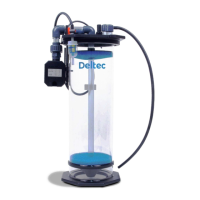

 To Next Page