7
FCC Warning
Title 47 Subpart, 15.105(b)
Note: This equipment has been tested and found to comply with the limits for a
class B digital device, pursuant to part 15 of the FCC Rules. These limits are
designed to provide reasonable protection against harmful interference in
residential installation. This equipment generates, uses and can radiate radio
frequency energy and, if not installed and used in accordance with the instructions,
may cause harmful interference to radio television reception, which can be
determined by tuning the equipment off and on, the user is encouraged to try to
correct the interference by one or more of the following measures:
- Reorient or relocate the receiving antenna.
- Increase the separation between the equipment and receiver.
- Connect the equipment into an outlet on a circuit different from that to
which the receiver is connected.
- Consult the dealer or an experienced radio/TV technician for help.
ICES-001: Industrial, Scientific, and Medical (ISM) Radio
Frequency Generators
This product has been tested with the listed standards and found to be compliant
with the Code of Industry Canada ES-001 and the measurement Procedure
according to CISPR 11.
CAN ICES-1/NMB-1
8
INSTRUCTIONS IMPORTANTES CONCERNANT LA
SÉCURITÉ
CONSERVER CES INSTRUCTIONS. CE MANUEL
CONTIENT DES INSTRUCTIONS IMPORTANTES
CONCERNANT LA SÉCURITÉ ET LE FONCTIONNEMENT.
1) IL EST DANGEREUX DE TRAVAILLER A PROXIMITÉ D’UNE BATTERIE AU
PLOMB. LES BATTERIES PRODUISENT DES GAZ EXPLOSIFS EN
SERVICE NORMAL. IL EST AUSSI IMPORTANT DE TOUJOURS RELIRE
LES INSTRUCTIONS AVANT D’UTILISER LE CHARGEUR ET DE LES
SUIVRE À LA LETTRE.
2) POUR RÉDUIRE LE RISQUE D’EXPLOSION, LIRE CES INSTRUCTIONS ET
CELLES QUI FIGURENT SUR LA BATTERIE.
3) NE JAMAIS FUMER PRÈS DE LA BATTERIE OU DU MOTEUR ET ÉVITER
TOUTE ÉTINCELLE OU FLAMME NUE À PROXIMITÉ DE CES DERNIERS.
4) UTILISER LE CHARGEUR POUR CHARGER UNE BATTERIE AU PLOMB
UNIQUEMENT. CE CHARGEUR N’EST PAS CONÇU POUR ALIMENTER UN
RÉSEAU ÉLECTRIQUE TRÈS BASSE TENSION NI POUR CHARGER DES
PILES SÈCHES. LE FAIT D’UTILISER LE CHARGEUR POUR CHARGER
DES PILES SÈCHES POURRAIT ENTRAÎNER L’ÉCLATEMENT DES PILES
ET CAUSER DES BLESSURES OU DES DOMMAGES;
5) NE JAMAIS CHARGER UNE BATTERIE GELÉE.
6) S’IL EST NÉCESSAIRE DE RETIRER LA BATTERIE DU VÉHICULE POUR
LA CHARGER, TOUJOURS DÉBRANCHER LA BORNE DE MISE À LA
MASSE EN PREMIER. S’ASSURER QUE LE COURANT AUX
ACCESSOIRES DU VÉHICULE EST COUPÉ AFIN D’ÉVITER LA
FORMATION D’UN ARC.
7) PRENDRE CONNAISSANCE DES MESURES DE PRÉCAUTION
SPÉCIFIÉES PAR LE FABRICANT DE LA BATTERIE, P. EX., VÉRIFIER S‘IL
FAUT ENLEVER LES BOUCHONS DES CELLULES LORS DU
CHARGEMENT DE LA BATTERIE, ET LES TAUX DE CHARGEMENT
RECOMMANDÉS.
8) SI LE CHARGEUR COMPORTE UN SÉLECTEUR DE TENSION DE SORTIE,
CONSULTER LE MANUEL DE L’USAGER DE LA VOITURE POUR
DÉTERMINER LA TENSION DE LA BATTERIE ET POUR S’ASSURER QUE
LA TENSION DE SORTIE EST APPROPRIÉE. SI LE CHARGEUR N’EST PAS
MUNI D’UN SÉLECTEUR, NE PAS UTILISER LE CHARGEUR À MOINS QUE
LA TENSION DE LA BATTERIE NE SOIT IDENTIQUE À LA TENSION DE
SORTIE NOMINALE DU CHARGEUR.
9) NE JAMAIS PLACER LE CHARGEUR DIRECTEMENT SOUS LA BATTERIE
À CHARGER OU AU-DESSUS DE CETTE DERNIÈRE. LES GAZ OU LES
FLUIDES QUI S’ÉCHAPPENT DE LA BATTERIE PEUVENT ENTRAÎNER LA
CORROSION DU CHARGEUR OU L’ENDOMMAGER. PLACER LE
CHARGEUR AUSSI LOIN DE LA BATTERIE QUE LES CABLES C.C. LE
PERMETTENT.
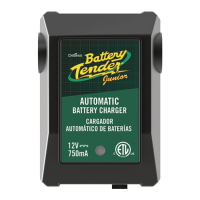
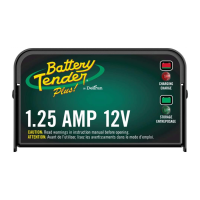
Deltran Battery Tender
Plus
Développé pour des batteries acide-plomb
à six cellules


 To Previous Page
 Loading...