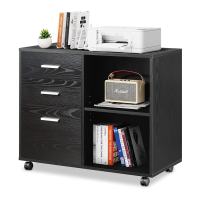
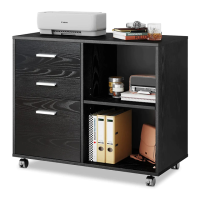
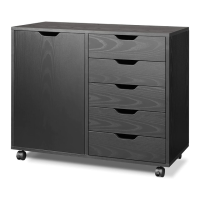
This document provides assembly and usage instructions for the DEVAÍSE AHDG018 Wood Large 1 Drawer Mobile Cabinet.
Function Description:
The DEVAÍSE AHDG018 is a mobile cabinet designed for storage, featuring a large compartment with a door, open shelves, and a single drawer. Its mobile design, indicated by the presence of casters, suggests it can be easily moved within a space. The cabinet is intended for general storage purposes, suitable for various items in a home or office environment. The combination of a closed compartment, open shelves, and a drawer offers versatile storage options for different types of belongings, from larger items behind the door to frequently accessed items on the shelves and smaller, private items in the drawer.
Important Technical Specifications:
Based on the exploded drawing and parts list, the cabinet is constructed from wood panels, likely particle board or MDF, given the use of minifix connectors and screws.
- Dimensions: While specific dimensions are not provided, the "Large" in the product name suggests a substantial size. The visual representation indicates a height suitable for under-desk placement or as a standalone storage unit.
- Drawer Mechanism: The drawer utilizes full-extension ball-bearing slides (parts E1, E2, I, J), ensuring smooth operation and full access to the drawer's contents. The slides are designed to be separated for easier installation.
- Casters: The cabinet is equipped with casters (parts O, P, Q, R, S, T), making it mobile. The assembly instructions show eight casters, suggesting good stability for movement.
- Hardware: The assembly relies on a variety of hardware components:
- Minifix connectors (A, B, C): These are common in flat-pack furniture for strong, concealed joints. Part A is a minifix bolt, B is a wood dowel, and C is a minifix cam.
- Screws (I, J, K, F, G, H): Various types and sizes of screws are used for different connections, including M4x14 (I, J) and M4x10 (J).
- Drawer slides (E1, E2): These are crucial for the drawer's functionality.
- Hinges (D, T): Used for the cabinet door, allowing it to open and close. Part D includes D1 (hinge plate) and D2 (hinge pin).
- Door magnets (K): Likely used to keep the cabinet door securely closed.
- Handles (L, M): For the drawer and door. Part L is a drawer handle, and M is a door handle.
- Casters (O, P, Q, R, S, T): For mobility. Part P is a caster base, Q is a caster wheel, R is a caster bolt, S is a caster washer, and T is a caster nut.
- Panel Components: The cabinet consists of numerous numbered wood panels (1 through 18) that form the sides, top, bottom, shelves, back, and drawer components. Key panels include:
- Side panels (1, 2, 3, 9): Forming the main structure.
- Top and bottom panels (7, 18): Providing the horizontal surfaces.
- Shelves (4, 5, 6, 10, 11): Creating storage compartments.
- Back panels (8): Enclosing the rear of the cabinet.
- Drawer components (12, 13, 14, 15, 16, 17): Forming the drawer box and front.
Usage Features:
- Versatile Storage: The cabinet offers a combination of a hinged door compartment, open shelves, and a drawer, catering to diverse storage needs. The open shelves are ideal for displaying items or storing frequently accessed objects, while the closed compartment and drawer provide discreet storage.
- Mobility: Equipped with casters, the cabinet can be easily repositioned, offering flexibility in room layout and cleaning. This feature is particularly useful in dynamic environments or for temporary storage solutions.
- Adjustable Hinges: The manual includes a "Hinge Adjustment" section, indicating that the door hinges can be adjusted for depth and side-to-side alignment. This allows users to correct any misalignment of the door after assembly or over time, ensuring a neat appearance and proper closure.
- Drawer Operation: The ball-bearing drawer slides are designed for smooth and quiet operation, enhancing user experience. The instructions emphasize proper installation of the slides to ensure perfect drawer functionality.
Maintenance Features:
- Regular Hardware Checks: The general guidelines recommend regularly checking the product's bolts and connections to ensure safe use. This is a crucial maintenance step for flat-pack furniture to prevent loosening and potential instability.
- Hinge Adjustment: The detailed instructions for hinge adjustment allow users to maintain the proper alignment and function of the cabinet door. This can prevent issues like doors not closing properly or rubbing against the frame, extending the lifespan of the cabinet.
- Cleaning: While not explicitly detailed, the mention of assembling on a "soft flat and clean surface" implies that the finished product should also be maintained in a clean environment. The material, likely laminated particle board, typically requires only wiping with a damp cloth for cleaning.
- Odor Ventilation: For new products, the manual advises airing out the unwrapped product in a shaded and ventilated area for a few days if an odor is present. This is a common practice for furniture made with composite wood materials.
- Damage Prevention: The warnings advise avoiding sharp objects or corrosive chemicals to prevent damage to the product, which is standard care for furniture. It also cautions against pinching hands by metal joints, especially for children, during assembly and use.

 Need help?
 General

 To Next Page