Manual information
This document is protected by copyright laws; copyrights of this document belong to Diapath S.p.A.
It is strictly forbidden, full or in part, to modify this manual in absence of an explicit authorization.
Diapath S.p.A. is not obliged to regularly update this manual, or to regularly send reviewed or updated versions of this
manual to its customers.
Information contained in this manual is subject to changes without prior notice.
Diapath S.p.A. guarantees the accuracy of the information present in this manual as the result of thorough research; if
information is incorrect or unclear, please contact Diapath S.p.A. or the distributor. Diapath S.p.A. is not responsible for
any kind of material damages or other damages related to non-compliance with indications or specific information
present in this manual.
Diapath S.p.A. continuously adopts a development policy and reserves the right to make changes and improvements to
any product described in this manual without prior notice.
The Serial number and date of manufacture are reported on the registration plate attached on the instrument rear part.
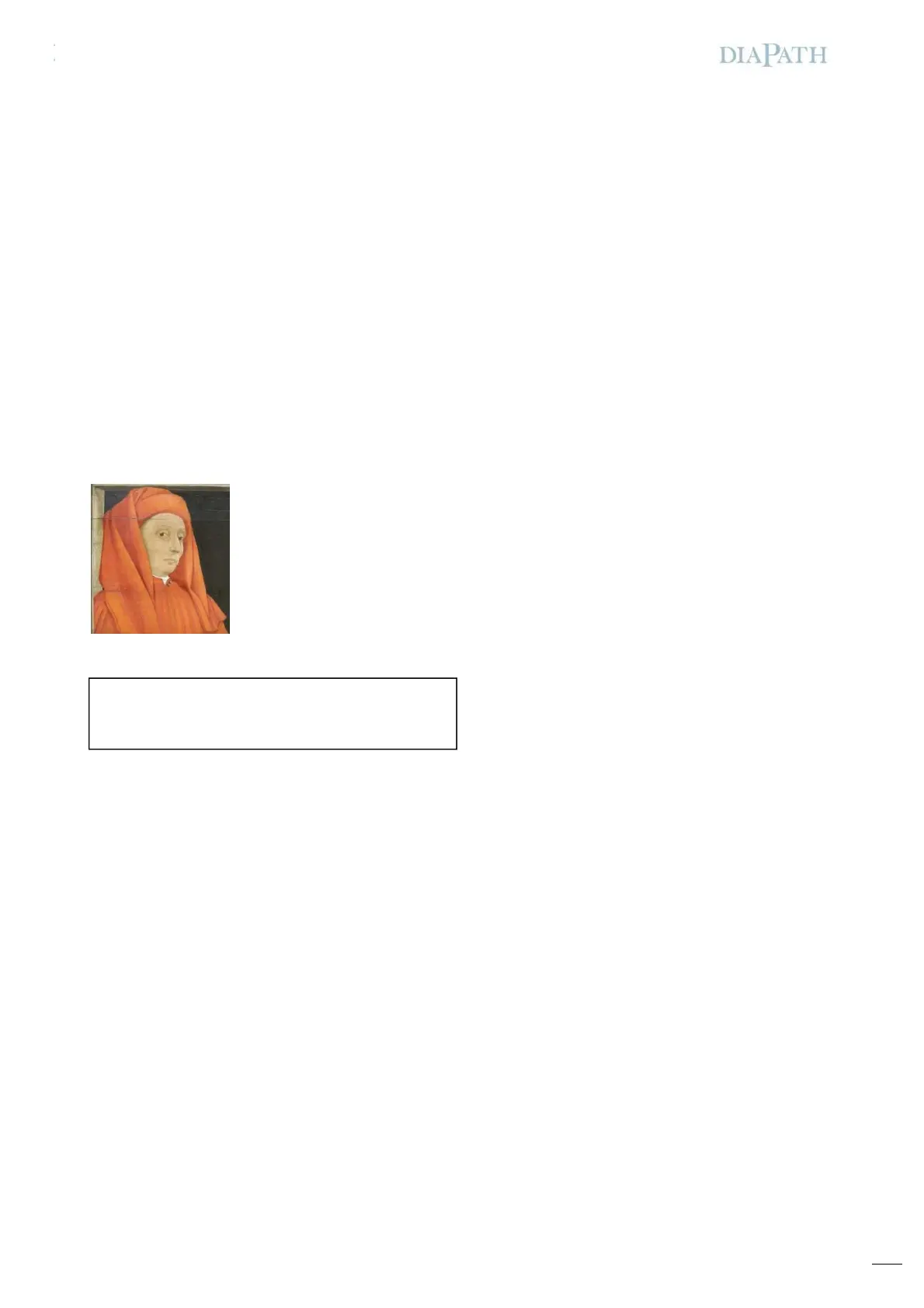
Inspired to:
Giotto (Vespignano, 1266/7 – Florence, 8
th
January 1337) Italian painter, architect and sculptor.
Since his childhood he showed a particular flair for art and drawing, for these reasons he started working at
Master Cimabue’s workshop in Florence.
Between 1288 and 1292 he painted a lot of frescos in the Cathedral of Assisi.
The Giottesco style began in Rimini and Ravenna.
Giotto’s works were fundamental for the development of Italian and European art: the two-dimensional
style, typical of the Byzantine period, was abandoned and the figure of mankind began to assume volume
inside space.
A lot of documents, dated 1334, shows his return in Florence as an architect, where he planned and
supervised all the architectural works of the city, such as the bell tower of the cathedral of Santa Maria del
Fiore.
Manual revision: Rev. 07
Edition date: 30
th
May, 2018
3


 To Next Page
 Loading...