1.0 INTRODUCTION
The procedures contained in this manual include
all the specifications, instructions, and graphics
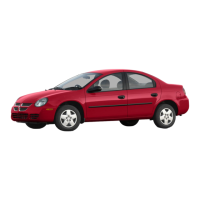
needed to diagnose 2004 Chrysler and Dodge Neon
Mark 20e Antilock Braking System (ABS) prob-
lems. The diagnostics in this manual are based on
the failure condition or symptom being present at
time of diagnosis.
Follow the recommendations below when choos-
ing your diagnostic path.
1. First make sure the DRBIIIt is communicating
with the CAB. If the DRBIIIt displays a “No
Response” condition, you must diagnose that
first.
2. Read and record DTC’s (diagnostic trouble codes)
and Freeze Frame information with the
DRBIIIt.
3. If no DTC’s are present, identify the customer
complaint.
4. Once the DTC or customer complaint is identi-
fied, locate the matching test in the Table of
Contents and begin to diagnose the symptom.
All component location views are in Section 8.0.
All connector pinouts are in Section 9.0. All sche-
matics are in Section 10.0.
An * placed before the symptom description indi-
cated a customer complaint.
When repairs are required, refer to the appropri-
ate service manual for the proper removal and
repair procedure.
Diagnostic procedures change every year. New
diagnostic systems may be added; carry over sys-
tems may be enhanced. READ THIS MANUAL
BEFORE TRYING TO DIAGNOSE A VEHICLE
CODE. It is recommended that you review the
entire manual to become familiar with all new and
changed diagnostic procedures.
After using this book, if you have any comments
or recommendations, please fill out the form at the
back of the book and mail it back to us.
1.1 SYSTEM COVERAGE
This diagnostic procedure manual covers the
Teves Mark 20e Antilock Braking System (ABS) on
the Neon.
1.2 SIX-STEP TROUBLESHOOTING
PROCEDURE
Diagnosis of the antilock brake system is done in
six basic steps:
• verification of complaint
• verification of any related symptoms
• symptom analysis
• problem isolation
• repair of isolated problem
• verification of proper operation
2.0 IDENTIFICATION OF
SYSTEM
Vehicles equipped with the Teves Mark 20e an-
tilock brake system can be identified by the pres-
ence of the hydraulic control unit located with the
controller antilock brake (CAB) under the hood
near the air cleaner housing, or by observing the
ABS lamp illumination during the bulb check.
3.0 SYSTEM DESCRIPTION AND
FUNCTIONAL OPERATION
3.1 TEVES MARK 20e SYSTEM
DESCRIPTION
This section covers the physical and operational
descriptions, and the diagnostic service procedures
for the Teves Mark 20eAntilock Brake System. It is
the only antilock brake system (ABS) available on
this vehicle.
The purpose of the antilock brake system is to
prevent wheel lockup under braking conditions on
virtually any type of road surface. Antilock braking
is desirable because a vehicle that is stopped with-
out locking the wheels retains directional stability
and some steering capability. This allows the driver
to retain greater control of the vehicle during brak-
ing.
All vehicles equipped with ABS use Electronic
Variable Brake Proportioning (EVBP) to balance
front-to-rear braking when the brakes are applied
in the partial braking range.
A Controller Antilock Brake (CAB) module is
used to monitor wheel speeds and to modulate
(control) hydraulic pressure in each brake channel
when ABS is actuated. The CAB also provides a
vehicle speed signal (VSS) to the powertrain control
module via PCI BUS.
During a non-ABS stop, the system functions as a
standard diagonally split configuration. The pri-
mary hydraulic system supplies brake fluid pres-
sure to the right front and left rear brakes, and the
secondary hydraulic system supplies the right rear
and left front brakes. A conventional proportioning
valve is not used. This system uses the existingABS
solenoids to replace andperform the same functions
that the proportioning valves do. The CAB has a
special software program that monitors the wheel
speeds and when certain criteria are met the soft-
1
GENERAL INFORMATION


 To Next Page
 Loading...