WARNING!
If TSC activates while driving, slow the ve-
hicle down, stop at the nearest safe location,
and adjust the trailer load to eliminate trailer
sway.
Ready Alert Braking (RAB)
Ready Alert Braking may reduce the time re-
quired to reach full braking during emergency
braking situations. It anticipates when an emer-
gency braking situation may occur by monitoring
how fast the throttle is released by the driver.
The EBC will prepare the brake system for a
panic stop.
Rain Brake Support (RBS)
Rain Brake Support may improve braking per-
formance in wet conditions. It will periodically
apply a small amount of brake pressure to
remove any water buildup on the front brake
rotors. It functions when the windshield wipers
are in LO or HI speed. When Rain Brake Sup-
port is active, there is no notification to the driver
and no driver interaction is required.
Dynamic Steering Torque (DST)
Dynamic Steering Torque is a feature of the ESC
and Electric Power Steering (EPS) modules that
provides torque at the steering wheel for certain
driving conditions in which the ESC module is
detecting vehicle instability. The torque that the
steering wheel receives is only meant to help
the driver realize optimal steering behavior in
order to reach/maintain vehicle stability. The
only notification the driver receives that the
feature is active is the torque applied to the
steering wheel.
NOTE:
The DST feature is only meant to help the driver
realize the correct course of action through
small torques on the steering wheel, which
means the effectiveness of the DST feature is
highly dependent on the driver’s sensitivity and
overall reaction to the applied torque. It is very
important to realize that this feature will not steer
the vehicle, meaning the driver is still respon-
sible for steering the vehicle.
AUXILIARY DRIVING SYSTEMS
Blind Spot Monitoring (BSM) — If
Equipped
The Blind Spot Monitoring (BSM) system uses
two radar sensors, located inside the rear bum-
per fascia, to detect highway licensable vehicles
(automobiles, trucks, motorcycles, etc.) that en-
ter the blind spot zones from the rear/front/side
of the vehicle.
When the vehicle is started, the BSM warning
light will be momentarily illuminated in both
outside rear view mirrors to let the driver know
that the system is operational. The BSM system
sensors operate when the vehicle is in any
forward gear or REVERSE.
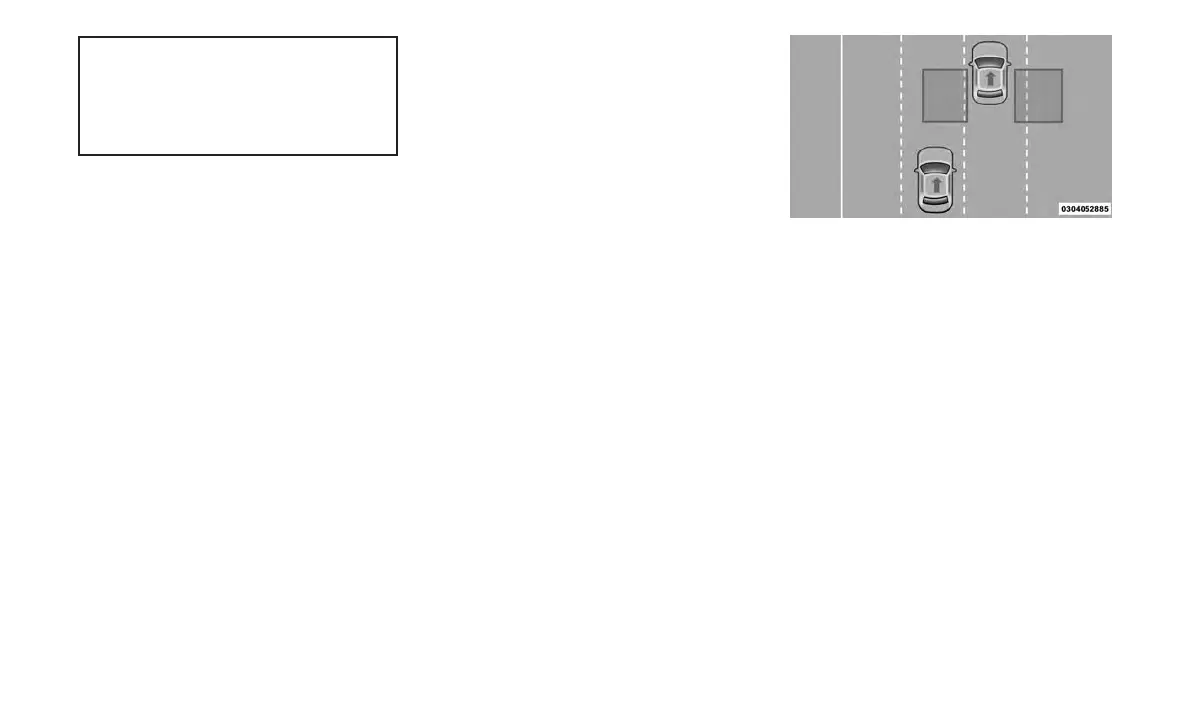
The BSM detection zone covers approximately
one lane on both sides of the vehicle 12 ft
(3.8 m). The zone length starts at the outside
rear view mirror and extends approximately 10 ft
(3 m) beyond the rear bumper of the vehicle.
The BSM system monitors the detection zones
on both sides of the vehicle when the vehicle
speed has reached approximately 6 mph
(10 km/h) or higher and will alert the driver of
vehicles in these areas.
NOTE:
• The BSM system DOES NOT alert the driver
about rapidly approaching vehicles that are
outside the detection zones.
Rear Detection Zones
104


 To Next Page
 Loading...