G420F(FE) Service Manual Chapter 5. Engine Management System (EMS) 165
When an operator turns on the key switch the lock-
off is opened, but if the operator fails to crank the
engine the SECM will close the lock-off after 5
seconds.
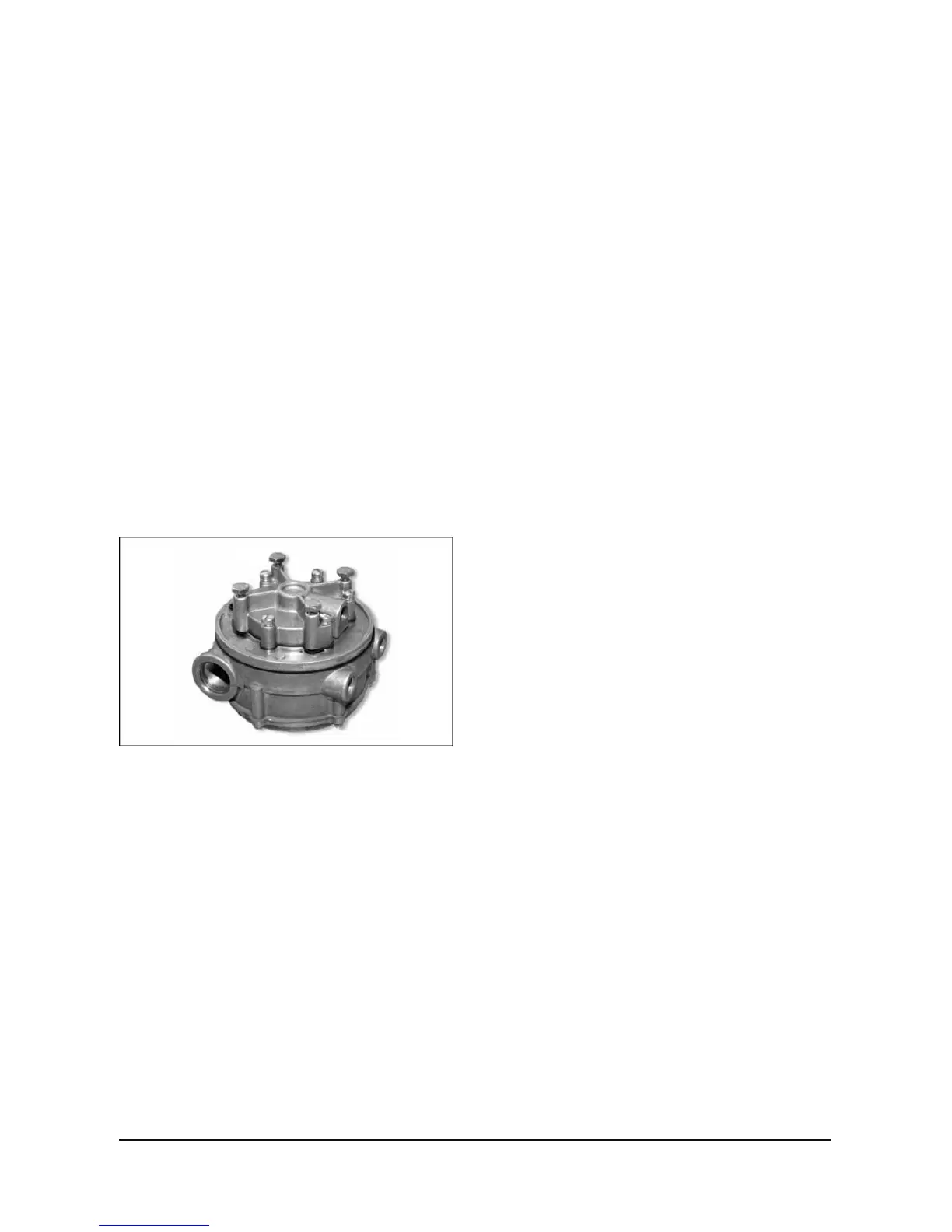
N-2007 Pressure Regulator/Vaporizer
The pressure regulator/vaporizer receives liquid
LPG from the fuel storage tank, drops the pressure,
changes the LPG phase from liquid to vapor, and
provides vapor phase LPG at a regulated outlet
pressure to the mixer. To offset the refrigeration
effect of the vaporization process, the regulator will
be supplied with engine coolant flow sufficient to
offset the latent heat of vaporization of the LPG. A
thermostat provided in the coolant supply line to
maintain regulator outlet coolant temperature at or
below 140oF (60°C) will minimize the deposit of fuel
contaminants and heavy ends in the regulator and
assure a more controlled vaporization process with
reduced pressure pulsations.
A higher flow pressure regulator is required on
larger engines.
Figure 5. N-2007 Regulator
The regulator is normally closed, requiring a vacuum
signal (negative pressure) to allow fuel to flow. This
is the second of three safety locks in the MI-07
system. If the engine stops, vacuum signal stops
and fuel flow will automatically stop when both the
secondary (2nd stage) valve and the primary (1st
stage) valve closes. Unlike most other
regulator/converters, the N-2007 primary valve
closes with fuel pressure rather than against
pressure, extending primary seat life and adding
additional safety.
Liquid propane must be converted into a gaseous
form in order to be used as a fuel for the engine.
When the regulator receives the desired vacuum
signal it allows propane to flow to the mixer. As the
propane flows through the regulator the pressure is
reduced in two stages from tank pressure to slightly
less than atmospheric pressure. As the pressure of
the propane is reduced, the liquid propane vaporizes
and refrigeration occurs inside the regulator due to
the vaporization of liquid propane. To replace heat
lost to vaporization, engine coolant is supplied by
the engine driven water pump and pumped through
the regulator. Heat provided by this coolant is
transferred through to the fuel vaporization chamber.
N-2007 Operation
(Refer to Figure 6.)
Liquid propane, at tank pressure, enters the N-2007
through the fuel inlet port (1). Propane liquid then
flows through the primary valve (2). The primary
valve located at the inlet of the expansion chamber
(3), is controlled by the primary diaphragm (4),
which reacts to vapor pressure inside the expansion
chamber. Two springs are used to apply force on
the primary diaphragm in the primary diaphragm
chamber (5), keeping the primary valve open when
no fuel pressure is present.
A small port connects the expansion chamber to the
primary diaphragm chamber. At the outlet of the
expansion chamber is the secondary valve (6). The
secondary valve is held closed by the secondary
spring on the secondary valve lever (7). The
secondary diaphragm controls the secondary lever.
When the pressure in the expansion chamber
reaches 1.5 psig (10.342 kPa) it causes a
pressure/force imbalance across the primary
diaphragm (8). This force is greater than the primary
diaphragm spring pressure and will cause the
diaphragm to close the primary valve.
Since the fuel pressure has been reduced from tank
pressure to 1.5 psig (10.342 kPa) the liquid propane
vaporizes. As the propane vaporizes it takes on heat
from the expansion chamber. This heat is replaced
by engine coolant, which is pumped through the
coolant passage of the regulator. At this point vapor
propane will not flow past the expansion chamber of
the regulator until the secondary valve is opened. To
open the secondary valve, a negative pressure
signal must be received from the air/fuel mixer.
When the engine is cranking or running a negative
pressure signal (vacuum) travels through the vapor
fuel outlet connection of the regulator, which is the
regulator secondary chamber, and the vapor fuel
inlet of the mixer. The negative pressure in the
secondary chamber causes a pressure/force
imbalance on the secondary diaphragm, which
overcomes the secondary spring force, opening the
secondary valve and allowing vapor propane to flow
out of the expansion chamber, through the
secondary chamber to the mixer.



 To Next Page