Need help?
Do you have a question about the Down4Sound JP23 and is the answer not in the manual?
Connects the amplifier's +12V terminal to the battery's positive terminal via an inline fuse holder.
Connects the amplifier's ground terminal to the vehicle's chassis for a secure connection.
Connects the amplifier's remote terminal to the head unit's turn-on signal wire.
Details the speaker wiring configuration for a single unit operating at 4 to 1 ohm loads.
Details the speaker wiring configuration for a single unit operating at 4 to 2 ohm loads.
Explains the RCA connection method for linking multiple amplifiers in a master/slave configuration.
Configuration settings for the master amplifier in a strapped system for input control.
Configuration settings for the slave amplifier in a strapped system for input control.
Details speaker connection for the master amplifier in a strapped setup, noting impedance limits.
Details speaker connection for the slave amplifier in a strapped setup.
Steps to diagnose and resolve situations where the amplifier produces no sound output.
Diagnosing and fixing common reasons for the amplifier entering protection mode.
Guidance on resolving audio distortion and unwanted noise during operation.
Tips for troubleshooting and improving the bass performance of the amplifier.
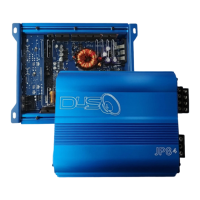
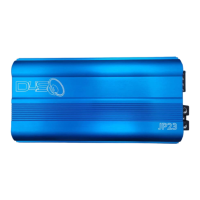
The JP23 is a high-performance digital monoblock amplifier designed for car audio systems, offering robust power delivery and a range of features to optimize sound quality and system protection. This owner's manual provides comprehensive instructions for installation, operation, and troubleshooting, ensuring users can maximize the amplifier's potential while maintaining system integrity.
The JP23 amplifier serves as a powerful component in a car audio setup, specifically designed to drive subwoofers with high efficiency and precision. Its monoblock design indicates it is optimized for single-channel output, making it ideal for dedicated subwoofer applications. The amplifier is strappable, which means two JP23 units can be linked together to double the power output into a single load, catering to more demanding audio systems.
A key aspect of the JP23's functionality is its stability into a 1-ohm mono load. This capability allows the amplifier to deliver significant power to subwoofers with low impedance ratings, providing flexibility in system design and ensuring strong, impactful bass reproduction. The high-speed MOSFET power supply is crucial for efficient power conversion and stable operation, even under heavy loads, contributing to the amplifier's ability to produce clean and consistent audio.
The JP23 incorporates several variable filters to fine-tune the audio output. The variable low pass filter (LPF) allows users to set the upper frequency limit for the subwoofer, ensuring that only bass frequencies are reproduced, preventing distortion and improving overall sound clarity. Similarly, the variable subsonic filter helps protect subwoofers by removing extremely low, inaudible frequencies that can cause damage or waste amplifier power. The variable bass boost feature provides an adjustable gain at specific bass frequencies, allowing users to enhance the low-end impact to their preference.
Protection is a paramount concern in amplifier design, and the JP23 includes a 4-way protection circuit. This system safeguards the amplifier and connected components against various potentially damaging conditions, including thermal overload (excessive heat), high and low voltage fluctuations, speaker short circuits, and DC offset. When any of these conditions are detected, the protection circuit activates, typically shutting down the amplifier to prevent damage, and an indicator light will illuminate to alert the user. This robust protection ensures the longevity and reliability of the amplifier and the entire audio system.
For ease of use and system monitoring, the JP23 comes with a remote control. This remote bass knob not only allows for convenient adjustment of the bass level from the driver's seat but also features a voltmeter and an amplifier temperature display. The voltmeter helps users monitor the system's electrical health, ensuring stable power delivery, while the temperature display provides real-time feedback on the amplifier's operating conditions, allowing users to prevent overheating during extended use.
The amplifier's construction also contributes to its performance and durability. A high-purity copper printed circuit board ensures optimal signal transfer and minimizes electrical resistance, leading to better sound quality. The use of 0-gauge power and ground terminals indicates the amplifier's capacity for high current draw, necessary for delivering substantial power, and ensures secure, low-resistance connections to the vehicle's electrical system.
Proper installation is critical for the JP23's performance and safety. The manual emphasizes the importance of correct power connections, starting with the +12V terminal. This connection requires a heavy-gauge cable, similar in diameter to the ground cable, connected to the positive terminal of the battery. Crucially, an in-line fuse holder must be installed approximately 11 to 16 inches (300 to 400 mm) from the battery's positive terminal. This fuse is a vital safety measure, protecting the vehicle's electrical system from potential short circuits or overcurrent conditions. The JP23 itself does not have internal fuses, making this external fuse holder mandatory.
The ground (GND) connection is equally important. The manual instructs users to connect the GND terminal to the car's chassis, ensuring the cable is as short as possible, ideally not longer than 20 inches. The connection point on the chassis must be free of rust, paint, or grime to ensure a solid, low-resistance electrical path. For high-power amplifiers like the JP23, connecting the ground directly to the negative terminal of the battery is often recommended for optimal performance and stability.
The remote (REM) terminal is used to turn the amplifier on and off in conjunction with the head unit. This connection should be made using 12 or 16 gauge electrical wire to the head unit's power antenna terminal or a dedicated remote turn-on output. This ensures the amplifier powers up only when the audio system is active, preventing unnecessary battery drain.
Speaker connections are detailed for both single-unit and strappable configurations. For a single JP23 unit, users can connect speakers with impedances ranging from 1 to 4 ohms. The manual provides diagrams illustrating how to connect speakers to the amplifier's output terminals, ensuring correct polarity.
When using two JP23 amplifiers in a strappable configuration, the process becomes more advanced. In this setup, one amplifier is designated as the "MASTER" and the other as the "SLAVE." The MASTER amplifier has total control over the SLAVE amplifier, meaning all input and control settings are managed through the MASTER unit. The manual specifies that the minimum working impedance for a strappable connection is 2 ohms, and any impedance lower than this can damage the amplifiers. It also provides a critical caution: the negative speaker terminal on the MASTER amplifier must be connected to the negative speaker terminal on the SLAVE amplifier. When connecting a subwoofer to two strapped amplifiers, the subwoofer's positive voice coil terminal connects to the MASTER amplifier's positive terminal, and the subwoofer's negative voice coil terminal connects to the SLAVE amplifier's positive terminal. This configuration ensures proper power delivery and phase alignment. Users are advised to check the power handling capabilities of their subwoofers to ensure they are not exceeded when using two amplifiers.
Input connections are made via RCA cables from the head unit or other signal processing devices. The manual illustrates how to connect the RCA outputs from the source to the amplifier's input terminals. For strappable configurations, an RCA cable connects the MASTER amplifier's output to the SLAVE amplifier's input, allowing the MASTER unit to control the signal for both amplifiers.
The amplifier features various controls on its endplate, including gain, subsonic boost, and LPF (low pass filter) adjustments. The gain control allows users to match the amplifier's input sensitivity to the output voltage of the head unit, preventing distortion. The subsonic boost and LPF controls enable fine-tuning of the bass frequencies, as described in the function description.
The JP23 is designed with "STATE OF THE ART" protection features to prevent damage from misuse or faulty conditions. However, understanding how to troubleshoot issues is an essential aspect of maintenance. The manual provides a dedicated troubleshooting section to guide users through common problems.
If the amplifier experiences "NO OUTPUT," users are advised to check several points:
If the amplifier "SHUTS DOWN (PROTECTION)," indicating the protection circuit has activated, the following steps are recommended:
For "DISTORTION & NOISE" issues, the manual suggests:
If experiencing "POOR BASS RESPONSE," users should:
The manual also highlights the availability of 0.5-ohm extended warranties, emphasizing that the standard warranty does not cover wiring below 1 ohm. Users planning to wire their subwoofers to a lower impedance are strongly advised to purchase this extended warranty to maintain coverage. This information serves as a crucial maintenance and warranty consideration for advanced users.
 General
| Channels | 1 |
|---|---|
| Amplifier Class | D |
| Input Sensitivity | 6V - 0.2V |
| RMS Power at 4 Ohms | 900W |
| RMS Power at 1 Ohm | 2300W |
| Subsonic Filter | 10Hz - 50Hz |
| Phase Shift | 0 - 180 degrees |
| Operating Voltage | 9V - 16V |
| Power Output (1 Ohm) | 2300W |
| Impedance | 1 Ohm |
| Power Output (4 Ohm) | 900W |
| Efficiency | >85% |

 To Next Page