Description
122
Ventilation Modes
MMV
Mandatory Minute Volume Ventilation
In contrast to SIMV, the MMV ventilation mode gives
mandatory breathing only if spontaneous breathing is not yet
sufficient and has fallen below a pre-selected minimum
ventilation. This minimum ventilation is controlled by the two
set values tidal volume V
T and frequency f, and results from the
product V
T x f.
Unlike SIMV, the mandatory strokes are not given regularly but
only in cases of insufficient ventilation.
The frequency of mandatory strokes is determined by the level
of spontaneous breathing: if spontaneous breathing is
sufficient, mandatory strokes are not applied at all:
If spontaneous breathing is not sufficient, intermittent
mandatory strokes of the set tidal volume V
T are applied.
If there is no spontaneous breathing at all, the mandatory
strokes are applied at the set frequency f.
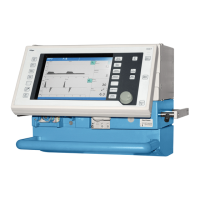
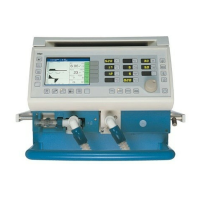
Evita 2 dura continuously monitors the difference between
spontaneous breathing and the set minimum ventilation. As
soon as the balance becomes negative, because spontaneous
breathing is no longer sufficient, Evita 2 dura applies a
mandatory ventilation stroke with the set tidal volume V
T, so
that the balance is again positive.
Experience shows that patients breathe very irregularly.
Phases of weak breathing alternate with phases of heavy
breathing. In order to allow for these individual fluctuations,
the balancing process also takes account of the extent by
which the set minimum ventilation has been exceeded. This
positive allowance is progressively reduced to zero by
Evita 2 dura within a maximum of 7.5 seconds after apnoea.
In other words, the response time of Evita 2 dura before
activating mandatory ventilation is automatically adapted to the
preceding cycle of spontaneous breathing:
If this spontaneous breathing was close to the minimum
ventilation, the machine responds rapidly within the
cycle time (1/f). By contrast, if the patient's spontaneous
breathing was much higher than the set minimum ventilation,
Evita 2 dura tolerates a longer breathing pause. In extreme
cases of sudden apnoea after a phase of heavy breathing,
the response time will be 7.5 seconds plus the trigger time,
with a minimum of 1 cycle time (1/f).
Response times longer than 15 seconds may only occur if the
minimum ventilation with a very low IMV frequency f is set to
correspondingly low values.
In this case, Evita 2 dura triggers an apnoea alarm that is
cancelled again as soon as the mandatory ventilation strokes
have been applied. If the cycle time (1/f) is set to a longer
period than the T
Apnoea > alarm limit, and if there is no
spontaneous breathing between the mandatory ventilation
strokes, the apnoea alarm will be regularly triggered.
014
Paw
Flow
T
insp
Pmax
PEEP
short
rise time
long
rise time
Trigger phase
V
T
Insp. Flow
t
t
1
f
ASB pressure support
015
MV
sufficient
spontaneous
breathing
spontaneously
breathed MV
set
MV
mandatory MV
beginning
spontaneous
breathing
no
spontaneous
breathing
t


 To Next Page
 Loading...