This document provides comprehensive instructions for the installation, use, and maintenance of a Dunster House log cabin, specifically the DEORE GARAGE 3.0m x 5.5m (45mm) model, identified as E10-3055DG-45. It emphasizes careful reading of the manual and checking all components prior to assembly to ensure a smooth construction process.
Function Description
The Dunster House log cabin serves as a versatile outdoor structure, primarily designed as a garage, but adaptable for various uses depending on the owner's needs. Its core function is to provide a durable and aesthetically pleasing shelter. The cabin is constructed from kiln-dried softwood, with pressure-treated bearers forming the foundation. The design incorporates interlocking wall logs, a robust roof structure, and pre-assembled doors and windows, all contributing to a secure and functional enclosure. The modular nature of the components allows for a systematic assembly, resulting in a sturdy and long-lasting building. The cabin is intended to be a standalone structure, offering protection from the elements and a dedicated space for storage, vehicles, or other activities.
Usage Features
The log cabin offers several usage features that enhance its functionality and adaptability:
- Customizable Layout: The manual highlights that the layout of doors and windows can be changed by installing relevant logs on opposite sides of the cabin or the front wall. This flexibility allows owners to tailor the cabin's design to their specific preferences and site requirements. For instance, if the primary use is a drive-in garage, the front bearer can be cut flush with the door frame.
- Optional Additions: The cabin is designed to accommodate optional features such as additional doors, windows, and roof insulation. These can be purchased separately and integrated into the structure, further enhancing its utility and comfort. The installation of additional doors and windows is recommended after the main cabin walls are built, allowing for precise aperture cutting and placement.
- Natural Wood Aesthetics: Being constructed from softwood, the cabin possesses a natural aesthetic that can be further enhanced with suitable timber treatments. The inherent properties of wood, such as knots, cracks, and variations in color, contribute to its unique character.
- Drive-in Garage Capability: For those intending to use the cabin as a drive-in garage, specific instructions are provided for cutting the front bearer flush with the door frames. This feature facilitates easy vehicle access.
- Ventilation: The inclusion of apex vents ensures proper air circulation within the cabin, which is crucial for maintaining timber health and preventing moisture build-up. These vents are designed with slatted grills on the outside and meshed grills on the inside.
- Security Features: The garage door installation includes shootbolt locks, which provide a secure locking mechanism. The manual details how to fix these shootbolts to the door sashes and a bearer support section, with an option to drill a hole in the ground for added security in drive-in garage configurations.
- Storm Bracing: Storm braces are a critical feature for enhancing the structural integrity of the cabin, especially in areas prone to strong winds. These braces are installed internally or externally, attaching to the apex or top wall log, and are designed to allow for vertical movement while remaining securely fixed.
Maintenance Features
Proper maintenance is crucial for the longevity and performance of the log cabin. The manual outlines several key maintenance features and recommendations:
- Timber Treatment: The most critical maintenance aspect is the application of a suitable timber treatment once the cabin has been built. This treatment should ideally include a water repellent and needs to be re-applied periodically. The manual warns against applying treatment too thickly, as this can restrict the natural movement of the logs.
- Addressing Natural Wood Properties: The manual acknowledges that wood is a natural material prone to knots, knotholes, cracks, warping, and imperfections. It provides guidance on how to manage twisted/warped timber during installation, suggesting techniques like using clamps, additional screws, and a rubber mallet to persuade logs into place. It also advises that minor imperfections that do not affect structural stability do not require replacement.
- Door and Window Adjustment: Due to the natural movement of wood, doors and windows need to be "free to realign." The installation instructions for door and window frames emphasize not fully tightening screws in slotted holes, allowing for vertical movement. The manual also provides troubleshooting steps for misaligned or stuck doors, including adjusting hinges and "heeling and toeing" sealed units.
- Regular Checks: Owners are advised to regularly check the cabin's squareness and levelness, particularly during construction and periodically thereafter. This helps identify and address any issues early on, preventing more significant problems.
- Securing Components: The manual details the use of various screws, nails, and bolts for securing different components, such as roof boards, eaves edging, fascia boards, and storm braces. Pre-drilling pilot holes for all screws and bolts is consistently recommended to prevent timber splitting, which is a key maintenance practice during assembly.
- Roof Covering Maintenance: Whether using roof felt or shingles, the manual provides detailed instructions for their installation, including overlapping techniques and nailing patterns, to ensure a waterproof covering. Regular inspection of the roof covering for damage or wear is implied to maintain its integrity.
- Addressing Splits/Knot Holes and Sap: The manual clarifies that splits, shakes, warps, cracks, and knots are inherent properties of timber and typically do not affect its integrity. However, if a component with such a feature causes concern, owners can contact customer services with a photograph for assessment. Sap is also noted as a normal occurrence that can be gently cut off once dry.
- Foundation Stability: The importance of a completely level and stable load-bearing foundation is stressed, as failure to ensure this can lead to installation issues and diminish the cabin's integrity. This foundational stability is a prerequisite for long-term structural health.
In summary, the Dunster House log cabin is a functional and adaptable outdoor structure designed for self-assembly, with clear instructions for construction and ongoing care to ensure its durability and aesthetic appeal.

 Need help?
 General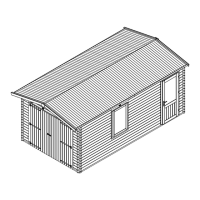

 To Next Page