
 Need help?
Do you have a question about the E-FLITE EFLG100 and is the answer not in the manual?
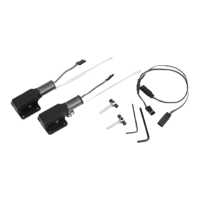
The E-flite 10- to 15-Size Electric Retracts are self-contained landing gear units designed for remote-controlled aircraft. These units are powered directly from the model's receiver, eliminating the need for separate servos, which simplifies installation and reduces overall weight. They are suitable for aircraft weighing between 2.0 and 4.5 pounds (0.9 – 2.0 kg).
The primary function of these electric retracts is to provide a retractable landing gear system for RC aircraft. When activated, the units retract the landing gear into the aircraft's fuselage or wing, reducing aerodynamic drag during flight and enhancing the model's scale appearance. When landing, the units extend the gear for a safe touchdown. The nose gear unit is steerable, allowing for ground control and taxiing. A key feature of the nose gear is a slot in its sliding steering arm, which is designed to prevent the steering cable from binding when the gear is retracted, ensuring smooth and reliable operation.
Installation of the retracts begins with test fitting the unit in the wing or fuselage to determine the appropriate strut length and axle location. The strut can be cut to length using a rotary tool with a cutoff wheel, and then flat spots are filed onto the end of the strut to secure the axle using a 2.5mm hex wrench. Threadlock should be applied to the retaining screws to prevent loosening due to vibration.
Wheels are installed on the axles, with brass wheel collars secured by a 1.5mm hex wrench, also with threadlock, to prevent loosening. Mounting hole locations for the retracts are marked on the aircraft's rails using a pencil, and appropriately sized holes are drilled for the chosen hardware. The retracts are then installed using screws, with #4 x 1/2-inch wood screws being a suitable option. Main units typically require 100-degree countersunk wood screws, while the nose unit uses a button head wood screw.
For radio connections, each retract unit connects to a supplied 3-into-1 wire harness (for tricycle sets) or a 2-into-1 harness (for main gear sets). The single lead from this harness then plugs into the gear channel of the receiver. An auxiliary channel can be used if the gear channel is already occupied.
Before operating the retracts in the model, it's crucial to check for any obstructions in the wheel wells that could impede gear operation. Once the transmitter and receiver are turned on, the gear or other assigned switch is used to activate the landing gear and verify correct operation. If the switch direction is opposite to the desired retraction direction, the transmitter's reversing function can be used to change it. For 2.4GHz radios, after setting the correct servo direction, the system must be rebound before flight.
The nose gear steering mechanism involves connecting a steering pushrod to the steering arm on the nosegear unit. This allows for directional control of the aircraft on the ground.
The E-flite retracts are designed for durability and ease of maintenance. The use of threadlock on all retaining screws for axles and wheel collars is a critical maintenance step to prevent loosening from vibration during operation. This ensures the integrity of the landing gear assembly over time. The self-contained nature of the units, without external servos, also reduces the number of components that might require separate maintenance or adjustment. Regular checks for obstructions in the wheel wells are part of routine pre-flight maintenance to ensure smooth operation and prevent damage. The modular design, with available replacement parts such as main retract units, wire struts, adjustable axles, nose retract units, nose gear wire struts, and steering arms, facilitates easy repair and replacement of individual components should they become damaged or worn. This ensures a long operational life for the retract system.
 General
| Brand | E-flite |
|---|---|
| Model | EFLG100 |
| Compatibility | E-flite Models |
| Material | Plastic |
| Power Source | Electric |

 To Next Page