EasyManua.ls Logo

Eddystone 990R - Page 31

Default Icon
57 pages
Print Icon
To Next Page IconTo Next Page
To Previous Page IconTo Previous Page
Loading...
RF
Alignment
,
(l.
Local
Oscillator)
Test
Equipment
Standard
Signal
Generator
covering
the
range 27-
240MHz.
with
crystal
* 0 ’
‘ *
*
4
* 8
*
s
0
0
°
scale
checking
facilities,
provision
for
amplitude
modulation
(30
fo
9
400Hz)
and an
output impedance of
75^.
Power
Output
Meter
matched to
30
impedance.
Small
insulated
trimming tool with metal
tip.
The
overall
calibration
accuracy
should first
be checked
to determine
whether
re-
alignment
of
the local
oscillator
circuits is
in fact
necessary.
The
internal
10
MHz
calibrator can
be used
for
this purpose provided
it
is first
standardised
as
described
on
the
previous page.
Control
settings should be
as
tabulated
on page
27
but
with
the
RF GAIK
at
maximum,
the
MODE
SWITCH
at
"PM",
the
IF INPUT "OFF"
and
the
CAL
RE-SET
ADJUSTER
at
mid-travel.
This
latter
adjustment can be
made quite easily
by
observing
cursor shift against
one
of
the scale
calibration
markings.
Commence
by
selecting
Range
1,
tuning
across
the
whole range, noting
errors at
each
check-point
without
altering
initial
setting
of
CAL
RE-SET.
Repeat
same
procedure
on
each
of
the
other
ranges.
If
the
error
at
the mid-scale
marker points
on
Ranges
3
and
4
is
greater
than that
at
the low-frequency
check-points, use an
external
standard
to
permit
checking at
75
and
45
MHz
respectively.
Specified calibration accuracy
without
use
of
the
internal
calibrator
and
with CAL RE-SET
at
mid-travel
is
within
1%
on
all
ranges.
Re-alignment
need not
be attempted
if
errors are
within
this
limit,
i.e.
2.4
MHz
at
240
MHz,
300
kHz at
30
MHz
.
If re-alignment
of
any range
should be
found
necessary, proceed
as
detailed
below.
Remove
the top cover
from
the
RF
Tuner Unit
by taking out the
four
screws
near the
corners.
The
cover can
be
removed
with the
Calibrator Unit
in-situ
provided
that
its
supply lead
and
output coax
are
disengaged at their respective
sockets.
All trimming
adjustments
are
from
the top
with
the
exception of
the Range
1 trimmers
(tube type).
These are
accessible
from
below
without
the
need
for removal
of
the
underside
cover.
If
inspection has
revealed
excessive errors on Range
1,
then
this
range must
be
re-aligned prior
to any
of
the
other
ranges
because
the Range
1
trimmers
are
in
circuit
at
all positions
of the
RANGE
SWITCH.
Further, for the
same reason,
if
re-alignment
of
Range
1
is
necessary,
then
re-alignment
of
all
other trimmers (but
not
necessarily
cores)
will be
required.
Normal
alignment
procedures apply,
i.e.
adjust trimmers at
IIP
end
of
range
and
cores
at
LF
end.
Repeat
adjustments
several
times
until
interaction
between
trimmer
and
core
is
nullified.
No special
procedures. are required
but
allowance
must
be
made
for
the
slight
de-tuning
effect
produced
by the
cover
when
this is replaced.
A
suitable
dummy
cover
provided
with
alignment
apertures to facilitate adjustment
can be
fabricated
locally
if desired.
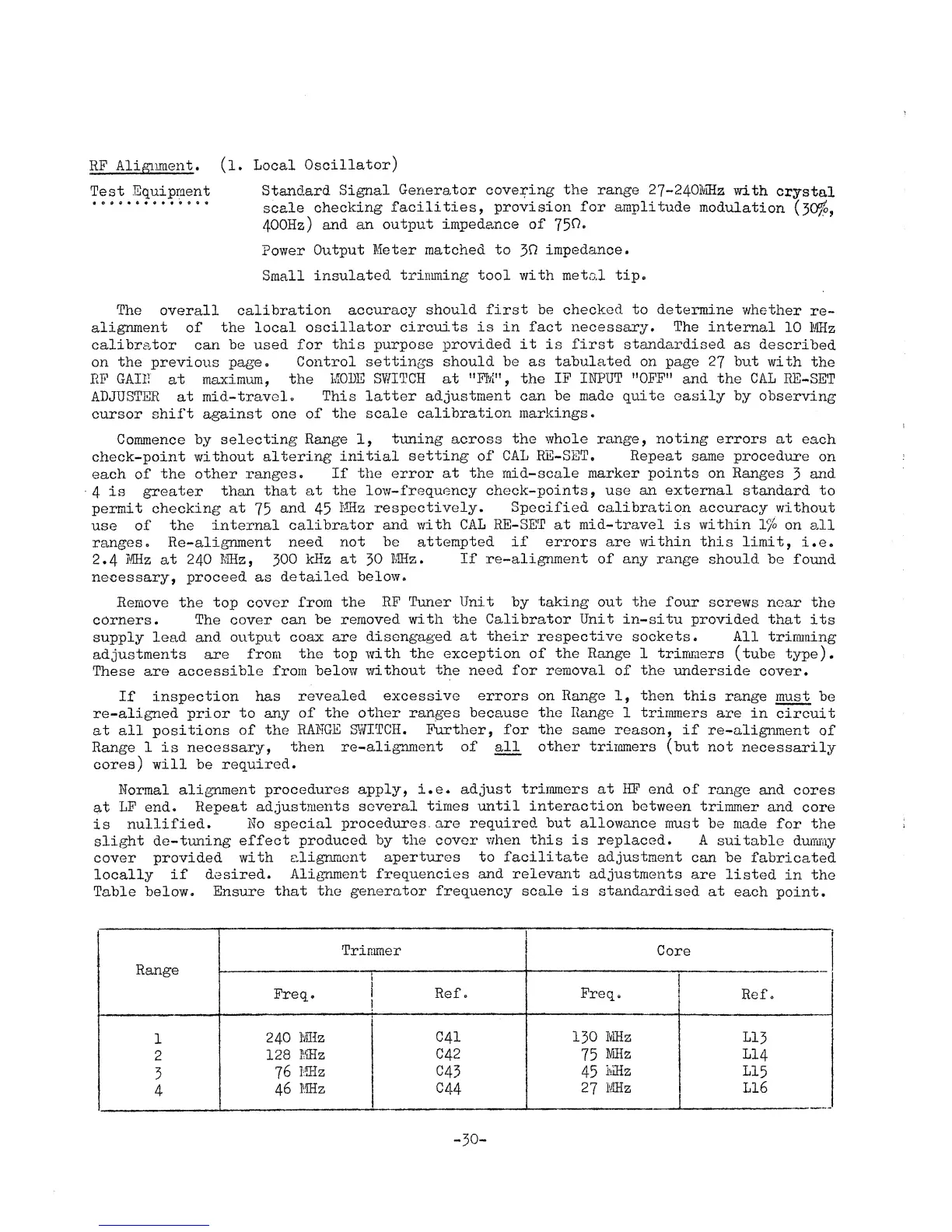
Alignment frequencies
and relevant
adjustments
are
listed
in
the
Table below.
Ensure
that the
generator frequency scale
is
standardised
at
each
point.
Range
Trimmer
.
Core
Freq.
Ref.
Freq,
Ref.
1
240
MHz
C41
130
IvlHz
L13
2
128
KHz 042
75
MHz
L14
5
76
MHz
C43
45
MHz L15
4
46
MHz
C44
27
MHz
L16
-
30
-