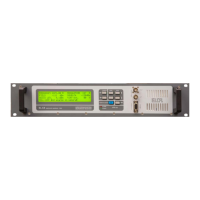
XPT/R2G
Pag. 11
XPR-2G GENERAL DESCRIPTION
The XPR-2G receiver is a modern, professional receiver created for the reception of
frequency modulated signals and broadcasted in the range 1300–2600MHz .
The high selectivity of the input circuit, the intermediate frequency stages, and the accurate
demodulation process, make it also ideal for signal repeating in the FM range.
The receiver’s electrical features are also guaranteed with input power signals of -20dBm,
and it can withstand powers greater than 30dB without being damaged.
Where used in very crowded transmitting sites, before connecting the antenna, it’s
recommended to ensure that the received signals are not stronger than the permitted ones; particular
attention must be paid in verifying the transmitter signals available at the sites, which can include
antennas placed on the same tower of the receiving one. It is not unusual to measure power levels
reaching considerable number of watts at the receiving antenna.
Where received signals exceed permitted levels, various measures must be taken to ensure
the receiver working under the best conditions.
The following solutions can be adopted to solve this issue:
a) Move the receiving antenna so it’s shielded from interfering signals
b) Attenuate the antenna signal by 10-20dB where the useful signal level
allows it
c) Apply a bandpass double cavity filter at the receiver’s input to increase
the selectivity
At the antenna input, the receiver is equipped with a highly selective four-cell filter. The
bandwidth is ±20Mhz with reference to the tuned frequency, and the attenuation of the image
frequency is greater than 55dB.
The next stage is composed of a broadband amplifier with low noise figure (NF=3dB) and
high IP3. The gain (<20dB) and the low noise figure allow the receiver to recover losses in the input
filter (approximately 3–4dB) and therefore to achieve a good sensitivity; with a monophonic signal,
10 microvolts are enough to achieve a signal-to-noise ratio greater than 60dB on the demodulated
and deemphasized audio signal.
The signal, thus filtered and amplified, is fed to an high-level balanced mixer (13dB); the
local oscillator, for conversion to 70Mhz, derives from a module previously used as a basis for
transmitters and featuring a very low phase noise.
The LO frequency is 70Mhz lower than the received frequency, and the minimum
programmable step is 50khz or 100kHz . A 10Mhz reference, thermally compensated, allows the
operation within a wide range of temperatures (0 – 40°C).
At the mixer output, the signal is fed to a 10 Mhz bandpass active filter with a high IP3. The
first intermediate frequency has three selective stages, which give an output signal that has a group
delay inside the band (±150kHz) of less than 500 nanosecs. The gain for the three stages is only a
few dB, but the task of this module is to clean the signal of any disturbance that the first input filter
is unable to eliminate because too close to the carrier signal. The good noise figure at this stage
doesn’t have significant effects on the receiver’s sensitivity.
The first IF filter is followed by an attenuator programmed by the AGC signal, allowing the
next two stages keeping on working in a linear zone. Two linear phase ceramic filters placed


 To Next Page
 Loading...